How the Government of Canada is (Or is Not) Monitoring Our Homegrown Hantavirus Strain
With over 30% fatality rate and new evidence of cross-species transmission, researchers say the rare Sin Nombre virus needs more surveillance
Out at a cattle ranch in Alberta, amongst cows grazing in pastures and farmers tilling the land, researchers from the University of Calgary have been setting traps for the past two years.
Once rodents — mainly deer mice and some voles — enter these traps, researchers take blood samples, mark the animals with tags and release them in the same place they had been found initially.
“Because we’re doing this over time, multiple times through the seasons and over multiple years, we get some very detailed information on how this population changed, and then how the amount of virus that they have is shared between individuals also changes over time,” said Dr. Mathieu Pruvot, a veterinary medicine professor at the University of Calgary and an affiliate wildlife epidemiologist with Wildlife Conservation Society.
Along with PhD candidate Laura Budd, Pruvot has been engaged in one of the few long-term studies being undertaken in Canada to determine the prevalence of the Sin Nombre virus — the strain of hantavirus that is known to affect humans in North America — based on changes in land use and climate in Alberta, where most cases have been detected thus far.
Hantavirus made international headlines last month, with passengers on the MV Hondius cruise ship being infected with the Andes strain of the virus, prevalent among wild rodents like long-tailed pygmy rice rats in Argentina and Chile. It’s the only known variant that spreads from human to human, and infected at least 11 people on the ship, including one Canadian, and claimed three lives.
There are, however, a number of different hantavirus strains around the world, each causing varying degrees of harm to humans, and with differing degrees of prevalence. Milder strains prevalent in Europe and Asia, like the Puumala and Seoul viruses, have fatality rates for humans that range from 0.1% to 2%.
When the North American Sin Nombre virus is contracted by humans, it causes a severe respiratory disease called hantavirus pulmonary syndrome (HPS), with a fatality rate of 30% to 50%. This virus caused one death in Arizona earlier this month.
For all known hantavirus variants, humans are typically exposed when they breathe in particles from infected rodent droppings, urine or saliva. There is no cure or vaccine yet.
As of May 1, according to Health Canada, there have been 168 known cases of hantavirus infection in the country since surveillance began in 1994.
But with just one lab in Canada able to test for hantavirus infections, several researchers have independently told PressProgress that cases might be getting missed. As climate change increases the risk of all zoonotic diseases growing in prevalence, scientists also emphasized the need for better surveillance of the Sin Nombre virus.
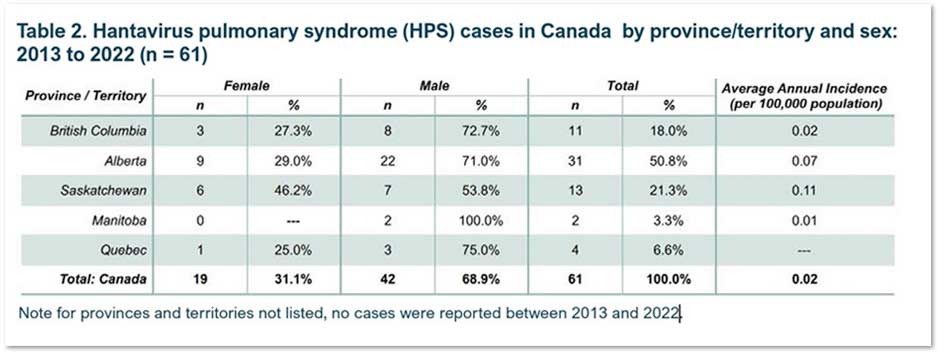
Source: Public Health Agency of Canada
Some evidence of virus crossover into other species
Pruvot and Budd’s research isn’t over yet. Their preliminary findings — based on blood-test strips sent to the National Microbiology Laboratory (NML) of the Public Health Agency of Canada — show that where there are more deer mice, there is more hantavirus.
“Even over the past couple of years that we’ve been doing this work, we’re seeing huge variation from year to year in population dynamics, abundance of these rodents in the different landscapes and even prevalence of hantavirus exposure,” Pruvot said.
Serologic testing, or tests for antibodies generated against a prior infection, shows that while deer mice are the main vectors for the Sin Nombre virus, the strain has also been detected in voles.
“Viruses change, and the more opportunities they have to spill over into new species, the more chances they have to adapt to this new species and evolve the capacity to transmit more effectively,” Pruvot said.
“That is why it’s so critical to have programs that continuously monitor the situation with these viruses in wildlife populations, but also have ways to link this to what’s happening in humans.”
The University of Calgary study is yet to be published. But a similar study conducted by scientists just south of the border, at Washington State University, was published last month.
The paper, published in the CDC’s Emerging Infectious Diseases journal, revealed the results of a long-term study in which researchers captured and tested 189 rodents, most of which were deer mice.
Their findings revealed that Sin Nombre virus is more prevalent among rodents in the northwest U.S. than previously believed, and that multiple hosts can carry this strain of hantavirus.
“One of the things that we were more surprised about was finding it in voles,” said Dr. Stephanie Seifert, an assistant professor at the Paul G. Allen School for Global Health at Washington State University.
“We are finding that the idea that hantaviruses are associated with just one host species in general, is probably not correct… I’m not saying that voles are necessarily contributing as much to human transmission, but they may be important in maintaining the virus in different populations.”
Seifert said her research team searched for long-term studies in Canada that would reveal the nature of the virus and its prevalence here, but came up short.
“It’d be great to know what diagnostic testing is like in Canada, especially in Western Canada, but also the prevalence in different rodent populations would be great to know,” she said. “We just weren’t able to find very many studies reporting those data.”
According to Dr. David Safronetz, chief of special pathogens and principal investigator at the NML, the federal public health agency is not currently involved in long-term surveillance studies for the Sin Nombre virus. Yet there remain a number of questions about the virus and how it transmits.
“It’s a big unknown for hantaviruses. We don’t know why you could have a whole bunch of deer mice running around that seem to be infected, and yet no human cases, and then suddenly you’ll get a human case,” Safronetz told PressProgress.
“We’re trying to understand what that trigger is. So, on occasion, when there’s need and the ability, we will go out and trap rodents around human cases.”
Missed cases
While in the U.S., a number of states have labs that can test for hantavirus, in Canada that ability is restricted to one place: the NML in Winnipeg.
According to Safronetz, when physicians suspect a case of HPS, they’ll send a blood sample to provincial labs, which forward them along to Winnipeg for testing.
There, lab technicians test the blood samples through both PCR testing for active virus and serologic testing for evidence of antibodies, which would prove the patient had been infected at some point.
Even in the U.S., where there are more labs available, doctors say testing becomes a challenge when not every state is equipped with the ability to diagnose HPS.
“I suppose hantavirus is rare enough that it may be hard to justify broader access to testing, but it is very frustrating when we do need to order tests, due to the paperwork and delays,” said Dr. Jeremiah Matson, an internal medicine fellow at the University of Utah, in an email to PressProgress.
“For patients at our facility that have been diagnosed with hantavirus, the diagnosis has only been made following discharge from the hospital, due to the processing delays.”
Seifert, in Washington state, also believes cases are likely getting missed.
“I think that’s a big issue with hantaviruses in general. It’s pretty low incidence, the individual risk is quite low, and so it’s pretty low on the diagnostic decision tree when people are coming in with nonspecific syndromes that are characteristic in those early stages of infection,” she said.
Pruvot and Safronetz independently said the same thing, adding that there is no way to prove how often this is happening in Canada.
“The decision to test really lies at the physician level. It’s difficult, I’ll be honest, because the incubation period of this disease can be weeks,” Safronetz said.
“One of the key indicators that would suggest it’s a hantavirus infection is unknown exposure to rodents, and that’s often forgotten about or missed when there’s the patient and physician consult. Without that data, sometimes people might overlook it. I’m not sure how frequently that’s happening.”
Unknown impact of public service cuts
In the U.S., cuts to the Centers for Disease Control and Prevention are already impacting the ability to conduct diagnostics and surveillance for hantavirus, Seifert said.
“It’s harder for folks to get reagent standards for things like surveillance and testing, [because] CDC provided a lot of those,” Seifert said.
“When it came down to even testing for Andes virus, I was even getting emails [asking], ‘Do you have primers and probes to do the diagnostic testing for Andes virus?’ I’m sending folks papers, because I’m familiar with the field and have done outbreak response prior to starting my lab, but I think that’s something that we really need a robust CDC for.”
Earlier this year, over 3,000 employees at Health Canada and Agriculture and Agri-Food Canada received layoff notices as part of the Carney government’s bid to cut 15% of the federal public service budget.
Safronetz declined to comment on whether his department was affected by these job cuts.
According to Pruvot, it is a challenge to maintain long-term studies of the Sin Nombre virus in Canada, with “shrinking of funding across many sectors.”
“If you look across systems in places where there’s been long-term studies, that’s where we learn most about the dynamic of the Sin Nombre virus and how weather changes and changes in climate influence the risk of transmission to humans,” Pruvot said.
“Unfortunately, we don’t have a lot of examples of long-term studies in Alberta and Canada more broadly.”
According to the Canadian Institutes of Health Research, the federal government has spent nearly $740,000 over the past 24 years on studies related to hantaviruses and bunyaviruses, the broader family of zoonotic viruses that encompasses hantavirus.
At the moment, there are two ongoing studies funded by CIHR: one in Saskatchewan that aims to hasten the development of a vaccine to prevent bunyaviruses in humans, and another in Toronto that aims to study and build diagnostic capacity for zoonotic diseases.
Pruvot agrees that investments in research to develop pandemic-preparedness tools remain ongoing and necessary, but says there is a need for more funding to maintain studies that aim to understand changes in how the virus behaves.
“It would be great if we got to a point where it was easier to fund long-term studies and monitoring, because again, that’s where we’re learning most,” he said.
“Whether it is from federal monitoring programs or university-based, long-term monitoring programs, I think these are essential to maintain and expand.”
Our journalism is powered by readers like you.
We’re an award-winning non-profit news organization that covers topics like social and economic inequality, big business and labour, and right-wing extremism.
Help us build so we can bring to light stories that don’t get the attention they deserve from Canada’s big corporate media outlets.
Become a member
 @brishti.bsky.social