
‘Resurgence’ of racism and xenophobia in Canada’s policies a result of ‘growing and systemic racial hatred,’ experts say
A UN Special Rapporteur noted that there are ‘multiple forms of systemic racism’ experienced by racialized groups across Canada
While progressives south of the border celebrate a ‘blue wave’ in the United States that saw the Democrats secure a number of long-held Republican seats, public sentiment and policy across Canada appear to be moving even further to the right.
After a visit in October, the UN Special Rapporteur on contemporary forms of racism, racial discrimination, xenophobia and related intolerance released a report about the “multiple forms of systemic racism” experienced by racialized groups across Canada.
“Those I met with often described experiencing multiple and intersecting forms of discrimination, resulting in historical and ongoing structural harm linked to white supremacy, complex and continually evolving racial hierarchies, and colonial legacies and practices,” wrote Special Rapporteur Ashwini K.P.
K.P. pointed to the gaps between Canada’s legal standards and protections, like the Canadian Charter of Rights and Freedoms, on the one hand, and the experiences of racialized Canadians on the other.
She added that racist narratives and hate speech on social media contributed to an environment where hatred is “normalized.”
“The growth of white nationalism and extremist groups, the emboldening of those espousing racist rhetoric, and rapidly increasing political and social polarisation were described as drivers of growing and systemic racial hatred,” wrote K.P.
Scholars who study the far-right in Canada told PressProgress that what we are seeing now all across the country is a more aggressive manifestation of a “long history” of xenophobia and racism in Canada’s policies.
“People sometimes like to think of this as a rise, whereas I see it more as a resurgence. We are returning to what we would now understand as far-right sentiments that were horribly common during the the early years of the country and during the genocide of Indigenous folks on the continent,” said Amy Mack, a professor at the University of Lethbridge who studies right-wing extremism.
Coming off the heels of the Alberta referendum where Albertans rejected separatism but approved scapegoating immigrants, Mack said that the results give us quantitative data on sentiments towards immigrants.
Over one million people voted in favour of questions on immigration that ranged from whether the province should have more control over immigration to whether immigrants should have access to provincial services like healthcare.
“Alberta has a really long history of these sorts of sentiments informing policy,” Mack said.
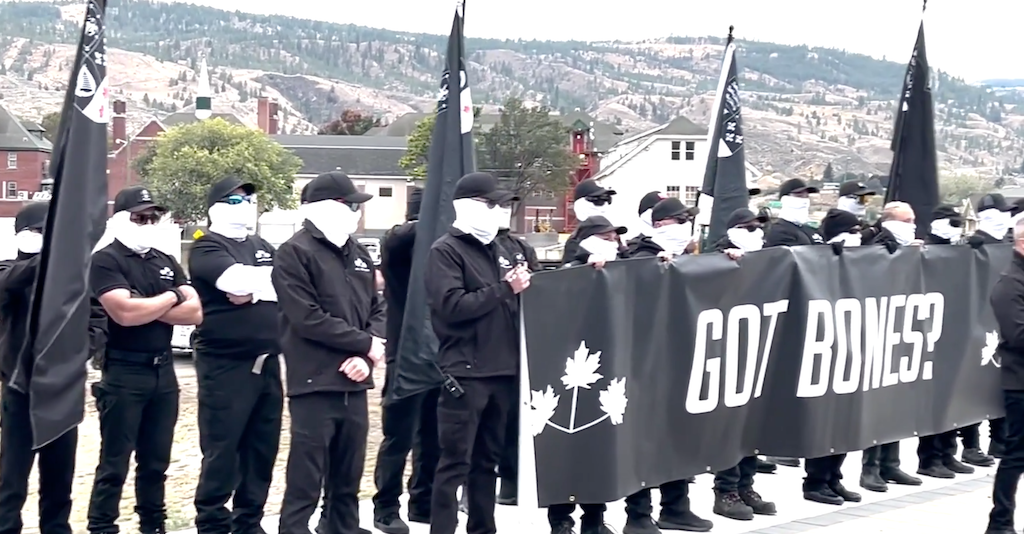
Mack added that while some forms of white supremacy are obvious, like the Second Sons holding a white supremacist banner in Kamloops, BC in September, the way that white supremacy can embed itself in institutions is less overt.
“People are less willing to or capable of understanding systems of supremacy,” Mack said. “Hate doesn’t grow if there’s no fertile ground there. Canada is a settler-colonial space that’s kind of primed to be vulnerable or to take up these sorts of far-right things.”
Some students are unable to attend school in Alberta due to their parents’ precarious immigration status.
Earlier this year, agents from the Canada Border Services Agency conducted an ICE-like immigration raid in Calgary, where international students were protesting after their study permits were denied en-masse after a quiet change to immigration rules.
But Alberta isn’t the only province where anti-immigrant and anti-Indigenous sentiments are informing policy.
In Quebec, secularism laws, which prohibit public servants from wearing religious symbols at work, have impacted minority groups who are trying to participate in public life.
Last month, the province’s education minister announced plans to extend a ban on religious symbols to elementary school students, a move that has been criticized by religious groups across the country.
On Friday, Indigenous groups and environmental organizations were among those protesting Bill C-39, the Build Canada Strong Act, which has the power to override Indigenous Treaty rights and fast-track various projects.
According to Terri Givens, a political science professor at the University of British Columbia, some Canadian politicians have tried to capitalize on anti-immigrant sentiments around the globe.
“What has happened is certain politicians, like [Pierre] Poilievre and others, have tried to take advantage of the broader global anti-immigrant sentiment we’re seeing in places like Europe and Australia,” Givens told PressProgress.
She added that various policies across the country are a sign that rhetoric of the far-right has entered political discourse.
“You see mainstream politicians saying things now that you would only hear coming from far-right politicians 20 or 30 years ago,” Givens said.
“There’s been an erosion of values, or even any sense of embarrassment or shame to say certain things, and that goes beyond just the anti-immigrant sentiment, but even around race and gender.”
In British Columbia, incoming premier and leader of the BC Conservatives, Lorne Doerkson, ran his campaign on being a ‘moderate,’ despite many of his candidates holding questionable and bigoted views.
The day after the BC Conservatives won a supermajority, a group of white supremacists called the Loyalist Pioneers were seen holding a sign calling for “remigration” in the province’s capital.
Stephanie Wilson, a North Vancouver activist and researcher into the far-right, said that recent demonstrations, like the one by Loyalist Pioneers in Victoria and Second Sons in Kamloops on the day before Truth and Reconciliation Day, are a sign that extremist groups are moving their activities offline and into the real world.
“Being unhappy online is not very satisfying, but being unhappy with people in your area who share your politics that you know in-person is, I think, a much more compelling offer,” Wilson told PressProgress.
“I think they’re trying to send the message that their numbers are larger than they are, and I think they’re trying to send the message that white nationalism is the solution to all the problems that we’re experiencing right now. They just want something easy that they can blame. Indigenous people and immigrants and refugees are unfortunately the easy targets right now.”
Wilson added that while incoming BC Premier Lorne Doerkson disavowed the white supremacist group in Victoria, he directly benefits from their existence.
“He actually can’t stop it because he is part of the system that allows them to thrive,” Wilson said.
“His own MLAs attack queer and trans people. His own MLAs attack immigrants and immigration. His own MLAs attack Indigenous rights and Indigenous people and Indigenous histories in Canada. Lorne Doerkson himself participated in Freedom Convoy events in the interior.”
Wilson noted that there is a need to understand the harmful ideologies that lead to overt attacks on racialized groups in Canada. Just last week, a Sikh man was assaulted in a hate-motivated attack in Barrie, Ontario.
It’s a very visceral reaction when they show up with their racist signs and their masks and seek to intimidate people,” Wilson said. “But something that I find more concerning is all of the softer, gentler forms of nationalism that are influencing what you see right now.”
“How do we address this softer ideology that’s leading people further and further down the road? We need to start being a lot more vocal about the problems when they start to show up. Not once they’re already a problem. And that means calling out white supremacy, white nationalism even when it’s kind, or when it pretends to be kind.”
Our journalism is powered by readers like you.
We’re an award-winning non-profit news organization that covers topics like social and economic inequality, big business and labour, and right-wing extremism.
Help us build so we can bring to light stories that don’t get the attention they deserve from Canada’s big corporate media outlets.
Become a member
 @rumneeek.bsky.social