
A Year of Health Policies on Course for Failure
In the face of proven solutions, Canada's provinces prefer risky experiments
It’s been the opposite of a banner year for Canadian healthcare.
From the country losing its nearly three-decade-long measles elimination status (with an outbreak in Quebec currently underway) to certain provinces (Alberta and Quebec) making it prohibitively expensive for most people to access lifesaving COVID-19 vaccines, public health is in dire straits.
Wait times to access doctors, surgeries and lab tests remain high for many Canadians, largely due to an ongoing labour shortage that has reached crisis levels. Yet politicians across the spectrum are focused on building infrastructure (for both hospitals and pipelines) instead of retaining healthcare workers, and pushing through involuntary-treatment legislation that, evidence shows, sweeps mental-health and addiction problems under the rug instead of addressing them.
In 2025, the four westernmost provinces introduced legislation strengthening the ability of family members, police, and in some cases, other “peace officers” to involuntarily detain and medicate people who have mental-health and/or substance-use disorders. Other provinces, like Ontario, are looking into doing the same.
Nowhere in Canada has involuntary treatment been implemented more frequently than in British Columbia, where over 20,000 people have been detained under the Mental Health Act every year from 2016 to 2021. Unlike other jurisdictions, legislation in BC has allowed for people detained involuntarily to also be given medical treatment without their consent since 2006.
Though involuntary treatment works for some people, its main critique from doctors, researchers, patients, lawyers and more is that there is no evidence to prove its broad effectiveness — especially compared to voluntary treatment options, which are severely lacking and have prohibitively long wait times across the board.
In the last few months of 2025, BC’s NDP government passed bills that make it even easier to force medication on young people and remove ostensible legal liability for healthcare workers and police who administer involuntary treatment.
Grassroots challenges
At the same time, the severity of the public health emergency that is the toxic-drug crisis in BC — which has killed nearly 19,000 people in the province since 2014 — has led to desperate and innovative grassroots solutions that now provide incontrovertible evidence of their life-saving value but which are increasingly being criminalized.
I’ve been one of several journalists following the BC Supreme Court trials of Eris Nyx and Jeremy Kalicum, who founded Vancouver’s Drug User Liberation Front (DULF).
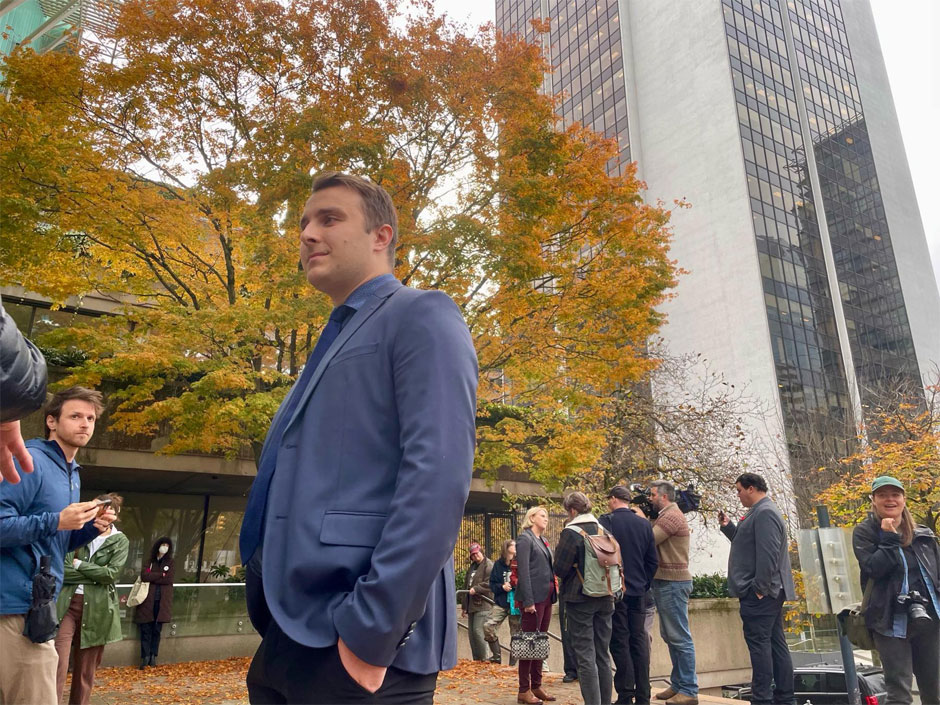
Jeremy Kalicum outside the Vancouver Law Courts after being found guilty of drug trafficking on Nov. 7. (Photo by Brishti Basu / PressProgress)
Testimony so far has recounted the number of ways the pair informed — and received either explicit or tacit support from — every relevant authority about the need for their compassion-club model that provided clean, tested drugs to 47 people in Vancouver’s Downtown Eastside who were already using toxic street drugs and therefore at risk of dying. There is now peer-reviewed evidence that shows how DULF saved lives.
So even though Nyx and Kalicum were found guilty of trafficking drugs, Justice Catherine Murray stayed their convictions until after a decision is reached in their Charter challenge against Canada’s drug laws (also presided over by Murray). That trial will continue in the new year, as will my coverage.
- Read more: Founders of Groundbreaking Vancouver Compassion Club Found Guilty of Drug Trafficking
- Canada’s Drug Laws Face Challenge from Founders of Vancouver Compassion Club
I’ve also spent time these past few months debunking some of the health misinformation wafting up to Canada from yonder Stateside, whether it’s to do with ostriches and avian flu, or Tylenol and pregnancy. Beyond ongoing measles outbreaks, Trump’s health appointees aligning with growing antivax movements have similarly caused the resurgence of a number of dormant diseases, like whooping cough, in the U.S. Naturally, these developments pose a threat to Canadian health.
But Canada can’t blame most of our healthcare issues on the U.S.
Labour crisis
At the federal level, the main healthcare funding priority in the Liberals’ 2025 budget is $5 billion allocated over three years to build more infrastructure, like hospitals and medical schools.

A rendering of the building that will house Simon Fraser University’s new medical school in Surrey. (Image via the Government of British Columbia)
Meanwhile, as revealed in a recent investigation by PressProgress labour reporter Emma Arkell, one of the biggest new medical schools in the country — Western Canada’s first in half a century, at Simon Fraser University — is doing everything in its power to ensure that no one on its faculty is unionized.
This, in a year when thousands of unionized healthcare workers across Canada showed up at their respective bargaining tables — and sometimes even voted to strike — in order to fight for (and win) better wages, benefits and workplace conditions. In Quebec, doctors’ unions have just forced the province’s health minister to step down, after the government’s phenomenally misguided move to tie physicians’ salaries to performance targets.
It’s the labour crisis that has caused frequent emergency-room closures and shuttered clinics — not a lack of buildings.
Federal and provincial governments are now courting healthcare workers from the U.S., amid the devolving government, immigration and public health situation in that country, which presents a unique opportunity to bolster Canada’s roster of physicians.
This is a promising step that has already resulted in a significant increase in the number of American doctors expressing interest in practicing in Canada this past year.
Whether Canada’s public system can successfully retain its new hires remains to be seen.
Liberals take a hands-off approach
It seems that, no matter the crisis or its own views, the federal government of Prime Minister Mark Carney won’t step in when provinces make health policy decisions that go against prevailing scientific evidence.
Speaking at a press conference following a meeting with the provincial and territorial health ministers in October, federal Health Minister Marjorie Michel applauded the start of domestic production of Moderna’s COVID-19 vaccine in Laval, Quebec.
But when asked by PressProgress about whether there was any talk of the federal government stepping in to remove the access barrier that is Quebec’s recent $150 to $180 price tag on the same vaccine for most of its residents, Michel said the provinces “make their choice, and I don’t intend to go in their lane”:
Michel has taken a similar hands-off approach when it comes to involuntary-treatment legislation, telling the Canadian Press last summer that while she did not think forced treatment was a way to “solve the problem” of addiction, she plans to “sit down and see results” of the provinces’ new plans.
At the same October press conference, Michel said she was “committed to having ongoing conversation” about pharmacare agreements with the nine provinces and territories that don’t have it yet. (BC, Manitoba, PEI and Yukon are the ones that do.)
But the following month, the minister told CBC News that there were no active discussions to expand agreements.
Most Canadians, much like our federal health ministry, can expect to see the results of these health policy experiments in real time this coming year.
Our journalism is powered by readers like you.
We’re an award-winning non-profit news organization that covers topics like social and economic inequality, big business and labour, and right-wing extremism.
Help us build so we can bring to light stories that don’t get the attention they deserve from Canada’s big corporate media outlets.
Become a member
 @brishti.bsky.social