
Union Says Employer is Relying on Decades-Old Law Prohibiting Ontario Healthcare Workers from Striking
Nurses association files legal challenge against “one of the most restrictive labour relations regimes in the world”
The union representing workers at a chain of for-profit long-term care homes in Ontario is accusing the company of intentionally delaying bargaining and relying on decades-old legislation that forbids healthcare workers in the province from striking.
The Canadian Union of Public Employees (CUPE) represents over 1100 workers at several Extendicare long-term care homes across Ontario who are bargaining for improved wages, staffing and workload levels, and safety issues that the union said have gone unaddressed in previous rounds of bargaining.
Fisher Haynes, president of CUPE Local 1307 and a registered practical nurse at Extendicare Crossing Bridge in Ottawa, told PressProgress that negotiations with the company “have not really gone anywhere so far.”
“They’re not willing to come back to the table, which tells us that they are not willing to give us a reasonable or fair deal,” said Haynes.
A representative from CUPE confirmed that the last time the bargaining team heard from Extendicare was June 29, and an interest arbitration date has been set for April 7, 2027.
In a statement to PressProgress, a spokesperson for Extendicare wrote that the company is “fully committed to meaningful and constructive engagement” with the union and is available to meet with the union leading up to the arbitration date.
“We deserve a wage that reflects the work that we do, but Extendicare is not willing to give that,” said Haynes, who added that chronic under-staffing in long-term care means that workers are often forced to pick up extra work on their shifts, leading to higher rates of stress and injuries.
Extendicare operates over 100 long-term care facilities across Ontario and Alberta. The company reported $96 million in profit in 2025, an increase of 28% from the previous year. Extendicare CEO Michael Guerriere was paid $2.6 million in 2025.
“We value the contributions of our team members and remain focused on supporting high-quality care for residents,” wrote Extendicare’s spokesperson in their statement.
Bargaining for CUPE-represented workers at Extendicare is done by the Extendicare Central Table, meaning that wages and working conditions for multiple homes are bargained at the same time. The union said the central table has typically set the pattern for bargaining in Ontario’s long-term care sector.
Long-term care workers are covered by the Hospital Labour Disputes Arbitration Act (HLDAA), which prohibits them from legally striking. If a union and an employer can’t reach an agreement at the bargaining table, they enter arbitration, where an arbitrator hears arguments from both sides and then imposes a contract.
The HLDAA notes that arbitration seeks to “replicate, to the greatest extent possible, the result that the parties would have reached through free collective bargaining.”
In making a decision, the HLDAA instructs an arbitrator to consider “all factors it considers relevant,” including the employer’s ability to pay in light of its fiscal situation, the economic situation in Ontario, working conditions in similar workplaces and the employer’s ability to attract and retain employees.
But healthcare unions argue that the HLDAA lets employers off the hook for bargaining in good faith because they know that strike action is prohibited.
Haynes said that arbitrators don’t necessarily understand the long-term care sector and the daily reality of their jobs, meaning that important decisions about their work are taken out of their hands and left to a third party.
“It takes away that power as a healthcare worker for me to speak for myself,” said Haynes. “The fact that we cannot strike, it gives somebody else the power to decide for us.”
The HLDAA has been in effect since 1965 and applies to workers in hospitals, long-term care homes and other designated healthcare settings, which amounts to nearly 90% of Ontario’s healthcare workforce.
In May, the Ontario Nurses’ Association (ONA) filed a constitutional challenge against the HLDAA, arguing that by prohibiting strikes, the legislation “strips them of fundamental rights to meaningful collective bargaining and guts their bargaining power.”
The ONA’s notice of application, filed with the Ontario Superior Court of Justice in August, argues that the HLDAA violates section two of the Canadian Charter of Rights and Freedoms (which the HLDAA predates) which ensures the right to freedom of association.
Erin Ariss, president of the ONA, said that the original intention of the HLDAA — as a “last ditch tool” to be used only when good-faith bargaining hasn’t produced an agreement — is far from how it is being used today.
“We believe it is being abused by employers and costs our members progress in improving wages and working conditions,” wrote Ariss in an emailed statement to PressProgress.
Ariss pointed to the past 15 years of bargaining with the Ontario Hospital Association, during which she said arbitration has been the “relied upon method of choice” for finalizing collective agreements.
“HLDAA is, we believe, one of the most restrictive labour relations regimes in the world,” wrote Ariss. “It is unacceptable to us that 90% of health-care workers in this province should be forced to forfeit their Charter rights and their working conditions at such a challenging time in healthcare.”
Healthcare professionals in most other provinces have the ability to take some form of job action, such as rotating strikes, overtime bans or work-to-rule, while maintaining essential services. This year alone, long-term care workers across Nova Scotia went on strike for nearly two months while nurses in BC struck for three weeks.
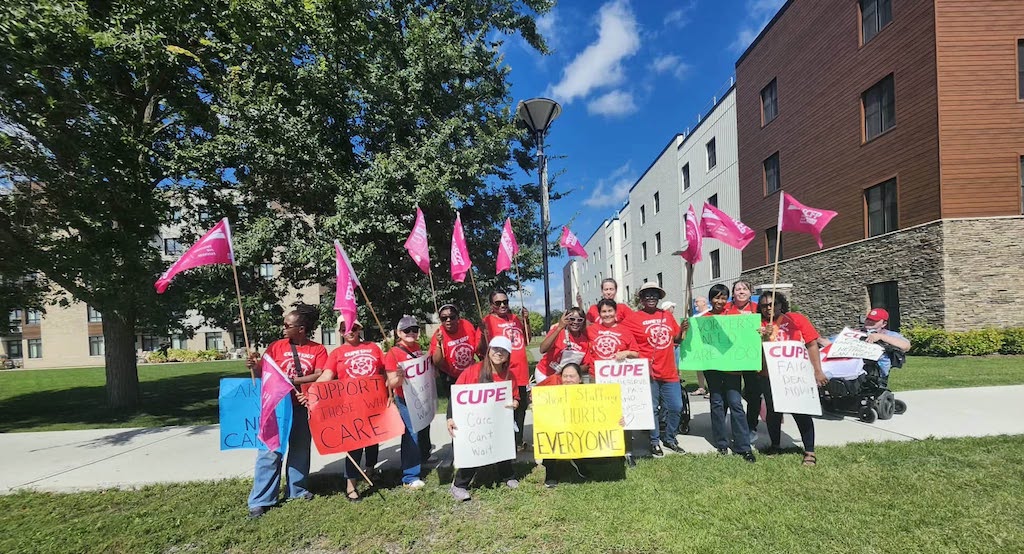
Haynes said that in lieu of strike action, she and her coworkers have been trying to put pressure on Extendicare in other ways, like organizing rallies in front of the long-term care home they work at.
At a rally on September 9, Haynes said family members of some of the home’s residents attended to show their support for the workers.
“It was really touching for us,” said Haynes. “The families showed us that they’re also there for us when we need them.”
Haynes has worked in long-term care for 22 years, and said the connections she makes with the home’s residents and their family members and getting the opportunity to learn about the lives the residents lived before they moved into long-term care, are what she loves most about her work.
“I’m here five days a week. I see most of them more than I see my family.”
Our journalism is powered by readers like you.
We’re an award-winning non-profit news organization that covers topics like social and economic inequality, big business and labour, and right-wing extremism.
Help us build so we can bring to light stories that don’t get the attention they deserve from Canada’s big corporate media outlets.
Become a member
 @emmaarkell.bsky.social