
Uber Drivers in Victoria Successfully Bargained a Collective Agreement, and Here’s What They Got
Labour experts say the union's contract reins in Uber's 'largely unfettered authority to do whatever it wants'
Uber drivers in Victoria, BC, have become the first app-based workers in Canada to gain the protections of a collective agreement.
In May, Victoria-based Uber drivers represented by the United Food and Commercial Workers (UFCW) Local 1518 ratified their collective agreement, less than a year after certifying their union.
While they aren’t the first gig workers to unionize in Canada — that achievement rests with Gig Workers United, which organized Foodora delivery workers before the company filed for bankruptcy and closed its Canadian operations in May 2020 — they are the first app-based workers to successfully bargain a collective agreement.
“I think this is a pretty groundbreaking agreement, considering the type of work, and that the main effort of Uber-style employment is to break up entirely the possibility of workers connecting with each other and organizing, let alone achieving collective agreement coverage,” Véronique Sioufi, a policy analyst at BC Policy Solutions, told PressProgress.
The agreement [pdf] covers all Uber drivers working in BC’s Capital Regional District, except Uber Eats drivers, for four years ending on May 19, 2030.
For the most part, the wages offered to unionized drivers are in line with what all app-based workers are entitled to under BC’s Employment Standards Act (ESA), which was amended in 2024 to add protections for online-platform workers.
Under both BC law and the UFCW-Uber collective agreement, platform workers earn $21.90 per hour for “engaged time,” which refers to periods when a worker has accepted an assignment. Periods when a worker is waiting for an assignment, or travelling between assignments, are not compensated — a detail that Sioufi suspects Uber had lobbied heavily around.
“The agreement accepts Uber’s logic, accepted also by the BC government, that platform drivers should only be paid for ‘engaged time’,” said David Doorey, a professor of labour and employment law at York University.
“This is not a traditional agreement,” Laura Miller, the head of public policy and communications for Uber Canada, said in a statement. “It is designed for how drivers actually work, and there is no change to how drivers use the Uber app today. This is part of an ongoing process as we learn what works best for drivers, balancing flexibility with representation and tailored incentives and benefits.”
The one area where the collective agreement differs from provincial standards in terms of wages is in bonuses. Drivers who completed more than 50 rides between July 1, 2025, and May 19, 2026 (the date the agreement was ratified), will receive a $250 bonus.
Unionized drivers are also now entitled to quarterly bonuses ranging from $75 to $600, depending on how many rides they have completed.
While the agreement doesn’t include a benefits package, it does give workers access to a “Driver Wellness Fund” that will “provide periodic funding to drivers who qualify.”
Details on the fund are scant, but the agreement states that qualification criteria will be developed and administered by the union. Uber will contribute a rate of $0.10 per trip to the fund starting in the second year of the agreement.
“My guess is that that will act as a buffer in lieu of having health benefits,” said Sioufi. “I’m assuming that this would be something that drivers could turn to if they’re sick or need to take personal leave.”
Doorey told PressProgress that focusing on compensation alone misses the bigger picture. The benefit of the UFCW-Uber agreement is in the representation rights it offers to workers, and the groundwork it lays for the union to organize more Uber drivers in BC.
Under the province’s employment-standards law, drivers whose accounts are suspended are entitled to 72 hours’ notice that tells the driver the reason for the suspension.
Drivers outside of Victoria, who aren’t represented by a union, have to take their complaints to the province’s Employment Standards Branch. A BC government website warns that the complaints process can take “several months,” and worker advocates have told media that workers often wait a year or more to get help. Sioufi said cuts to the Employment Standards Branch included in the BCNDP’s 2026 budget will likely make those wait times even longer.
But unionized drivers, who have the protection of a legally enforceable collective agreement, are now able to file a grievance if their account is suspended, waitlisted or deactivated, and take the issue to an arbitrator.
This goes beyond the dispute-resolution service UFCW offered to Uber drivers after striking a voluntary agreement with the company in 2022.
Doorey said that this means Uber’s “largely unfettered authority to do whatever it wants is now restrained.”
“That’s an important step, because this is not a company with a history of being a leader in corporate social responsibility,” said Doorey.
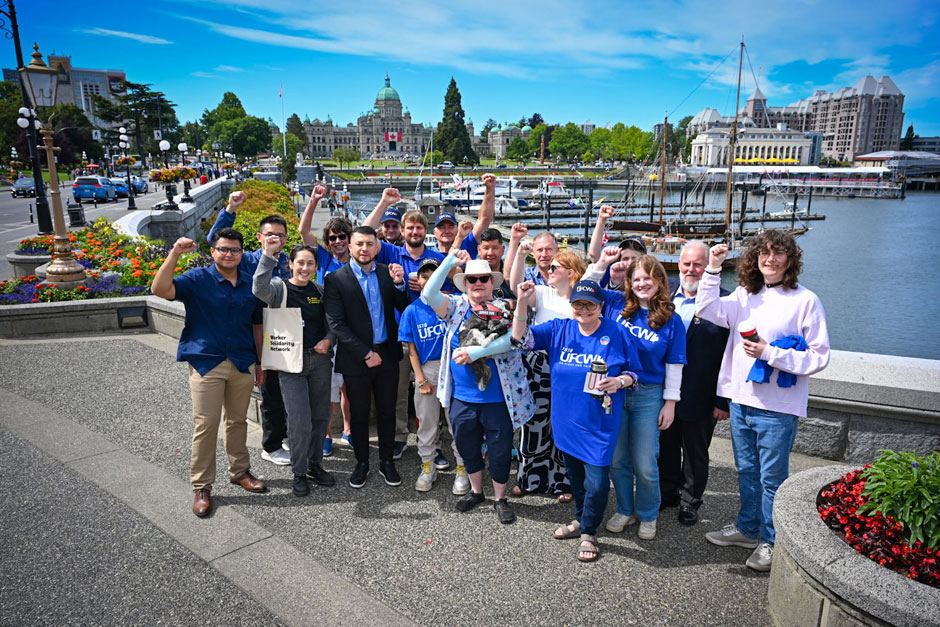
Victoria Uber drivers gathered on the city’s waterfront on July 3, 2025, to celebrate their union’s certification. (Photo via UFCW 1518 on Facebook)
Uber defended its in-house arbitration process — which required drivers to take legal challenges against the company to arbitration in the Netherlands after paying a $14,500 USD filing fee — at the Supreme Court of Canada in 2019. The company lost the case, and the Supreme Court struck down the clause.
Sioufi said that the grievance process is not only useful in cases where drivers have their accounts suspended or deactivated, but also for cases in which a number of drivers experience issues with the app that could be a result of changes Uber has made to its algorithm.
Whereas before, workers had no formalized way of communicating with each other, they now have a union that can collect driver experiences and complaints, and file group grievances.
The agreement also includes an accretion clause that automatically extends the agreement to any additional unit of Uber drivers organized by UFCW in BC.
Doorey said that with just Victoria drivers unionized, UFCW has limited power, but the union’s bargaining power will grow if it can organize drivers in other regions.
“Imagine a province-wide bargaining unit covering all Uber drivers under a single agreement, with a single common strike date?” said Doorey. “That could mean real leverage to build on the agreement down the road, if the workers buy in and the UFCW wants to push the envelope.”
He said this could open the way for the union to bargain for things like compensation for non-engaged time.
The transparency that the collective agreement requires, specifically around the number of Uber drivers working in Victoria, could also help the process of organizing new bargaining units in other parts of the province.
“It’s really hard to know how many drivers there are in any region — Uber will not share that information,” said Sioufi. “That’s part of why it was so hard to organize in the first place.”
Last year, UFCW president Patrick Johnson told PressProgress that it took the union more than a year of working with Uber drivers to get over 500 union cards signed.
Now, as part of the process of collecting monthly dues, Uber has to share with the union the names and contact information for all of the region’s drivers.
“We’re pleased that drivers voted 99% in favour of ratifying this agreement,” said Miller. “The result reflects months of constructive, good-faith discussions and protects the flexibility drivers value.”
Doorey said that he thinks it’s important to recognize this agreement for what it is: a first step.
“Time will tell if the Uber drivers and the UFCW can build upon it going forward.”
Our journalism is powered by readers like you.
We’re an award-winning non-profit news organization that covers topics like social and economic inequality, big business and labour, and right-wing extremism.
Help us build so we can bring to light stories that don’t get the attention they deserve from Canada’s big corporate media outlets.
Become a member
 @emmaarkell.bsky.social