
Two of BC’s Public Sector Unions Just Went On Strike As Public Servants Push Back Against Rising Costs of Living
Wages that don't keep pace with inflation and outsourcing contract work are at the centre of two public sector strikes in British Columbia
Two of BC’s public sector unions have expanded picket lines across the province amidst a labour dispute over wages and the contracting-out of public sector work.
The BC General Employees’ Union (BCGEU) and the Professional Employees Association (PEA) issued simultaneous strike notices on August 29, with both unions launching strikes against the provincial government on September 2.
The unions initially picketed government ministries in Victoria, Surrey and Prince George, but have since expanded picket lines to other cities, including Vancouver.
On Wednesday, BCGEU president Paul Finch told PressProgress that the union’s strike plans are evolving based on whether the government is prepared to return to the bargaining table.
“The sites that we’ve opened with, for the most part, are to basically minimize disruption to the public, and are focused more internally towards government,” said Finch. “Of course, if we’re not able to compel government to come back to the table for a deal, that will change.”
At the centre of the dispute is the issue of wage increases. The provincial government has tabled a general wage increase of 3.5% over two years, less than half of the BCGEU’s ask of 8.25% over the same time period.
Finch said the government’s proposal is not only below inflation, but it also fails to address the increased cost of living in BC over the past couple of years.
“It obviously doesn’t address the needs of our membership in light of those heightened costs of living,” said Finch.

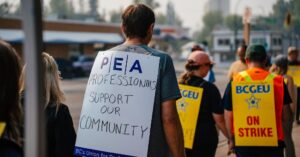
Members of the BC General Employees’ Union and the Professional Employees Association picketing in Prince George, BC, on Tuesday. (Photo via the Professional Employees Association)
Last week, BCGEU membership voted 92.7% in favour of strike action. The union said a recent survey of its members who work in the provincial public service found that 70% spend more than 30% of their income on housing, half describe themselves as living paycheque to paycheque and nearly a quarter work a second job.
PEA president Melissa Moroz told PressProgress that both unions are watching public service bargaining in other provinces closely.
“BC lags behind,” said Moroz. “When you look at recent settlements in Alberta and Ontario — in governments that are not labour-friendly — they’re getting higher settlements.”
Alberta’s public service union, the Alberta Union of Provincial Employees, just ratified a new collective agreement that includes salary increases of 3% every year until 2027.
In Ontario, the Professional Engineers Government of Ontario secured an 11.5% wage increase over four years, and AMAPCEO members in the provincial public service will receive a general wage increase of 7% over three years.
“This most recent proposal that we have from the employer in this round of bargaining is worse than I’ve seen in multiple rounds of bargaining,” said Moroz.
Tyler Dergousoff has worked in forestry in Prince George for nine years, the last five of which have been with the public service as a member of PEA. As a professional forester with BC Timber Sales, Dergousoff focuses on reforestation and tree-planting, which he said requires balancing legal reforestation obligations, timber values and the uncertainty of climate change.
After starting his career in the private sector, Dergousoff chose to transition to work in the public service, even though, he said, it came with a 25% pay cut.
“I felt like I could have more of a positive impact on forest management, which is really why I got into professional forestry to begin with,” Dergousoff told PressProgress.
Dergousoff, a member of the union’s bargaining committee, said that low wages in the public service have led to major recruitment and retention problems. When vacancies are difficult to fill, that work is often then contracted out to private companies, which costs more than having the work done by a professional employed directly by the government.
“Sometimes it’s to the point in some of our offices where we’re not just hiring contractors to do the work, we’re hiring other contractors to oversee those contactors because we don’t have enough staff,” said Dergousoff.
Finch said the BC government has made a series of “poor governance decisions,” including dramatically expanding the size of non-union management positions. He estimates over the last decade, the management-to-frontline-worker ratio has gone from one-to-four to one-to-three.
He said that on average, management positions are paid $45,000 more than BCGEU public servants.
“One of the biggest complaints of our membership is that they’re over-managed, they’re micromanaged,” said Finch. “It doesn’t make for effective work environments, and there’s a financial cost.”
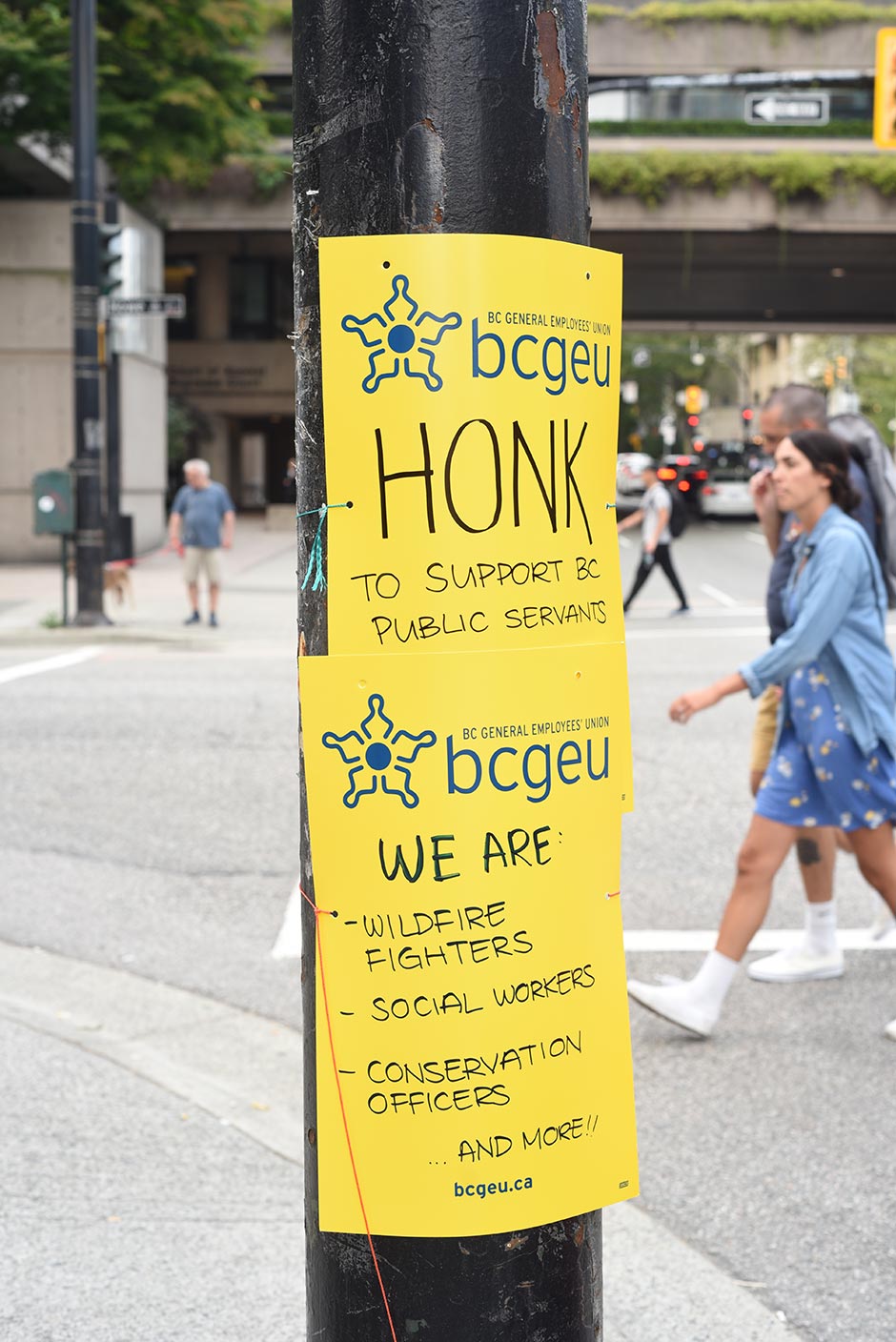
Signs at the BC General Employees’ Union picket in Vancouver this week. (Photo: Emma Arkell / PressProgress)
Along with lower wages, Moroz and Dergousoff said that professionals in the public service are also expected to cover at least part of the cost of their professional licences, which are required in order for them to be able to do their jobs.
As a professionally licenced forester, Dergousoff said he pays $300 per year out of pocket in order to renew his licence.
“I don’t know anyone who works outside of the BC government in forestry who doesn’t have their licence fully covered by their employer. It’s just a common thing that people get as a work benefit,” explained Dergousoff.
This is only the second time in the 50-year history of the PEA’s public service chapter that the union has been on strike. Moroz said union membership and leadership saw solidarity and coordinated strike action with the BCGEU as important this time around.
Not only are both unions currently in bargaining with the provincial government, they share health and dental plans, a pension plan, sick leave plans and long-term disability coverage. Given the BCGEU represents over 34,000 public service workers and the PEA represents around 1,800, aligning with the bigger union was also a strategic choice.
“Whatever they get at the bargaining table, we get at the bargaining table,” said Moroz.
On August 28, the Hospital Employees’ Union (HEU) announced that its facilities workers had “secured a bargaining framework” with the provincial government.
A finance ministry press release about the framework noted that both parties “reached agreement on all of the compensation increases that will be provided to [Facilities Bargaining Association] employees in the new collective agreement, including additional wage comparability increases linked to low-wage redress that will be over and above the general provincial public-sector bargaining mandate.”
Details of the framework have not been publicly released. In June, HEU rejected a 3.5% wage increase over two years, at the time noting the provincial government’s offer was “less than projected inflation.”
“We don’t consider ourselves in any way bound by that framework,” Finch added. “It wouldn’t be acceptable to our members.”
Clarification: This article has been updated to clarify that the BC government’s offer to HEU of a 3.5% wage increase over two years was rejected by HEU in June.
Our journalism is powered by readers like you.
We’re an award-winning non-profit news organization that covers topics like social and economic inequality, big business and labour, and right-wing extremism.
Help us build so we can bring to light stories that don’t get the attention they deserve from Canada’s big corporate media outlets.
Become a member
 @emmaarkell.bsky.social