Special interest groups spent hundreds of thousands of dollars on ads during Toronto’s municipal election
Experts say loopholes allow groups to bypass rules on third-party advertising
Special interest groups spent hundreds of thousands of dollars on advertising ahead of the Toronto municipal election, but given the grey areas in third-party advertising laws, critics say non-registered organizations may be getting away with influencing voters.
On October 26, Olivia Chow was re-elected mayor with the single largest number of votes in a Toronto election. Runner-up Brad Bradford received over 400,000 votes after a campaign in which Bradford and Chow appeared to be neck and neck, a substantial improvement for Bradford after he placed eighth in the 2022 municipal election.
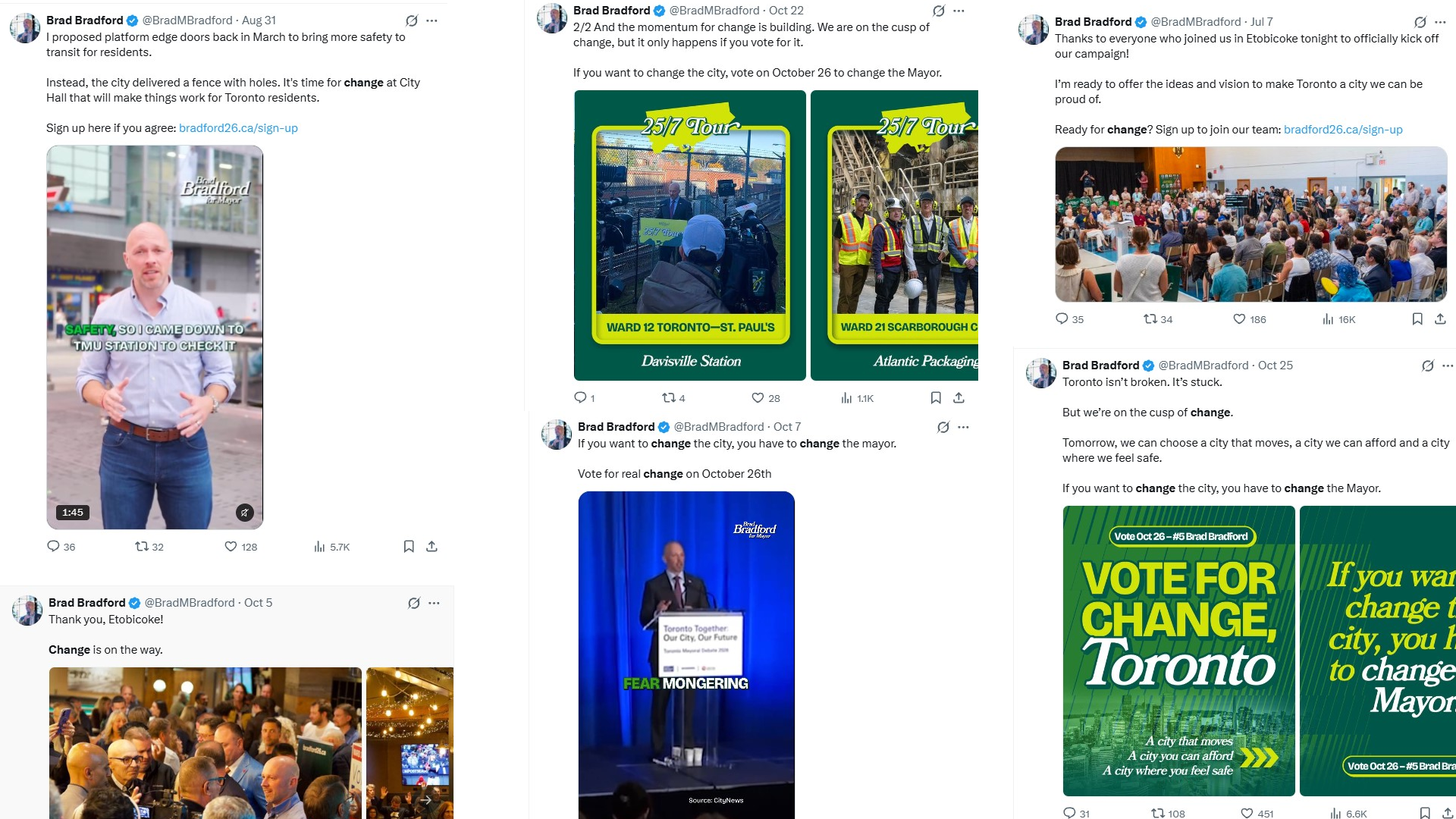
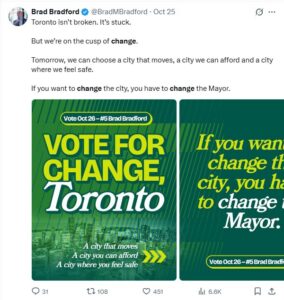
Bradford, a Toronto city councillor for Beaches-East York since 2018, ran on a platform promising change, with messaging about Toronto’s decline, affordability and the need for public safety. “Vote for change” was a slogan used heavily on Bradford campaign materials and social media posts.
But Bradford’s and Chow’s campaigns were not the only groups paying for political advertising on Meta platforms (Instagram, Facebook and Threads) during the election. A number of groups ran advertising that referenced Toronto’s election and some of the key issues from the election like building homes faster, increasing safety — particularly on the TTC — and freezing property taxes.
Parties that are not involved in elections are meant to register as third-party advertisers and have specific spending limits for advertising during an election. In Toronto’s recent election, there were 15 registered third-party advertisers.
The rules that regulate who can influence elections through advertising are set in the 1996 Municipal Elections Act, which defines who is considered a third-party advertiser, what counts as an advertisement and how much they can spend.
Dr. Andrea Lawlor, a political science professor at McMaster University, told PressProgress that these rules are meant to prevent external parties from having more of a voice in elections than political parties themselves.
“We don’t want to prevent other people from meaningfully participating within the election environment, [so] one way that they can do that is advertising a message—whether it’s about candidates, whether it’s about issues—so we have this class of actors called third parties,” Lawlor said.
Terra Loire Gillespie, a digital strategist who teaches digital campaigning at Seneca College and worked on Diana Chan McNally’s campaign for city councillor, collected and analyzed Meta ads from several special interest groups during the election.
She told PressProgress that the rules governing election advertising don’t take into account how digital advertising works in 2026.
Build Canada
Build Canada, a think tank that allegedly “grew out of a WhatsApp group” started by Shopify founder Tobias Lutke, spent hundreds of thousands of dollars in digital advertisements during Toronto’s most recent election.
According to data compiled by Loire Gillespie, Build Canada, which was not registered as a third-party advertiser, ran 196 ads on Meta platforms between July 24 and October 26.
The Meta Ads Library’s data shows that the organization paid over $226,000 for digital ads in the past 90 days (since August 12).
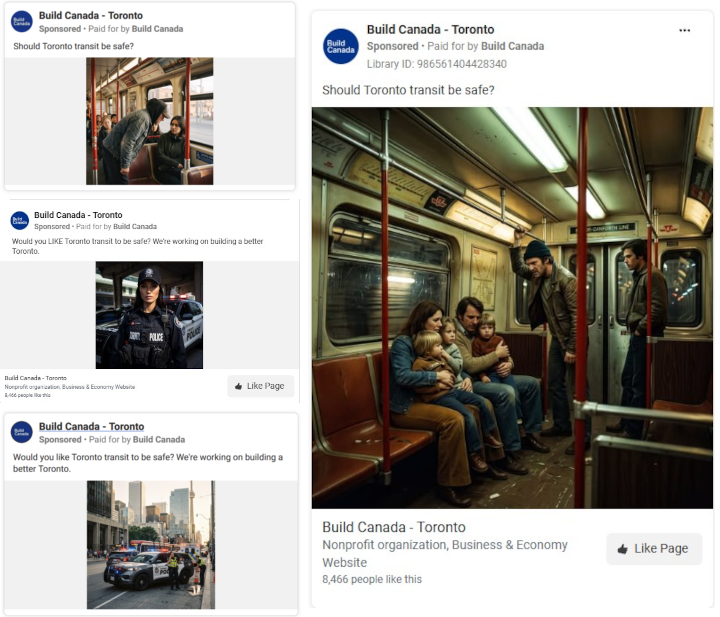
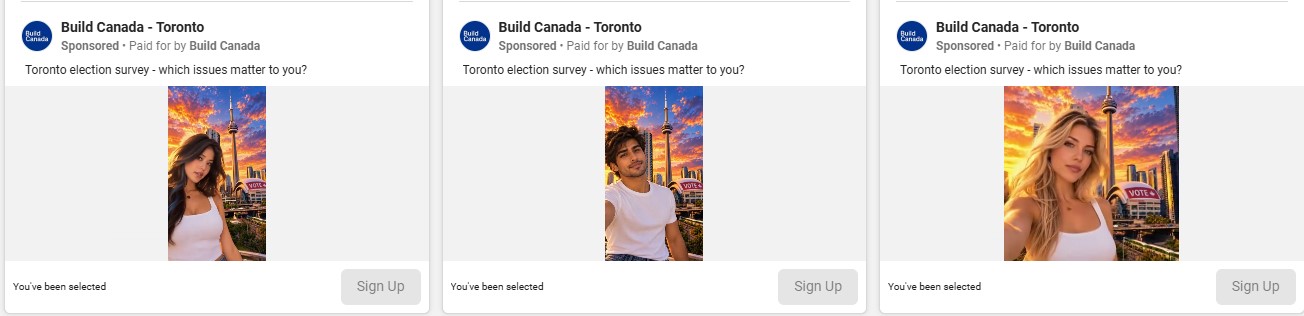
Some of those ads asked the viewer if they planned on voting, if they thought Toronto transit should be safe, stated that homes should be built faster, or encouraged the viewer to vote for a Toronto they think is possible. Some of these ads share similarities with Bradford campaign messaging around making the TTC safer, utilizing AI-generated images of police and leering passengers intimidating others.
Other Build Canada ads promoted a quiz, called the Toronto Priorities Survey, that showed users which mayoral and council candidates most closely aligned with the user’s answers.
The quiz asked questions about the direction people want the city to take and collected their emails and postal codes. A disclaimer above the sign up form read, “We’ll send you the results for your ward. Nothing Else.”
“We put the same questions to every candidate on the ballot. See how they answered — then answer them yourself and find out who lines up with you,” reads the copy on their website.
According to Build Canada’s website, only 17 mayoral candidates out of a possible 53 responded to questions from Build Canada. Most notably, incumbent Mayor Olivia Chow did not respond.
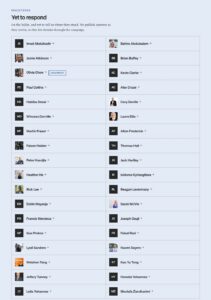
Digital ads promoting this quiz reached hundreds of thousands of people on Meta platforms, but according to Lawlor, it isn’t clear if advertising a quiz using an incomplete dataset that would influence voters away from the incumbent is a violation of third-party advertiser election rules.
“This is where it gets super gray and would rely on the decision of some elections administrator,” Lawlor said. “These sorts of things, even different ways of engaging voters through interactive online tools, if there’s an implicit message in there about ‘support this person, don’t support this person,’ I think elections administrators are increasingly sensitive to the fact that guerrilla advertising, as sometimes people call it, is still a form of advertising.”
Loire Gillespie said organizations like Build Canada remaining unregistered means that they don’t have to work with the same spending cap as a registered third party, and they can troubleshoot specific messaging to make sure it doesn’t break municipal election rules in a literal sense.
“The purpose of third-party rules is simple: voters should know who is trying to influence their vote, and no one should be able to buy a louder voice than everyone else,” said Loire Gillespie. “Build Canada’s Toronto campaign told people to vote, collected their data through surveys and pushed a ‘change’ narrative.”
“It spent more than either mayoral campaign on Meta, and it did all of this without registering, without a spending limit and without filing a financial statement.“
According to EOK Consults, Chow spent $132,700 on Meta ads compared to Bradford’s $97,700 over the final three months of the election.
Lutke and Build Canada have been involved in Canadian politics on multiple fronts this year. Lutke supported Ontario’s thwarted plan to expand Billy Bishop airport to allow jets to land in the city, and came under fire for endorsing a tweet that said people who pay higher taxes should have more of a say in elections. According to The Grind, Lutke endorsed Bradford for mayor.
Build Canada did not respond to questions from PressProgress.
ABC Toronto
A Better City (ABC) Toronto, a not-for-profit founded by business lawyer Jeffrey Kroeker, spent between $15,000 and $19,000 on Meta ads between April and October.
ABC Toronto describes itself as an organization of “concerned citizens who believe Toronto must become a highly livable city that is the envy of the world.” Their homepage explicitly endorses Brad Bradford for mayor.
One ad campaign paid for by ABC Toronto that, according to the Meta Ads Library, ran between April 21 and May 1 explicitly called for people to not vote for Olivia Chow.
The voiceover in the ad claimed Toronto couldn’t “afford Olivia Chow.” The ad claimed property taxes had risen over 25% since she became mayor, and criticized her for not clearing snow fast enough last winter, potholes on streets, food bank usage and visible homelessness.
“With Olivia Chow, you pay more but you get less. She’s a failed mayor, it’s time for change.”
According to Meta’s Ad Library, the last day of this ad campaign fell inside the election advertising blackout period.
From May 1 to election day, anyone who ran an ad endorsing or criticizing a candidate was required to be a registered third-party advertiser. Organizations found to be violating this rule can be subject to fines.
“If a person, corporation or trade union intends to spend money between May 1 and October 26, 2026 (election day) on advertisements or other materials that support, promote or oppose a candidate in the municipal election they are conducting third party advertising and must register with the City Clerk,” states a notice on the City of Toronto’s website.
In a statement to PressProgress, a representative for ABC Toronto said the organization is aware of the rules and regulations related to election advertising, and that they have not broken any.
“We did not register as a third party because there was no need to do so,” ABC Toronto told PressProgress. “The pre-registration ads you reference ran from April 21 to April 30, so there is an issue with how Meta is reporting those.”
Meta did not respond to questions from PressProgress regarding the accuracy of the dates displayed in its Ads Library.
After May 1, ABC Toronto’s messaging became more ambiguous. It didn’t name Chow or Bradford directly, but instead advocated for voters to “choose change” at city hall — similar to Bradford’s messaging.
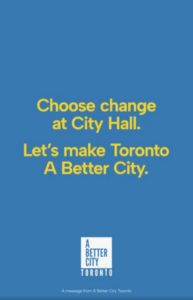
“Drugs, shootings, stabbings, carjackings. When the violence follows you onto the TTC and into your own home, nowhere feels safe,” a voiceover playing on top of ominous music states, before the music dramatically shifts to a more hopeful tone. “On October 26, you can stop the decline. Choose change at City Hall, let’s make Toronto a better city.”
The caption for the video followed suit.
“Toronto’s Decline[sic] is a choice. Let’s choose to build a better city and choose change on October 26,” read a caption for an ad run from October 20 to 27.
Lawlor said the two most common ways third-party advertising rules are broken is when advertisers spend beyond the limits set out in the Municipal Elections Act, and when advertisers put out messaging that skirt the third-party advertising rules. Lawlor says the latter are more difficult to detect.
“If there is a campaign of, ‘let’s clean up the Humber River’ or something to that effect, then citizens can get together and have informational campaigns about cleaning up the Humber River,” Lawlor said.
“Where it gets a little bit sticky is if you have a candidate in that election who is running on the platform of cleaning up the Humber River, and then the issue kind of gets tied to the candidate, and that’s where there’s a little bit of gray space.”
The penalties for an individual or group found violating third-party election rules in Ontario include up to six months in prison, $25,000 in fines for individuals and $50,000 in fines for corporations and unions.
Other provinces have similar laws. Take Back Alberta, a third-party advertiser, was subject to a $22,500 fine on February 4, 2025 for “circumventing the election advertising spending limits.”
Part of the issue, according to Lawlor, is that lawmakers are not sure how to prevent this sort of behaviour with legislation.
“It’s not clear how to write the legislation to be precise to catch some of these things, because advertisers [and] marketers are notoriously good at getting around the rules and finding different and creative ways to reach people,” Lawlor said. “It’s not a blunt instrument anymore.”
Lawlor said there isn’t a clear metric to use to measure influence, the way dollars used to be able to when advertising was mostly in print. She also said that, because of the complex nature of digital advertising in politics, the rules should be up to the interpretation of elections officials.
“I think you kind of have to consider what the spirit of of the act is trying to catch, and that is the act is trying to catch individuals, groups, unions, etc., who are participating in elections advertising with the intent of influencing somebody’s vote calculus outside of their own internal organization and are putting money into doing it,” Lawlor said.
On top of this, Lawlor said sometimes specific ads do not result in fines simply because a clerk’s office does not have the resources to monitor for all potential third-party advertising violations.
Loire Gillespie said that despite the amount of money Build Canada spent on election-related advertising and the number of accounts those ads reached, the organization would probably not receive a fine for their advertisements during the election period.
She added this would not be the case on the federal level, because the Canada Elections Act defines advertising in a way that includes taking a position on an issue that a political party or candidate is associated with.
“It’s not a fault of the voters for not being able to navigate this insane web-like system with all of these different actors in place, and nor should it be,” Loire Gillespie said. “It should be clear for voters to know who’s spending money to sway their vote and why, and that’s why we need to have stronger regulations to help people navigate.”
Our journalism is powered by readers like you.
We’re an award-winning non-profit news organization that covers topics like social and economic inequality, big business and labour, and right-wing extremism.
Help us build so we can bring to light stories that don’t get the attention they deserve from Canada’s big corporate media outlets.
Become a member
 @ericwickham.ca