

Public Servant Surprised by Voicemail from Doug Ford Suggesting They ‘Get Another Job’
The worker had messaged Ford's number to express concern about the Ontario government's return-to-office mandate
When Ontario Premier Doug Ford stood in front of a line of trades workers for a press conference last August, he briefly commented on an announcement from earlier that day: that workers in Ontario’s public service would be mandated to return to the office five days a week as of Jan. 5, 2026.
“All the companies I’ve talked to — from the banks to the insurance companies to everyone else — everyone needs to go back to work,” said Ford. “Half the public service is already at work five days a week, and I want to thank them. And I just look forward to having everyone back to work.”
But just days later, Ford seems to have taken a different tone in a voicemail left for a member of the Ontario public service (OPS).
“You know what my mother said to me one day when I said I was having a tough job? ‘Doug, you don’t like it, go get another job.’ That’s what she said to me,” Ford is heard saying in the message. “So, I’ll leave you with that one. You take care.”
The message, provided to PressProgress by the public servant who said they received it, was apparently left in response to a text message the worker had sent to the premier, in which they expressed concern over the impact of the return-to-office (RTO) mandate on working parents, caregivers, disabled workers and the environment. PressProgress agreed not to identify the worker due to concern for their job security.
In the message, the worker wrote that the return-to-office mandate put Ontario’s public servants in a difficult position. They said their colleagues were frustrated with being forced back into the office five days a week, given there were studies showing remote work improves worker satisfaction and productivity.
The following day, the public servant received a call from a blocked number that left a voicemail. Although the number was unknown, the voice on the other end was unmistakable.
“It’s Doug Ford calling, thanks so much for your message, and thanks for all the work you do.”
The voicemail then addressed the concerns mentioned in the text message: “We’re all going back to work, just like 95% of the population. And I understand, child care and so on and so forth, but we need to get back to normal, as I call it.”
“Okay, you take care,” it continued, before abruptly pivoting to the motherly advice.
The premier’s office did not respond to multiple requests for comment from PressProgress.
The public servant, a member of Ontario Public Service Employees Union (OPSEU), told PressProgress they were surprised to receive such a candid response.
They said that, prior to the August announcement, there had been conversations in the public service for months about the potential for a full return-to-office mandate. Around half of the workers covered by the OPS Unified collective agreement — which includes most OPSEU members who work for the OPS, with the exception of corrections workers — had been expected to work in-office three days a week since 2022.
The return-to-office mandate announced last summer first required public servants to return to the office four days a week starting Oct. 20.
Now, with the mandate fully in effect and public servants back at the office five days a week, the worker described widespread dissatisfaction with the return, even amongst management.
They told PressProgress that, while their superiors have told them they don’t want the policy, many in the public service are afraid of losing their jobs and not being able to make ends meet. As a result, the mandate has been implemented “by-the-book.”
The OPS Unified collective agreement expired at the end of 2024. Negotiations for a new one have been ongoing for nearly a year and a half.

OPSEU’s Amanda Usher speaks to attendees at a cold morning rally outside the downtown Toronto offices of the Ontario Labour Relations Board on Jan. 23. (Photo by Eric Wickham / PressProgress)
On an exceedingly cold recent Friday morning, members of OPSEU gathered for a rally outside the Ontario Labour Relations Board office on Toronto’s University Avenue. In short order, a team from the union would be heading inside to begin mediation with the government, in an effort to fight the return-to-office mandate.
Amanda Usher, chair of the union’s central employee relations committee (CERC), told PressProgress she was feeling confident heading into the mediation.
Usher pointed out that Section 86 of Ontario’s Labour Relations Act says after a bargaining unit serves notice to an employer to bargain, the employer can’t make any unilateral changes to the conditions of employment.
“It says that working conditions, wages, benefits of employment … are to be frozen,” said Usher, adding jokingly that she was feeling frozen at the moment as well.
“Even Mother Nature is sending the message, it’s time to continue the freeze — for goodness’ sake,” OPSEU President JP Hornick said to the crowd.
“We’re hoping that the mediator may be able to talk some sense into this government — being our employer — and rescind RTO for the OPS Unified bargaining unit, because that is a clear violation under the act,” Usher said.
On Dec. 8, the Toronto Star reported on an internal email from the Treasury Board Secretariat telling public service unions and employee associations that there had been a “high volume” of requests for alternative work arrangements submitted by public servants since the transition to the five-days-per-week in-office mandate began.
As of Nov. 19, nearly one in six public servants had requested to work remotely at least one day a week.
Usher said there could be larger consequences for workers in the province if the freeze on working conditions were successfully circumvented.
“What’s the next mandate?” Usher said. “What’s the next worker right that’s going to be stripped away — from not just union members, not just private sector workers, [but] every worker that keeps this province running?”
Julius Arscott, president of OPSEU Local 532 and an applications assessment officer for the Ministry of the Environment, Conservation and Parks, said that — between not having to rush to the subway, saving money by making his own lunch at home and being available to do small chores around the house on breaks — remote work has improved his quality of life.
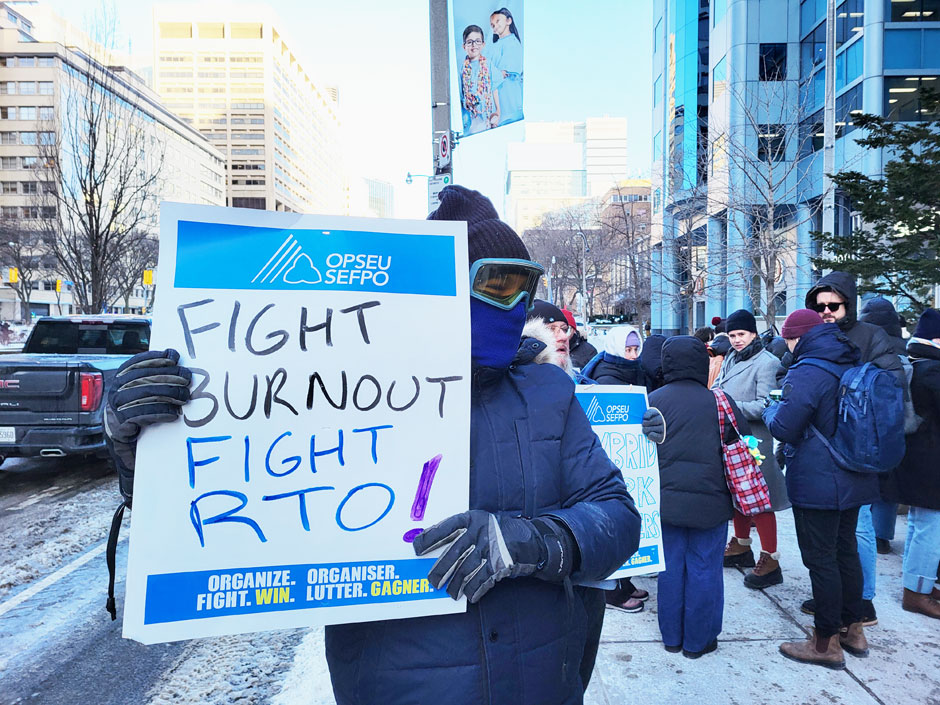
OPSEU held a rally outside the University Avenue offices of the Ontario Labour Relations Board in Toronto on Jan. 23. (Photo by Eric Wickham / PressProgress)
Arscott said the return-to-work mandate makes no sense, and that he believes it has never been about productivity, but rather about benefitting commercial landlords.
The premier himself has gone on record saying that in the PATH, Toronto’s mostly underground pedestrian walkway network, there are “hard-working entrepreneurs [whose] businesses basically just died when they weren’t seeing the flow of traffic.”
In an update subsequently posted to the OPSEU website, the OPS Unified CERC team wrote that the mediation had been unsuccessful, because the government “was not prepared to meaningfully address our concerns or reconsider their RTO mandate.”
The government and OPSEU will now head to a formal hearing at the labour relations board, which is tentatively scheduled for May 26 and June 5.
The public servant who received the voicemail from the premier said they’re aware that, for some people, the issue of a return-to-office mandate could seem like a “champagne problem.” But for them and their coworkers, the chance to work remotely impacts their “ability to do important work outside of our offices, and also take care of ourselves and do more work in our community.”
Our journalism is powered by readers like you.
We’re an award-winning non-profit news organization that covers topics like social and economic inequality, big business and labour, and right-wing extremism.
Help us build so we can bring to light stories that don’t get the attention they deserve from Canada’s big corporate media outlets.
Become a member
 @emmaarkell.bsky.social