
Here’s How Much International Students Have Been Paying for BC Healthcare
Despite federal study-permit caps, the contributions have continued to grow
International students in British Columbia have contributed nearly half a billion dollars to the province’s healthcare coffers in the past seven years, with the amount increasing every year despite federal limits on study permits.
BC is the second-most expensive province for international students to access healthcare, requiring each student to pay $900 per year into the public healthcare system. The most expensive is Manitoba, with a $1,200 annual premium that international students are required to pay to a private insurance company.
According to data obtained by PressProgress via a freedom-of-information request, BC has collected over $417 million directly from international students through the International Student Health Fee (ISHF) — a price on public healthcare that only applies to this demographic.
In BC, international students have been mandated to pay $75 per month through the ISHF since 2020. A similar fee existed for years prior, before briefly being reduced to $37.50 a month in 2019 and returning to the original rate in 2020.
The data obtained via FOI shows that in spite of federal limits on study permits taking effect in January 2024 and causing a significant drop in the number of students entering Canada, the total amount billed for BC’s Medical Services Plan (MSP) continued to rise.
MSP contributions from international students have increased by about $10 million every year since 2021, reaching a total of over $93 million last year.
“It’s surprising to see that although there are less international students enrolled in institutions across Canada, they are still contributing multi-millions to the health sector in the province,” said Mary Feltham, chairperson of the Canadian Federation of Students, in an interview with PressProgress.
“There’s a lot of investments that international students contribute to the economy and the community that they’re in.”
In a statement to PressProgress, a BC Health Ministry representative said bill totals can rise even when new student enrolments are on the decline.
“These variations reflect normal program operations, including differences in billing timing and length of coverage rather than a single factor such as the number of study permits issued in a given year,” they wrote in an email.
“A further contributing factor is the continued Medical Services Plan enrolment for international students remaining in BC under multi‑year study permits approved by Immigration, Refugees and Citizenship Canada in earlier years.”
The Health Ministry statement noted that the dollar amounts are “amounts billed, not necessarily amounts collected or recovered within the same year.” However, the FOI documents disclosed by the Finance Ministry describe the amounts as “net fees collected” each year.
The FOI’d data obtained by PressProgress was initially sought from the BC Health Ministry, which quoted a fee of $427.50 in order to access it. We then filed the same request with the provincial Finance Ministry, which disclosed the requested documents with no charges, delays or redactions.
Differential access across provinces
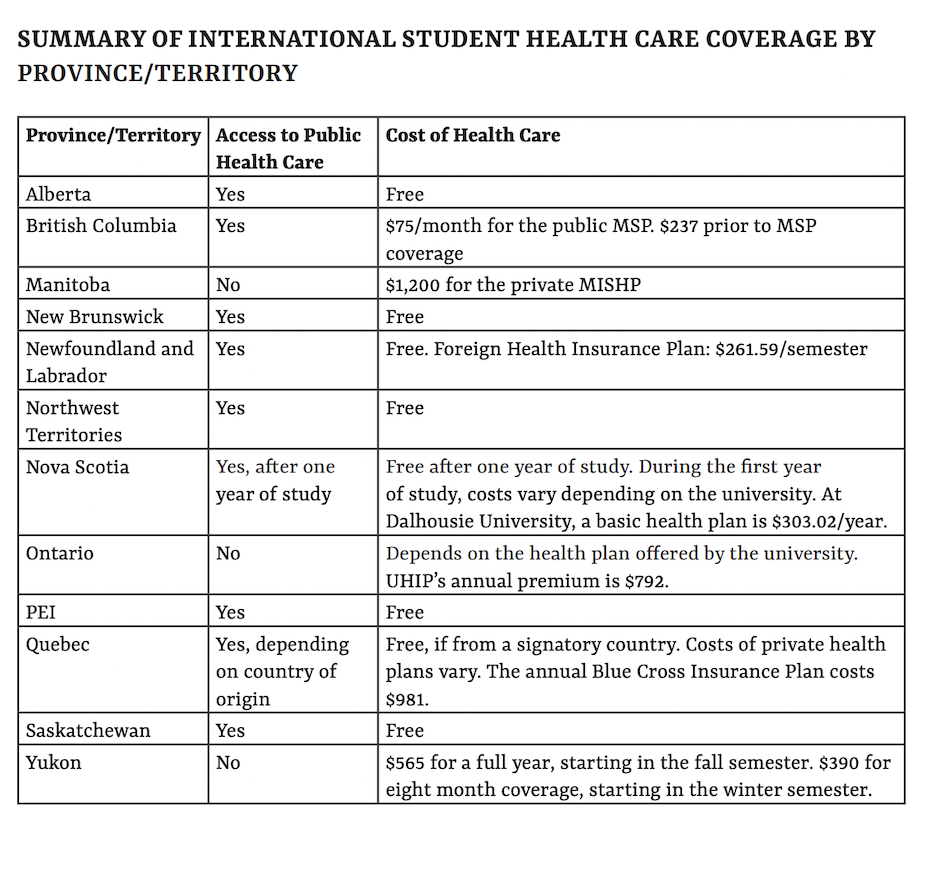
According to a comprehensive report by the Canadian Health Coalition and Madhu Verma Migrant Justice Centre released in January, access to public healthcare for international students differs across provinces and territories.
Alberta, Saskatchewan, New Brunswick, Newfoundland and Labrador, Northwest Territories and Prince Edward Island offer free access to public healthcare for all international students with no strings attached.
In Quebec, public healthcare is free for international students who hail from one of 11 European countries — Belgium, Denmark, Finland, France, Greece, Luxembourg, Norway, Portugal, Romania, Serbia and Sweden — that have signed a social security agreement with the province. Students from all other countries studying in Quebec must obtain private health insurance.
In Ontario, which typically attracts the largest number of international students — over 56% of all foreign students in Canada in 2023, according to Statistics Canada — students are typically required to enrol in a private insurance plan offered by their school.
Usually, the plan offered is the University Health Insurance Plan (UHIP), which covers services that would fall under Ontario’s public health plan and costs $792 per year, or $66 a month.
The most expensive by far is Manitoba, where international students in most institutions must buy private health insurance at a cost of $1,200 per year through the Manitoba International Student Health Plan — which is managed by Studentcare and Manitoba Blue Cross — as a requirement set by the province in 2018.
Source: “Free and Universal? Disparities in International Student Health Care in Canada” (pdf)
Even in provinces and territories where access to public healthcare is free for international students, there is often a waiting period before coverage kicks in, and a medical plan renewal process that students must undertake.
“Students are definitely scared about getting ill, depending on the province that they’re in, knowing that it could cost them a substantial amount, or they delay seeking out care because they’re not sure if their coverage has yet been approved,” said Feltham, who also works as a registered nurse in Newfoundland and Labrador.
“There was actually a case while I was doing my undergraduate in Newfoundland and Labrador, where someone had renewed the [plan] on time, but the provincial government had delayed their acceptance of it by a month.”
“They had to have an emergency surgery during that period and then had to pay over $2,000 for that surgery, which any other resident within the province would not have had to pay.”
According to the most recent available data, international students contributed over $37 billion to Canada’s economy in 2022.
In spite of this and foreign students’ direct financial contributions to the healthcare system in BC and beyond, the federal Liberal government claimed that study-permit caps were necessary to alleviate “pressures on housing, healthcare and other services” caused by a rise in the number of international students choosing Canada for their post-secondary education.
The result, according to an auditor general report released in March, has been a much steeper decline in new students entering Canada than expected.
“In 2024, the department [IRCC] approved fewer than half the forecasted number of new study permits,” the report states.
“This continued into 2025, with just over 50,000 of the 255,360 forecasted number of new study permits approved by September. The department did not know why approval rates were lower than projected.”
Our journalism is powered by readers like you.
We’re an award-winning non-profit news organization that covers topics like social and economic inequality, big business and labour, and right-wing extremism.
Help us build so we can bring to light stories that don’t get the attention they deserve from Canada’s big corporate media outlets.
Become a member
 @brishti.bsky.social