

We Don’t Know How Many Bike Mechanics Are in Canada. That’s a Problem.
Workers who service bicycles want the government to recognize the job as a distinct profession and skilled trade
Across Canada, bicycle mechanics and their supporters are working to improve and grow the profession, but they keep coming up against the same barrier: the federal government doesn’t classify bike repair as a distinct occupation and thus collects no data on the workers who fix our bikes.
Earlier this year, a group called Bike Training Collective Canada submitted an application requesting that the government create a National Occupational Classification (NOC) code for bicycle mechanics [pdf], a move they hope would lead to establishing the job as a skilled trade. The NOC is the government’s system for describing jobs, and it’s key to gathering a wealth of information that shapes the country’s labour policies.
“We’re in this situation where we’re quite stuck, because we don’t have the information to prove that we should be a skilled trade, and we can’t be a skilled trade without getting that information,” said Zoé Kruchten, a bike mechanic and manager of programming at the Bike Kitchen, a community bike shop in Vancouver.
Kruchten told PressProgress that although bike mechanics typically earn low wages in a precarious job with little to no formal training, workers and advocates see their work as fundamental to the larger transition to greener transportation.
Rather than having their own dedicated NOC code, bike mechanics currently fall under NOC 73209 — “Other Repairers and Servicers” — which covers workers employed by specialty shops who “repair and service a wide variety of products, such as cameras, scales, musical instruments, coin machines, vending machines, sporting goods and other miscellaneous products and equipment.” This includes over 100 occupations, with the government offering such examples as beer-dispensing equipment repairer, accordion repairer, juke box mechanic and gas meter repairer. The category takes in people who service pipe organs and people who service pipelines.
When combined with data from annual tax returns, the NOC system provides insight into how many workers are employed in a given job, how much those workers earn on average, how many enter or leave the profession every year and how much demand there is for training programs.
Without a dedicated NOC code, not much is known about bike mechanics in Canada. Much of what we do know is gleaned from surveys or estimates based on bicycle retailer data.
A 2023 report by the Centre for Active Transportation about Toronto’s micro-mobility workforce estimated that in order to keep up with the city’s targeted growth in bike ridership, Toronto’s bike-mechanic workforce would need to grow by 10-20% per year. The authors also looked to Montreal, where increased bike ridership caused the volume of repair activity to jump by 67% in one year.
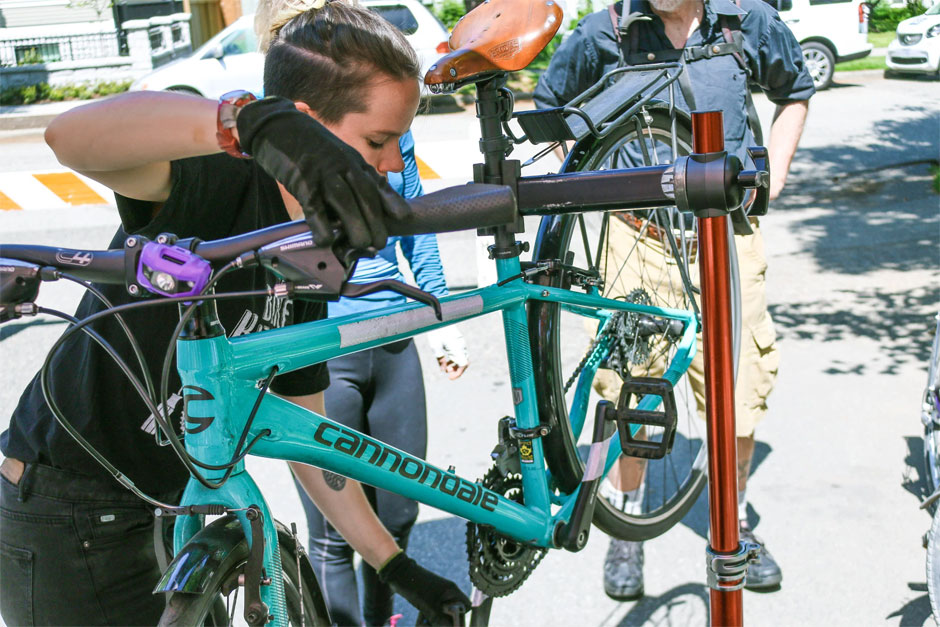
A worker at Vancouver’s Bike Kitchen (via their website).
Keeping up with the demand for repairs will be a challenge, because the report also found the bike-mechanic industry in Toronto struggles to attract, retain and develop the skillset of its workers.
Frustrated with poor working conditions and little change, Kruchten and a few fellow bike mechanics started a research group to gather information about the job, with the hope of empowering mechanics to ask for better conditions. They found many mechanics struggled with low wages, wage theft and pressure from their employers to work unpaid overtime hours during the busy summer months.
“There’s quite a lot of wage theft” and practices that “don’t really follow” employment standards, Kruchten said.
Rob McMonagle was a senior advisor for the City of Toronto when the Centre for Active Transportation report was commissioned, and is working with Bicycle Training Collective Canada to advocate for a bicycle mechanic NOC code. He said a lack of basic data about the profession means workers are at a disadvantage when negotiating wages with employers. When workers are offered a wage or a wage increase, there is no official information they can compare that offer to.
“When there’s no information, salaries tend to be much lower than when you have published salaries, [like] within the trades,” McMonagle told PressProgress.
On top of low wages and unpaid overtime hours, bike-mechanic work is seasonal in most parts of Canada. During the slow winter months, many bike mechanics have their hours reduced or cut altogether, making the job precarious and the income inconsistent. This leads many bike mechanics to leave the industry, resulting in what McMonagle and Kruchten estimate is a high rate of worker turnover.
“Because there’s turnover in the industry, we lose those expert mechanics,” said Kruchten. “And all that knowledge leaves with them.”
That knowledge drain is especially damaging for an occupation with no formal training or accreditation. Most bike mechanics learn from more experienced coworkers rather than by taking a course. Kruchten said this not only makes hiring bike mechanics difficult for shop owners, but since there’s no clear certification to help assess the skill level of a potential hire, it adds to the workload of experienced mechanics — without additional pay.
“You’re just paid your regular wage, but you’re basically apprenticing this other person who may or may not even stay for the whole season, and you’re also doing your own work orders and your job,” said Kruchten.
Montreal’s CycloChrome hosts the only program in Canada that offers a certification for bike mechanics. The organization’s bike programs started with a course for high school students, where the goal was to teach basic bike-mechanic skills and ensure the students graduated.
Pierre-Luc Langlois has worked in the bicycle industry since he was 16, and after seeing how little has changed in the subsequent decades in terms of wages and training, he arrived at CycloChrome hoping to improve the industry. Creating a formalized training program seemed like a logical first step, but without an occupational code, it was difficult to get the course off the ground.
“We created the first professional diploma, which is not a DEP [diplome d’études professionnelles, or diploma of vocational studies], so it’s not a diploma, it’s a certification, because there’s no NOC number, so the government doesn’t really want to give the real full acknowledgement of the course,” Langlois told PressProgress.
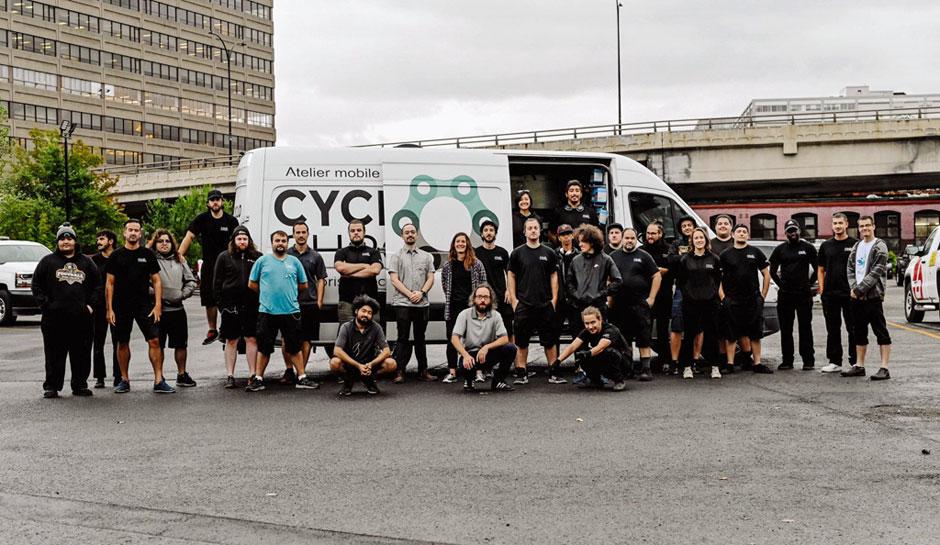
The team at Montreal’s CycloChrome, circa 2021 (via their website).
Langlois said it took nine years to get the course up and running. Right now, it runs twice a year with 12 students per semester. Since it’s not a diploma program, the school CycloChrome partners with to run it has to re-apply for accreditation to run the program every year.
While bike mechanics’ wages, working conditions and lack of training have remained largely the same for decades, the bicycle industry has become more complex with the introduction of hydraulic brakes, cargo bikes and e-bikes.
E-bike motors, batteries — which are known to explode or catch on fire — and significantly heavier bicycle frames also present additional workplace hazards for mechanics.
“This is kind of the driver, in a lot of cases, to provide more professional training for the people in the industry,” explained McMonagle.
But in McMonagle’s experience while working with Bike Training Collective Canada, securing government funding for training programs has been a non-starter because of the lack of statistics.
“Every time we went to get some funding, it was always like, ‘Well, how many jobs are there in this trade? Where are you in the statistics?’”
Canada is an outlier when it comes to bike-mechanic training and occupational codes. Countries across Europe, as well as Australia and New Zealand, have recognized bike mechanics as a skilled trade, run training programs with diplomas or certifications and have a dedicated occupational code for the profession.
Kruchten saw this first-hand when she worked in Belgium, where she said bike shop owners are required to have a diploma, and at least one mechanic per shop must be certified.
“They had a really robust apprenticeship program that provided mechanics with not only technical training, but also some business and communications training,” said Kruchten.
McMonagle said bike mechanics are one of many green-economy jobs that lack an occupational code and thus we know little about, such as solar and wind energy technicians.
The NOC code system is reviewed every five years, with a review currently underway. Bike Training Collective Canada submitted their proposal for a bike mechanic code in June and is waiting to hear if it’s been accepted.
In a statement to PressProgress, the federal Department of Employment and Social Development, which administers the NOC alongside Statistics Canada, wrote that the NOC is “monitored on an ongoing basis and receives minor revisions every five years and undergoes major revisions every ten years to ensure that it reflects the evolution of the Canadian labour market, such as the emergence of new occupations or changes in the nature of work.”
“Both reviews involve in-depth research, analysis and assessment of the feedback received through consultations and occupational research, including input from the public and stakeholders.”
On top of an NOC code, Kruchten and McMonagle believe an industry trade association would improve communication between mechanics, shop owners and training programs across the country, and help professionalize the job.
Kruchten said despite the lack of training, low pay and precarity of the job, she and her fellow bike mechanics see how valuable their work is.
“We view it as a very important part of sustainable transportation in the city, and it is quite a satisfying job, or it could be, but it’s just very undervalued.”
Our journalism is powered by readers like you.
We’re an award-winning non-profit news organization that covers topics like social and economic inequality, big business and labour, and right-wing extremism.
Help us build so we can bring to light stories that don’t get the attention they deserve from Canada’s big corporate media outlets.
Become a member
 @emmaarkell.bsky.social