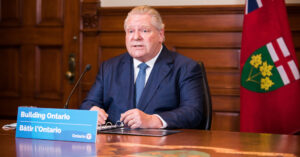

After three cities in Ontario declare food insecurity an emergency, experts hope for more action from Doug Ford
"Housing prices, the rising cost of food, inflation, as well as economic uncertainty" play a role in dramatic increases in food insecurity
As Ontario prepares itself for an early election, experts, municipal politicians and advocates are hoping to see more support from the next provincial government on the food insecurity crisis, which has been prevalent in Ontario for some time.
Kingston is the third city in Ontario to declare food insecurity an emergency in the past three months, following Toronto and Mississauga.
According to regional public health officials, one in three people in Kingston are experiencing food insecurity.
Food insecurity is the inadequate access to food caused by financial constraints. Tim Li, the Research Program Coordinator at PROOF, said that if a household is experiencing food insecurity, that is likely not the only necessity they are compromising on.
PROOF is a group of academic researchers that investigate policy solutions to reduce food insecurity in Canada.
“They’re probably behind on various bills, behind on rent and then compromising on housing and other things to make ends meet,” Li told PressProgress. said. “The thing with food is that it’s one of those necessities that people can cut costs on more easily than rent.”
Li said food insecurity can have serious negative health effects and in severe cases, can cause premature death.
He also said that housing prices, the rising cost of food, inflation, as well as economic uncertainty and turbulence have created the conditions for this dramatic increase in food insecurity across the province.
“For a lot of people if their incomes are also unstable or they’re dealing with income shocks like a sudden rise in the cost of food or some other sudden expense or or a job loss, then that can easily put a household into food insecurity,” Li said.
Rose Butler, Interim Vice President of Research and Advocacy at the Daily Bread Food Bank in Toronto says that the use of food banks has skyrocketed over the past years.
She also notes that people using the food banks include those with jobs struggling to keep up with the increased cost of living.
“Of people using the food bank, after they paid for food and rent, they have about $7.78 a day to live on,” Butler told PressProgress.
Although food insecurity is impacting many Ontarians, the groups hardest hit by the crisis are people on fixed incomes—particularly those on social assistance.
As the cost of living in Ontario has increased, according to Li, the support provided to these people is simply not enough.
“70% of households that rely on social assistance are food insecure,” Li said. “So basically, relying on social assistance is almost a guarantee that you’re going to be food insecure.”
He added that households reliant on social assistance are some of the most likely to be severely food insecure, meaning they’ll skip meals, lower their food intake and even not eat for several days in extreme cases.
Butler echoed this statement. “Right now, the reality is if you’re living with a disability in Ontario, you’re most likely using the food bank to eat.”
The two major forms of social assistance in the province are Ontario Disability Support Program (ODSP) and Ontario Works. While ODSP has received an insubstantial increase in the last few years, Ontario Works has not seen an increase since 2018.
Councillor Greg Ridge introduced the motion to declare a food insecurity emergency in Kingston. He said that increasing social assistance rates can go beyond reducing food insecurity in Ontario.
“The number one way to reduce the amount of people who go into homelessness is to increase ODSP,” Ridge told PressProgress. “When you take a look at ODSP rates and how frankly abysmal they are, there’s already significant questions about whether individuals who are on ODSP can afford to live in many median or mean rent costs for individuals.”
Li said Public Health Units in Ontario do a food costing exercise every year using average rent for their area compared to social assistance rates and in most cases, social assistance is used up almost entirely by or is unable to cover housing and food costs.
“This is a really big problem, and it’s something the provincial government is entirely responsible for.” Li said.
In their food insecurity emergency declarations, Toronto, Mississauga and Kingston all included calls to the provincial government to increase social assistance.
Other cities have also asked for social assistance increases over the past two years, including Hamilton, Waterloo, Goderich, Owen Sound and Orangeville.
Ontarians go to the polls on February 27, and according to Butler there are several straightforward policy solutions that would help lower the number of food insecure households, including policies that protect and increase affordable housing and better social assistance rates.
However, Butler says she’s not sure these policies will be discussed on the campaign trail.
“I don’t know if the issues of people living in poverty and using food banks (are) going to be what we talk about [in the upcoming election], but it should because these are the people who are most affected by decision-making at all levels of government,” Butler said.
Ridge said addressing the food insecurity crisis in Kingston and the rest of the province is important because it will have a lasting impact.
“If we really want to tackle not just food insecurity, but social determinants of health for the lives of children that live in poverty, there’s no better time to act than now,” he said.
“We really need to prioritize addressing these issues now because they are going to have effects that echo through the next generation of Ontarians and Canadians.”
Our journalism is powered by readers like you.
We’re an award-winning non-profit news organization that covers topics like social and economic inequality, big business and labour, and right-wing extremism.
Help us build so we can bring to light stories that don’t get the attention they deserve from Canada’s big corporate media outlets.
Become a member
 @ericwickham.ca