
A Year of Government Interference in Collective Bargaining
More often than not, governments across Canada sided with corporations instead of workers.
Labour was a top story this year, with the ongoing Canada Post dispute and the Air Canada flight attendants strike making headlines across the country.
While the federal government did make at least one significant progressive change to the country’s labour laws — banning the use of scab labour during strikes and lockouts for federally-regulated workers — more often than not, governments across Canada sided with companies and corporations, not workers.
Here are some of the ways federal and provincial governments intervened in labour disputes in 2025.
A series of unfortunate events at Canada Post
It’s difficult to write about the federal government’s interventions in the still-ongoing bargaining between the Canadian Union of Postal Workers (CUPW) and Canada Post without first writing about the initial strike in late 2024.
My latest: Workers at Canada Post Are On Strike. Here’s What Postal Workers Are Fighting For.
Postal workers say they are fighting to protect pensions, improve working conditions and push for higher wages that keep pace with inflation
pressprogress.ca/workers-at-c…— Rumneek Johal (@rumneeek.bsky.social) November 22, 2024 at 10:04 AM
CUPW was on strike for over a month leading up to the Christmas holidays — which many would say is the time of year they have the most leverage — when then-labour minister Steven MacKinnon used Section 107 of the Canada Labour Code to force workers back to their jobs.
Rather than using Section 107 to also enforce binding arbitration, the government commissioned an Industrial Inquiry Commission (IIC) report on the situation at Canada Post.
Fast-forward to May of this year, and the IIC report, authored by arbitrator and lawyer William Kaplan, was released. The report detailed Canada Post’s dire financial situation, the decline in letter mail, the boom in parcel delivery that Canada Post hasn’t managed to capitalize on and the ascendance of companies like Amazon, whose same-day, seven-days-a-week delivery system is built on the backs of non-union workers who have significantly higher rates of injury.
In the report, Kaplan recommended the postal service end daily door-to-door delivery for individuals (but not businesses), lift a moratorium on rural post office closures and increase postage prices.
He also recommended Canada Post have the ability to hire more part-time workers (who he stressed should be paid the same rates as full-time workers), re-assign workers who have finished their routes early and introduce dynamic routing so that delivery routes would change depending on mail volumes.
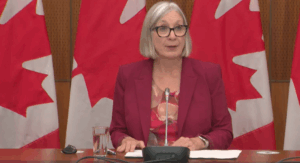
A month later, Minister of Jobs and Families Patty Hajdu announced Canada Post workers would be forced to vote on what Canada Post called its “final offers.” Though Hajdu had previously asked the parties to draft terms for binding arbitration, Canada Post requested the federal government put the corporation’s offers up for a vote instead, because arbitration would be “too slow.”
The move was criticized by major unions like CUPE.
“Once again, the Liberals are putting their thumb on the scales in collective bargaining and siding with the employer,” said CUPE National president Mark Hancock. “Would a Conservative government under Pierre Poilievre act any differently? Probably not.”
Workers rejected the offer, with nearly 70% of posties in both the urban and rural bargaining units voting against it.
At the end of September, the Minister of Government Transformation, Public Works and Procurement, Joël Lightbound, announced the government would be implementing all of the recommendations from the IIC report — at least, the ones that are within the government’s direct power to carry out.
Daily door-to-door delivery for residential addresses and the moratorium on rural post offices would both be coming to an end, and a postage increase would be on its way.
Canada Post workers hit the picket lines in a surprise strike escalation just hours after the federal government announced massive cuts to the postal service.
I break down what the government is planning and what some CUPW members think about the proposed changes for @pressprogress.ca
— Emma Arkell (@emmaarkell.bsky.social) September 26, 2025 at 2:11 PM
Within hours, CUPW was back on the picket line across the country. Nicole Chouinard, president of CUPW Local 812 in Prince George, BC, told PressProgress that workers felt “extremely frustrated” after hearing the government’s announcement.
“The fact that their way to save money involves getting rid of a whole bunch of our jobs is insulting,” she said.
After over two weeks on the picket line, postal workers reduced the full work-stoppage to a rotating strike, and then paused that when an “agreement in principle” was announced on November 21.
Flight attendants fight back
Air Canada flight attendants had been in bargaining for eight months when membership voted 99.7% in favour of strike action on August 5. The following week, their union, CUPE’s Air Canada Component, issued a 72-hour strike notice.
The company responded with a lockout notice, began cancelling flights and asked the federal government to intervene in the dispute and send both parties to binding arbitration.
Just 12 hours into the strike, Minister Hajdu used Section 107 of the Canada Labour Code to order flight attendants back to work.
But this time, it didn’t go as planned. Flight attendants stayed on the picket line, becoming the first union to defy a strike-breaking Section 107 order.
I’m at Vancouver Airport where CUPE’s Air Canada Component is picketing.
Air Canada flight attendants are still on strike, defying a back-to-work order from the federal government.
— Emma Arkell (@emmaarkell.bsky.social) August 18, 2025 at 2:51 PM
CUPE National president Mark Hancock told reporters he was willing to go to jail to defend the flight attendants’ right to strike.
The union’s refusal to back down to government and company pressure led to renewed bargaining, and days later, a tentative agreement was reached.
Polling data showed the flight attendants’ fight against unpaid labour struck a chord with the public.
Air Canada flight attendants resoundingly rejected the tentative agreement, and will begin arbitration hearings in early 2026.
The future of Section 107 remains unclear. On the one hand, the Canada Industrial Relations Board dismissed CUPW’s Canada Industrial Relations Board challenge of the Section 107 order. (CUPW is also seeking judicial review of the order in Federal Court.) On the other hand, NDP MP Leah Gazan tabled a bill to repeal the section from the Canada Labour Code.
Carney’s budget hints of further interference
Prime Minister Mark Carney’s budget forecasted potential changes to the collective bargaining regime for public servants.
Alongside cutting 40,000 public service jobs over the next five years, the budget proposes amendments to the Federal Public Sector Labour Relations Act to “ensure the government can attract and retain the necessary public service talent” while respecting the government’s “fiscal circumstances.”
Budget 2025 singles out adjustments to the “collective bargaining dispute resolution framework,” but is light on specific details. Nathan Prier, president of the Canadian Association of Professional Employees, told PressProgress the government hasn’t provided the union with any clarification on what those changes could look like.
“So it’s obviously not good news,” said Prier. “We’re not anticipating that these will be progressive changes by any means.”
Alberta and Quebec: “Hold my beer”
Not content to let the federal government have all the fun, a couple of provincial governments got in on the strike-breaking action.
In Alberta, Danielle Smith and her United Conservative Party (UCP) sent 51,000 striking teachers back to work after just over three weeks on strike. To do that, the UCP passed the Back to School Act, also known as Bill 2, at 2 a.m. local time with the help of the notwithstanding clause, which overrode the teachers’ right to strike.
Alberta’s leading labour organization has vowed retaliation against the government.
On the other side of the country, Francois Legault’s Coalition Avenir Québec (CAQ) government has spent 2025 passing a number of pieces of legislation targeting unions and the right to strike.
Law 14, which came into force on Nov. 30, allows the government to suspend the right to strike or lock out to ensure services guaranteeing the population’s “social, economic or environmental security” are not disproportionately affected.
The CAQ also recently tabled Bill 3, which would split union dues into “principal” dues and “optional” dues. Unions could draw from only their optional dues to fund legal cases that don’t directly concern a collective agreement or condition of employment.
Labour Minister Jean Boulet singled out a teachers’ federation’s Supreme Court challenge of Quebec’s secularism law, when discussing the bill.
All of these stories are still developing: postal workers and Air Canada flight attendants are still without new contracts, tens of thousands of federal public servants are in bargaining and Quebec’s labour movement is just beginning to contend with Legault’s labour law assault.
Even Alberta’s teachers, who are back at work with a contract that was forced on them, are moving forward with a legal challenge that could topple the Back to School Act.
Maybe 2026 will be the year we finally reckon with the federal government’s use of Section 107, and the provinces’ adoption of increasingly aggressive legislation, to end strikes and lockouts.
Our journalism is powered by readers like you.
We’re an award-winning non-profit news organization that covers topics like social and economic inequality, big business and labour, and right-wing extremism.
Help us build so we can bring to light stories that don’t get the attention they deserve from Canada’s big corporate media outlets.
Become a member
 @emmaarkell.bsky.social