

BC’s Longest Nursing Strike Ends After Mediators Step In
Their recommendations include sending the union and employer into binding arbitration over wage increases.
The longest nursing strike in BC history and the first Canadian union-led provincial nursing strike in decades came to an end last week, after recommendations put forth by government-appointed mediators were accepted by the BC Nurses’ Union.
After three weeks of nurses refusing overtime and non-nursing duties and rotating picket lines outside hospitals in the Lower Mainland and Vancouver Island, all job action was halted as of midnight on July 24.
But a new contract has yet to be negotiated, and several steps remain before ratification can take place.
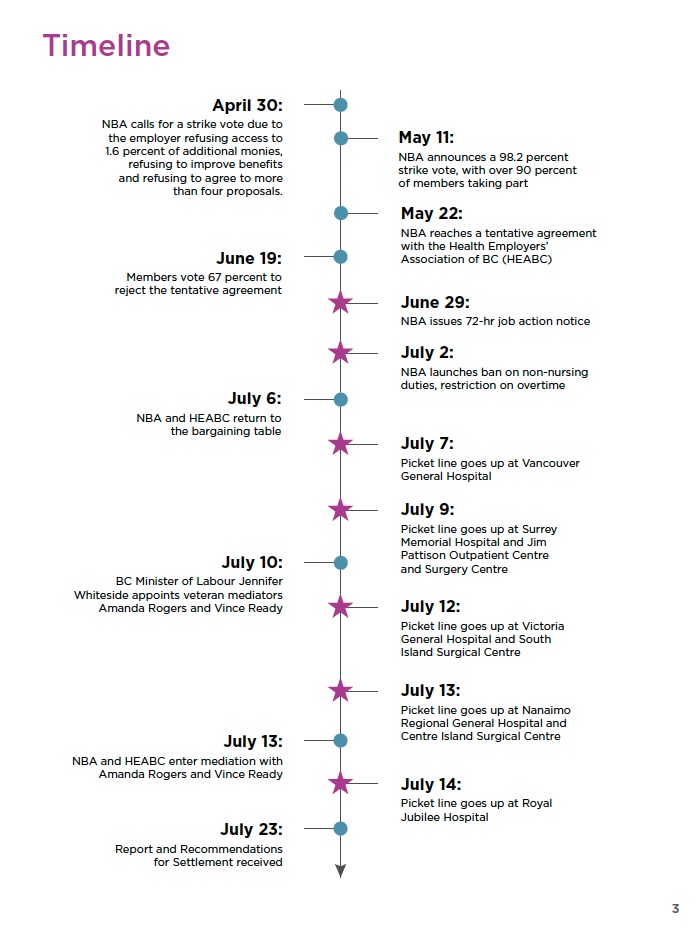
Timeline of job action included in mediators’ recommendation report shared with BC Nurses’ Union members
In the mediator’s report, reviewed by PressProgress, special mediators Vince Ready and Amanda Rogers addressed a lasting “stalemate” over wage increases for nurses in their next contract.
While the employer representing the government’s mandate stands firm at a maximum 14% wage increase over four years — the same amount that was ratified in contracts for 125,000 other public sector workers in the province, after BC General Employees’ Union strike last year — the Nurses Bargaining Association is seeking a 32% increase over four years.
The nursing union is also seeking a $5,000 signing bonus for new nurses, and “a reduction in the steps in the wage grid” so that workers can reach their top salary in the wage grid within five years instead of 10.
“The differences between the Parties with respect to wages and compensation are greater than 100%,” Ready and Rogers wrote. “Neither party has offered any indication they are prepared to soften their position – both sides seem intractable on the issue of compensation.”
Read also:
- ‘I’m Not Optimistic’: First Canadian Nursing Strike in Nearly Three Decades Under Way in BC
- ‘It’s an Extremely Physical Job’: BC Nurses Could Vote to Strike over Possible Cuts to Health Benefits
As a result, the mediators put forth a firm recommendation for the parties to enter a voluntary binding interest arbitration process with Rogers and Ready.
If this were to be declined, “the government may take the steps necessary to end the dispute by legislation,” their report warned.
The “me-too” clause
The employers’ position is based on the existence of a “me-too” clause, which requires that any wage increases for nurses that exceed the amounts agreed to for other public sector unions would then have to be offered to those other unions.
This would create a “major financial impact on the government totaling billions of dollars given that it would have to extend comparable increases to all public sector workers covered by these me-toos,” according to the report.
However the “me-too” clause cannot be triggered for wage increases that are “awarded through binding interest arbitration,” meaning that if nurses do win higher salaries through arbitration, this would not automatically apply to other public sector unions.
In an interview with PressProgress, Adriane Gear, president of the BCNU, addressed the fact that going into arbitration, which would pause the application of this “me-too” clause, removes a significant barrier for the union.
“It doesn’t guarantee an outcome for us, but what it does do is it removes the constraints that we’ve been basically running up against in the 10 months that we’ve been bargaining,” Gear said.
“It is our best chance to have our compensation considered based on the merits of what we’re arguing.”
Both the union and the employer have accepted the mediators’ recommendations.
But not everyone is pleased with an arbitration process that would disregard the “me-too” clause.
“That outcome would be fundamentally unfair to HEU members,” wrote Lynn Bueckert, Secretary Business Manager of the Hospital Employees Union, in a statement.
“HEU members made real sacrifices throughout this dispute and deserve to be treated fairly. If this process results in additional wage increases for nurses, HEU will pursue every available option to ensure our members are not left behind.”
Sarah Kooner, president of the Health Sciences Association which represents 23,000 workers, also said this outcome is “deeply disappointing,” in a public statement.
“We don’t need a lopsided health care system, where one profession is given special treatment at the expense of all the others.”
Agreements address top two priorities for nurses
According to Gear, a survey of nurses after the initial tentative agreement was rejected in May showed that wage increases and benefits were the top two priorities for the 25,000+ union members who responded.
Nurses who talked to PressProgress during and prior to the three-week-long strike said the reason they had voted against the tentative agreement, which led to the job action in the first place, was due to significant cutbacks to their employer-paid benefits package.
They said they were faced with a contract that removed their unlimited paid massage and physiotherapy, as well as entering nurses into a joint benefits trust that could require them to co-pay, or make partial payments for their benefits at some point.
According to this report, both the union and employer agreed to a new memorandum of agreement on July 7, about a week before mediators stepped in, to guarantee that all payments into this joint benefits trust would be made by the employers, not employees.
“People don’t trust the [joint benefits] trust, they don’t trust the employer,” Gear said. “What we were able to do on that is achieve some improved language that makes it very clear that a co-pay cannot happen unless both parties [the employer and the union] agreed and directed the trustees to do it.”
The other agreement in this memorandum is to guarantee double the regular rate of pay for nurses who work overtime.
“What we were able to achieve was that if you work a 12-hour shift or a 10-hour shift — anything over eight hours — those first two hours, instead of being paid at time and a half, would be would be paid at double time, and then what happens after two hours is it’s all double time,” Gear said.
However this provision will not kick in until April 2028, “because we didn’t get any more money to do it, and it costs money,” she added.
Other recommendations
For the mediators’ part, in addition to recommending binding arbitration on the heated topic of wage increases, they also addressed the issue of what constitutes “non-nursing duties”, as well as workplace violence reports.
During the job action, the union directed nurses across the province to refuse overtime and to stop performing tasks that they deemed to be “non-nursing” duties, like delivering meal trays and lab samples, consolidating patient prescriptions, and portering patients around the hospital.
There are currently over 5,200 formal complaints before the BC Labour Relations Board, all from nurses alleging that they were “intimidated, coerced and threatened” by their managers when they refused these tasks, according to the mediators’ report.
In mediation, the employer “fundamentally disagrees that the disputed tasks can be properly characterized as non-nursing – whether during or outside of job action – stressing that nurses’ scope of practice and job description includes all of these duties,” reads Ready and Rogers’ report.
The mediators stated that this is “not a one-size fits all” issue and recommended the BC Ministry of Health undertake a review of what nurses currently do, and what can be done to make sure they spend the majority of their time taking care of patients.
They also recommended the health ministry do a study to identify where nurses are at most risk of violence and how more security guards — called Relational Security Officers (RSOs) by the province — could be implemented to reduce the risk of workplace violence.
According to the report, in spite of the fact that the province hired 320 extra security guards in 2022, bringing the total to 780 guards working full-time across the province, about 46 nurses a month still suffer injuries while at work in BC.
The union sought security guards for every healthcare facility in the province, but all parties recognized that “introduction or expansion of uniformed security personnel may raise concerns arising from historical and current experiences with health services, policing and other public institutions” specifically in Indigenous communities and for marginalized populations.
The mediators’ recommendation on addressing workplace violence involves asking the ministry to also seek input from these latter groups during their study.
For next steps in coming up with a new tentative agreement for nurses, with wage increases as a priority, the binding arbitration process is slated to begin this fall.
Our journalism is powered by readers like you.
We’re an award-winning non-profit news organization that covers topics like social and economic inequality, big business and labour, and right-wing extremism.
Help us build so we can bring to light stories that don’t get the attention they deserve from Canada’s big corporate media outlets.
Become a member
 @brishti.bsky.social