

‘I’m Not Optimistic’: First Canadian Nursing Strike in Nearly Three Decades Under Way in BC
After first week of job action, union considers expanding picket lines to more hospitals
BC Nurses Union leadership is considering expanding picket lines to healthcare facilities beyond the Lower Mainland, after nurses escalated job action by picketing outside Vancouver General Hospital (VGH).
Union president Adriane Gear told PressProgress that the bargaining unit was in talks with the employer until midnight on Monday, with talks expected to resume midweek.
“I would say that conversations were very respectful and productive to some extent. However, the employer has been really clear that they can’t move beyond the mandate that the government determines,” Gear said.
“I’m not optimistic. This will require some government intervention, I think.”
The vast majority of nurses represented by the BCNU — about 55,000 — have been refusing to perform non-nursing duties since July 2, while nurses at VGH have been outside holding the picket line since Tuesday.
According to the union, full fledged strike action will expand to Surrey Memorial Hospital and the Jim Pattison Outpatient Care and Surgery Centre on Thursday.
I’m at the BC Nurses’ Union picket line in front of Vancouver General Hospital. Nurses across the province are currently engaged in a work-to-rule strike, refusing overtime and non-nursing duties.
@pressprogress.ca
— Emma Arkell (@emmaarkell.bsky.social) July 7, 2026 at 8:04 AM
This is the first time nurses have gone on strike in British Columbia since 1989, and the first province-wide nursing strike anywhere in Canada since nurses in Saskatchewan and Newfoundland and Labrador went on strike in 1999.
According to a timeline from the CFNU, the BCNU strike represents the first indefinite strike from a provincial nurses union in decades.
“What BCNU is doing now is telling the Premier and Minister of Health, ‘It is not working at the bargaining table… you need to step in,’” said Linda Silas, president of the Canadian Federation of Nurses. Silas flew to Vancouver to join the picket line at VGH on Wednesday morning.
“[Our role] is to put pressure nationally, and all the provinces and territories are looking at what’s happening in BC.”
Between last Thursday and Monday, Gear said the union had received over 1,400 formal complaints from nurses who alleged that managers have been pressuring them to continue to perform non-nursing duties.
“A lot of [managers] are saying to nurses, ‘If you don’t do it, I’m going to report you to the College [of Nurses and Midwives]… you’re not meeting your practice standards, you’re abandoning patient care,’ or as bold as ‘I’m going to have you fired,’” Gear said.
“We’re identifying different fact patterns, and we’ve made emergency applications to the BC Labour Relations Board.”
This pattern of intimidation, though not present at every healthcare facility, has been widespread enough for the union to discuss a strategy to expand strike action to other facilities.
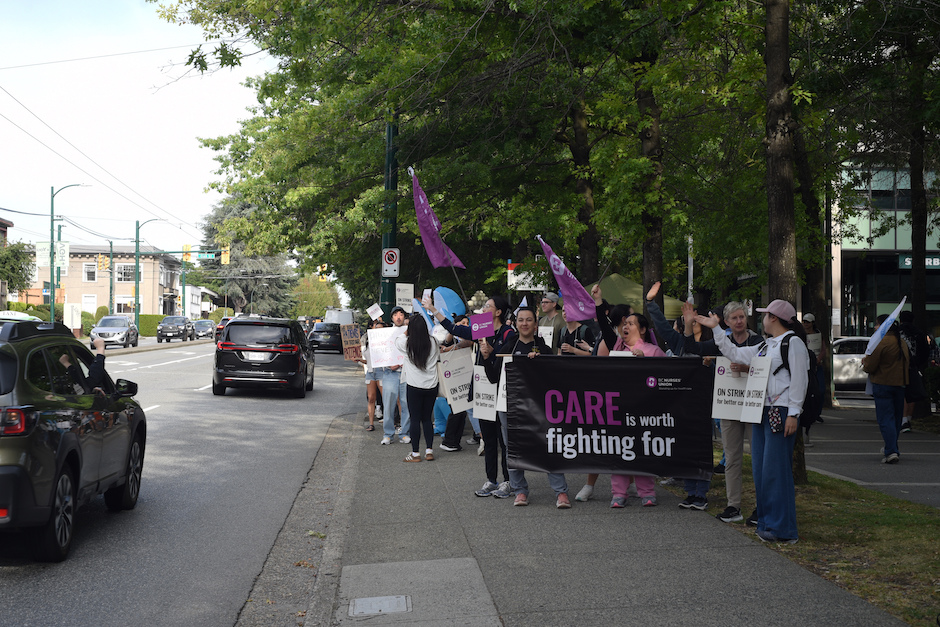
BC Nurses picketing at VGH
Image credit: Emma Arkell
The provincial government has yet to speak to the union regarding the ongoing strike action. Neither Premier David Eby, nor health minister Josie Osborne responded to questions from PressProgress prior to publication.
The main sticking point
The union issued a strike action notice last week after the majority of its members — 67% — rejected a tentative agreement reached by the union and employer in May.
The agreement was penned after the union took a strike vote in which over 50,000 nurses voted 98.2% in favour of job action, following bargaining talks that have been ongoing since summer 2025.
“We were pretty much expecting a really good contract, and then we got the tentative agreement for ratification and it’s very basic,” said Rachel, a nurse who works at a facility in the Lower Mainland whose name has been changed upon request, to prevent potential backlash from her employer for speaking to media.
“They are still trying to take away our unlimited massage and they’re also getting rid of our employer-paid benefits and entering us into a joint benefits trust.”
A joint benefits trust is the same type of benefits package that had been problematic for 21,000 other healthcare workers who, among other jobs, support seniors and people with mental illnesses and addictions, said BCGEU president Paul Finch when speaking to PressProgress during bargaining talks last summer.
Nurses at the time also told PressProgress that employer-paid benefits are crucial to keep intact if the province wants to retain workers and reduce turnover rates. According to Gear, there are between 4,500 to 6,000 permanent nursing roles unfilled at any given time across BC, meaning nurses on the job are constantly working short-staffed.
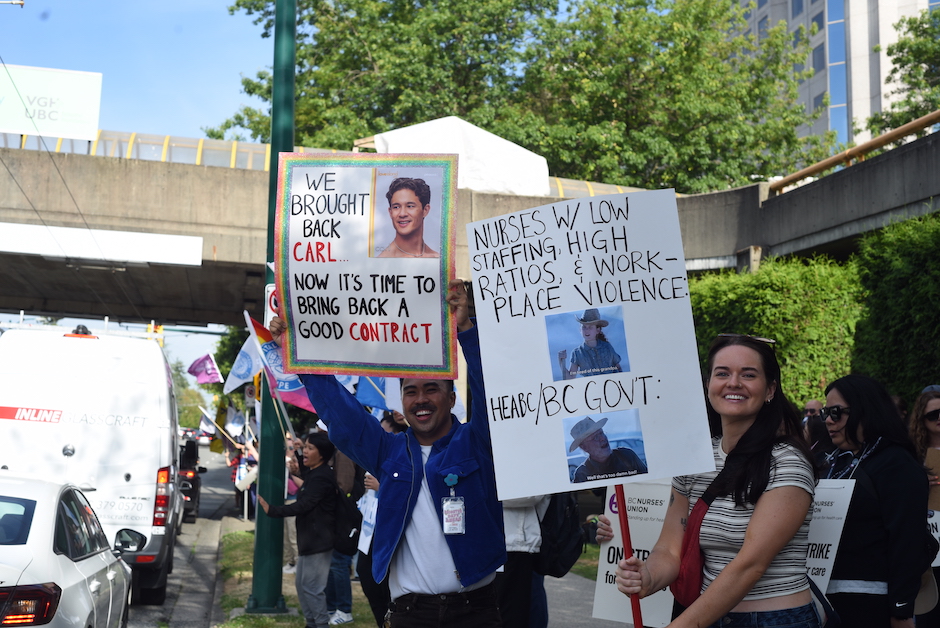
BC Nurses picketing at VGH
Image credit: Emma Arkell
“I voted no [to the tentative agreement] because I was not comfortable with the change in benefit plan to a joint co-pay benefit plan,” said Kat, a Victoria-based nurse who also spoke to PressProgress last summer.
“I’m not happy about the cut to unlimited massages. I would only take that much of a cut if I got a substantial increase in mental health benefits.”
Gear said the union is aware of these challenges, but said the bargaining unit has done as much as possible to mitigate nurses’ concerns.
“I can tell you that for nurses they’re not trusting of the [joint benefits] trust the way it’s been set up…the bargaining team does believe that we’ve mitigated any possible risks,” Gear said during a press conference on June 29th.
“However, for our members, they’re not convinced. They do want to see increases to their benefits, but they would prefer I would say a defined benefit as opposed to a defined contribution model, and so that’s where we are with that.”
Job action trials and tribulations
As part of the job action across BC, nurses are refusing overtime work and declining non-nursing duties like delivering meal trays, consolidating patient prescriptions, portering patients around the hospital, and delivering lab samples.
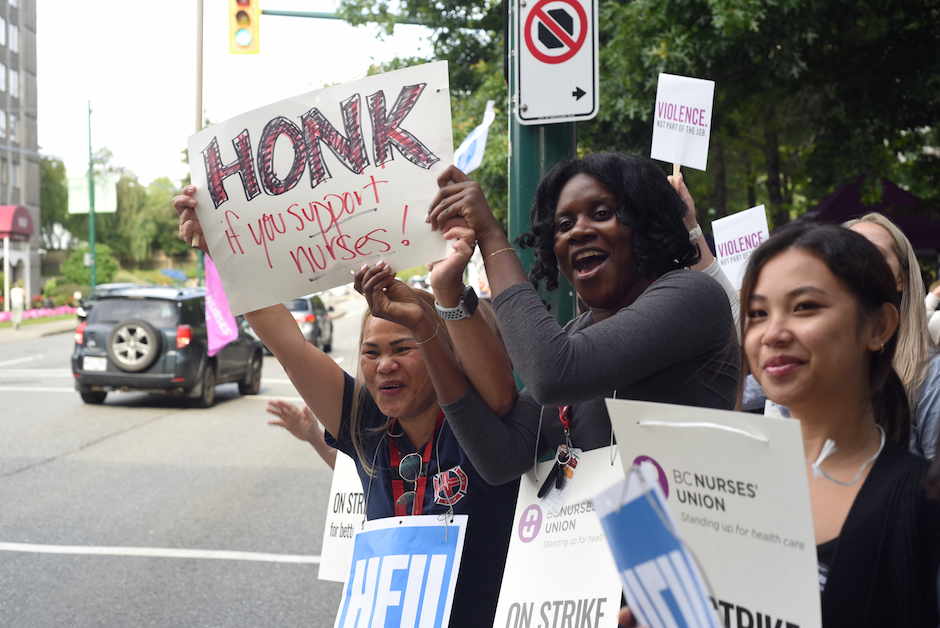
BC Nurses picketing at VGH
Image credit: Emma Arkell
For Rachel, who works in the Fraser Health authority, the transition has been smooth.
“While work is still stressful, it has been nice focusing only on my nursing duties. It has been also nice seeing bewildered looks on people’s faces as they figure out how to do things we have always done without question,” she said.
“I remain grateful for really good management on my floor.”
Kat’s experience at a Vancouver Island Health authority hospital, on the other hand, has not been as fortunate.
“The last three days at work have been so disheartening and just really soul crushing to realize how much the employer does not care,” she said. “We are getting pushback from multiple levels of management, both social work management and nursing management, despite the union saying that’s not our job.”
It’s not just management pushing back against nurses abdicating their usual non-nursing tasks.
Kat described one incident while heating up her lunch in a microwave used by the health administration team, when she overheard that team “complaining loudly” about patients going to them for help when nurses refused to register them and said that is the administrators’ job.
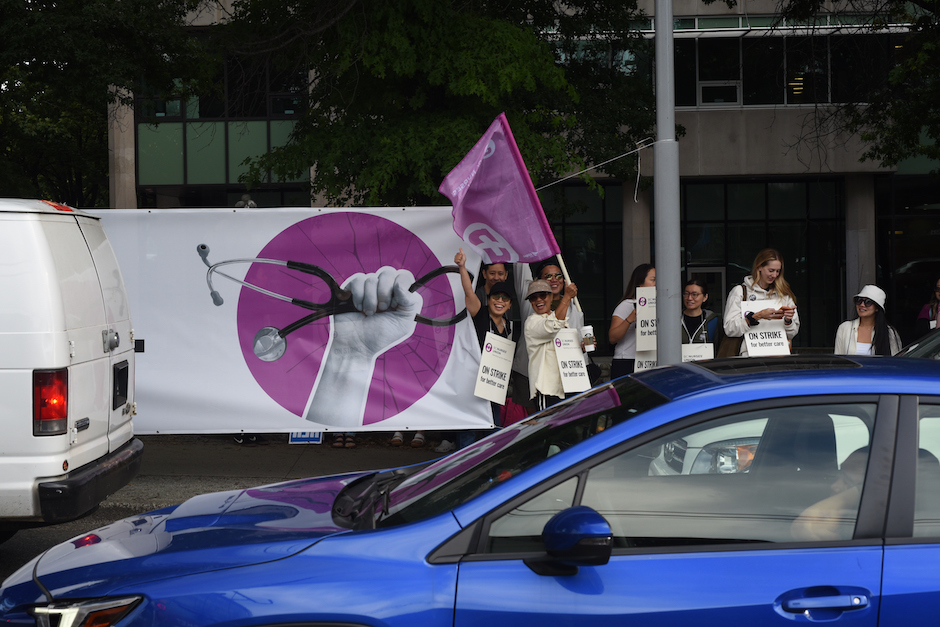
BC Nurses picketing at VGH
Image credit: Emma Arkell
“These clerks are getting really mad and saying it’s not fair for the patients, but that’s the whole point of the strike and job action, is to make everyone recognize how much nurses are doing,” she said.
“But unfortunately that’s resulting in a lot of delays in care and a lot of frustration.”
Tensions at town halls
For Kat and Rachel, it seemed like union leadership did not anticipate that members would reject the tentative agreement last month, illustrated by what Kat said is a lack of clarity regarding what exactly constitutes “non-nursing duties.”
“I emailed [the union] once, four weeks ago. I emailed them just before the strike announcement. I emailed them 27 hours into the strike announcement, and I only just got a response from a steward this afternoon,” Kat said during an interview on Monday.
“My questions were pertaining to nursing roles versus non-nursing roles, because it’s not super black and white. Some stewards on the ground told me, ‘Anything you need a BSN degree to do, you can do, but anything else don’t do’; whereas another union steward said, ‘Continue most of your job as usual,’ so it’s been very inconsistent and confusing.”
At the same time, both nurses expressed their frustration with the way BCNU CEO Jim Gould tried to get members to vote yes on the now-rejected tentative agreement.
“Our chief arbitrator, Jim Gould, has been talking down towards us during the ratification town halls,” Rachel alleged in an interview last month. “He’s gone on record saying that we would be ‘fucking stupid’ to vote this down.”
“It was being presented in a very condescending and coercive way, with [Gould] talking to nurses like they’re in grade five, and saying, ‘We think this is going to be the best thing for you, and it’s going to be really silly to vote no on this, because you could lose everything,’” Kat said.
Addressing this frustration, Gear stood by Gould, stating she has not heard him swearing at town halls, and that he has a difficult job to do.
“The role of chief negotiator is a tough one, and I think, yeah maybe his style isn’t everyone’s cup of tea,” Gear said. “But at the end of the day, he’s a person with a lot of integrity, and I feel the nurses are in a way better situation having him on our side.”
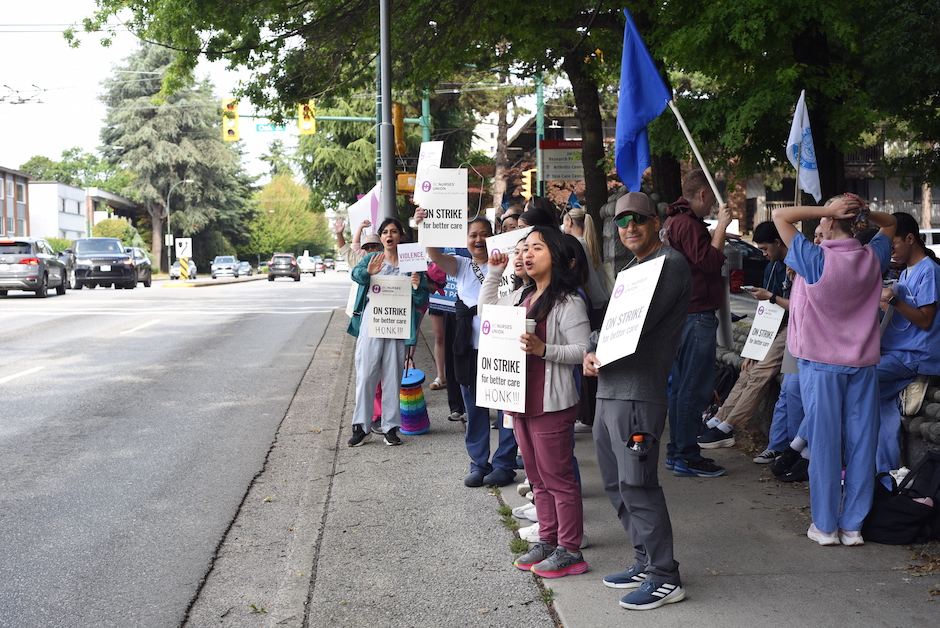
BC Nurses picketing at VGH
Image credit: Emma Arkell
For Rachel and Kat, the job action has overall been a welcome move to show the province that nurses stand united against unstable workplace conditions that have been deteriorating since at least the COVID-19 pandemic.
“I reflect on all the fantastic nurses I know who never made it back to the profession after stress or injury leaves,” Rachel said.
“I think of all the nurses who quit within five years because the pressure becomes too much. I do this for them.”
Update:
After publication, BC Health Minister Josie Osborne provided a statement to PressProgress.
“Progress has been made at the bargaining table on important issues this week, but substantial gaps still remain,” Osborne said.
“The Health Employers Association of BC is ready to return to the table at any time and it’s our expectation that they will continue to work with the union to reach an agreement that is fair for nurses and sustainable for the public health-care system they support.”
Our journalism is powered by readers like you.
We’re an award-winning non-profit news organization that covers topics like social and economic inequality, big business and labour, and right-wing extremism.
Help us build so we can bring to light stories that don’t get the attention they deserve from Canada’s big corporate media outlets.
Become a member
 @brishti.bsky.social