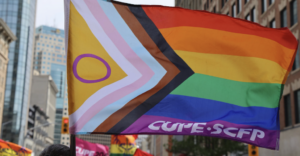

Oxfam Canada Workers Pushing to Include Policies to Support 2SLGBTQ+ Workers and Domestic Violence Survivors in Collective Bargaining
Policies protecting the rights of 2SLGBTQ+ workers have recently gained traction in public sector unions
Carla Caxaj and her coworkers at Oxfam Canada didn’t expect to spend so much of their time at the bargaining table arguing for paid leave for workers pursuing gender-affirming care.
Caxaj, a monitoring, evaluation and learning officer at Oxfam Canada and a member of the bargaining committee, is one of nearly 60 Oxfam Canada workers who has been on strike since June 11.
Alongside higher wages and a cost of living adjustment, workers are fighting for policies that support 2SLGBTQ+ workers and survivors of domestic violence — issues that are more recently becoming incorporated into collective agreements.
“We work on these issues with communities around the world, and we want to be able to apply what we are working on and advocating for externally to our own membership as well,” Caxaj told PressProgress.
Oxfam workers in Toronto and Ottawa, represented by CUPE 2722, have been in bargaining with the organization for over a year.
Caxaj said that the union has bargained for a number of policies that ensure the rights of 2SLGBTQ+ workers.
One such policy is an expanded definition of family that goes beyond biological or legal ties. She said this policy would not only benefit members of the 2SLGBTQ+ community, but also Oxfam Canada employees who have come to Canada as refugees who have ‘chosen families’ in their new home.
She said this policy would also have implications for workers who need to take caregiving leave for someone who isn’t their biological relative.
Additionally, Caxaj said the union is asking for an additional 10 days of paid leave for workers who are undergoing any form of gender-affirming healthcare, and an additional 5 days of leave for those impacted by domestic violence.
In a statement posted on June 15, Oxfam Canada wrote that their bargaining proposal “preserves the generous benefits package currently in place” which includes up to 72 days of paid leave a year.
“Our Collective Agreement includes a range of paid leaves – such as compassionate leave, sick leave, and special leave – that staff can access when they need time off for a range of personal needs, including gender-affirming care, experiences of domestic violence, and diverse family responsibilities.”
But Caxaj said Oxfam Canada is including things like paid vacation and statutory holidays in their count of paid time off. She said Oxfam Canada has told the bargaining committee that the organization isn’t looking to expand on their leave policies, and that workers can access existing leave options if they need time off.
“We don’t feel that any person who’s going through any of these situations should have to use up those things for these types of conditions and situations,” said Caxaj.
Oxfam Canada declined to answer questions about gender-affirming care provisions and directed PressProgress to the organization’s public statement.
Lily Chang, the secretary-treasurer at the Canadian Labour Congress (CLC) and the lead officer of the CLC’s human rights department, told PressProgress that it’s generally considered best practice to have different paid leaves set aside for specific purposes.
“It is less likely for an employer to be able to deny [the leave request] based on what they think is important, whether they think your personal situation fits with the intent of a leave,” said Chang.
Naseeb Bolduc, a senior officer in the human rights branch at CUPE National, told PressProgress that comprehensive leave policies with time dedicated for gender-affirming care acknowledges that workers are multi-faceted, and prevents workers from having to use vacation time, sick leave or even bereavement leave when trying to access gender-affirming care.
“Someone could experience an illness, and then months later undergo gender-affirming care, and they shouldn’t have to choose which of those two they can allot their dates too,” said Bolduc.
Gender-affirming healthcare encompasses a range of procedures, including hormone therapy and surgery. Recovery time for surgery varies depending on the type of procedure.
Chang said that policies ensuring the rights of 2SLGBTQ+ workers have gained a lot of traction in the past decade, especially in public-sector unions like CUPE and the Public Service Alliance of Canada. These policies have gradually grown out of unspecified unpaid leave policies that allowed workers to request paid time off for a variety of reasons.
Though these policies are less common in the private sector and in workplaces without unions, Chang said some companies have taken it upon themselves to adopt progressive policies in order to attract and retain workers.
“They know that if they want to attract good quality candidates, that they need to provide these kinds of policies as well,” said Chang.
Both the CLC and CUPE have published guides for workers who are looking to enshrine policies respecting the rights of women, 2SLGBTQ+ and gender-diverse workers in their collective agreements.
Bolduc creates these resources as part of her role at CUPE. She said one of the challenges that workers in bargaining may face is dispelling the misconception that domestic violence isn’t a workplace issue.
In 2014, the CLC and Western University’s Centre for Research and Education on Violence Against Women and Children undertook a survey that found 1 in 3 Canadian workers has experienced domestic violence in their lifetime. Over 80% of those who have experienced domestic violence said that it negatively impacted their work.
“Employment is such a huge part of everyone’s lives, it provides income security, physical safety, and social connectedness that ultimately creates a pathway to leave a violent situation,” said Bolduc. “So it absolutely should be in a collective agreement.”
CUPE also has a bargaining guide for writing policies about domestic violence in collective agreements.
Another misconception that workers may encounter in bargaining is the idea that very few workers will be impacted by these policies, or that certain workforces don’t require policies that affirm the rights of women and the 2SLGBTQ+ community.
“That way of thinking also doesn’t leave open the possibility that someone is in the process of self discovery or someone simply hasn’t come out yet,” said Bolduc.
At the union’s 2025 biannual convention, CUPE delegates voted in favour of updating educational materials and workshops on “understanding the defending Two Spirit, trans, and gender diverse worker issues.” Bolduc is currently working on an updated version of CUPE’s bargaining guide for 2SLGBTQ+ inclusive policies, Bargaining Beyond the Binary.
She told PressProgress that the shifting political climate has meant spending more time focused on how collective agreement language can protect against hate and discrimination.
“It’s unfortunate that it has to be this way, but since the first version of this guide came out, context has changed, obviously, so we’re also thinking about anti-harassment and protections for workers who may experience violence in the workplace on the basis of their gender identity,” said Bolduc.
Chang said the strike at Oxfam is about bringing working conditions at the organization in line with its progressive public image.
“This is not about asking Oxfam to invent any new rights, it’s about closing the gap,” said Chang. “It’s about making sure that the rights that are being afforded in other progressive workplaces are also being provided at Oxfam.”
Our journalism is powered by readers like you.
We’re an award-winning non-profit news organization that covers topics like social and economic inequality, big business and labour, and right-wing extremism.
Help us build so we can bring to light stories that don’t get the attention they deserve from Canada’s big corporate media outlets.
Become a member
 @emmaarkell.bsky.social