
BC Health Experts Say the Province Has Solutions to the Toxic Drug Crisis. 10 Years In, Policies Still Ignore The Evidence.
“We have this bizarre dichotomy where everybody agrees that this is a health issue, but the majority of the resources…goes to law enforcement.”
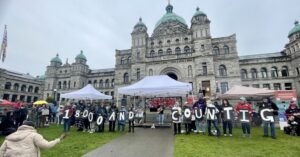
The rain picked up and died down at various points during the two-hour-long event outside Victoria’s BC legislature building on Tuesday afternoon. But the crowd gathered there remained steadfast throughout.
Around 200 doctors, nurses, advocates, people who use drugs and those who have lost loved ones to unregulated toxic street drugs showed up to mark the 10-year anniversary of BC declaring a public health emergency, after a spike in overdose deaths when fentanyl entered the street-drug market.
That declaration in 2016, by former Provincial Health Officer Dr. Perry Kendall, was unprecedented in Canada and was made after 474 people died from using toxic drugs in 2015.
Last year, nearly four times as many people lost their lives to unregulated street drugs. In total, over 18,000 people have died in BC in the past 10 years.
The public health emergency declaration allowed the province to set up frameworks for researching this crisis and programs to support people who use drugs, like the Take Home Naloxone program, drug-checking services, overdose prevention sites and limited prescribed safer-supply programs.
When the research showed a clear need to step away from criminalizing drug use, BC piloted a three-year program to decriminalize personal possession of small amounts of illicit substances — but quickly ended its support for it after a moral panic induced by misleading media and predominantly right-wing political rhetoric.
Now, the same experts the provincial government turned to for evidence-based solutions to this healthcare crisis are calling them out for policies that continue to ignore the evidence.
- Read also: The Far-Right’s Newest Scapegoat: ‘Drug Users and Unhoused People’
- Read also: No, BC Liberals: Kids in British Columbia Can’t Buy Drugs From ‘Vending Machines’
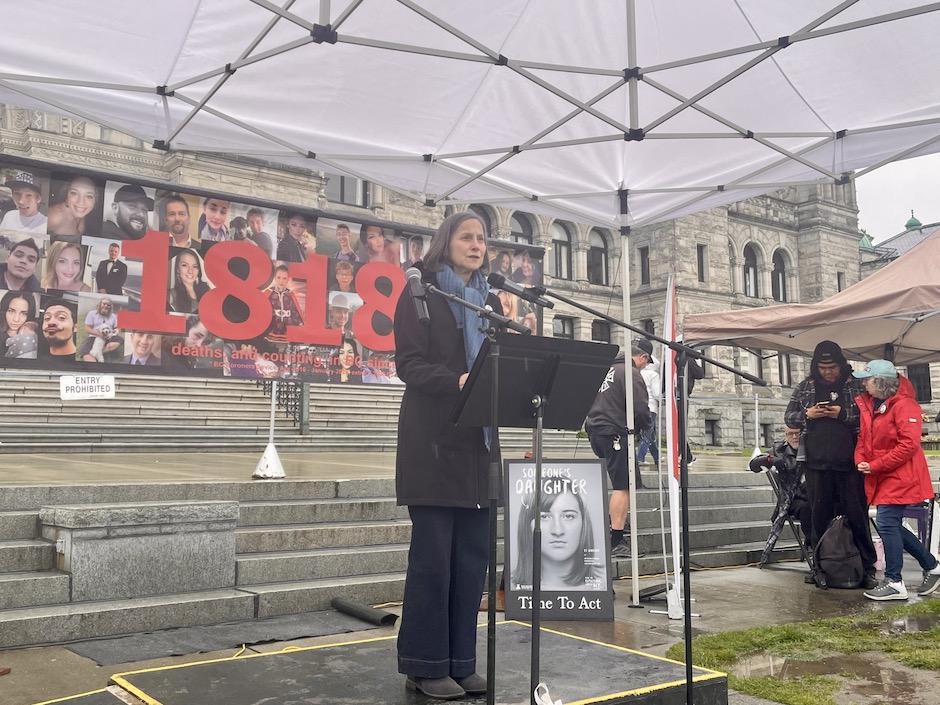
BC’s former chief coroner, Lisa Lapointe, speaking at the event. Lapointe served in that role for 13 years before stepping down in 2024. Photo credit: Brishti Basu
“The evidence-informed innovations that we really need, that will actually reduce the dying and reduce the significant harms that are being experienced, really haven’t been supported by the government to any meaningful level. It’s been very frustrating,” said BC’s former chief coroner, Lisa Lapointe, in an interview with PressProgress.
“We have this bizarre dichotomy where everybody agrees that this is a health issue, but the majority of the resources, the financing, the attention, goes to law enforcement, and that’s one of the huge challenges.”
Province’s actions “challenging and disappointing,” says top health officer
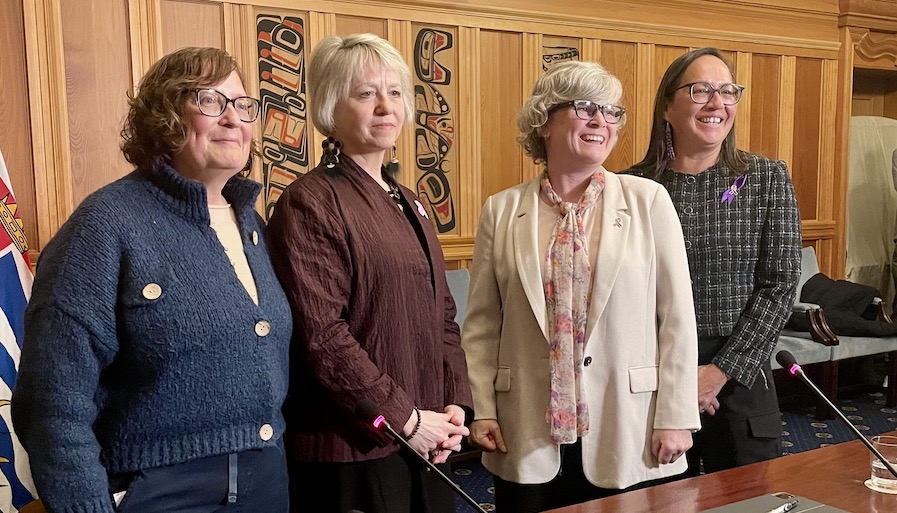
[Left to right:] Dr. Bernie Pauly (scientist with CISUR), Dr. Bonnie Henry (provincial health officer), Dr. Nel Wieman (chief medical officer at First Nations Health Authority). Photo credit: Brishti Basu
The same sentiment was stated by BC’s current Provincial Health Officer, Dr. Bonnie Henry, at a press conference on Monday, in conversation with Health Minister Josie Osborne.
“It is challenging and disappointing,” Henry said, when asked about the province walking back support for decriminalization and other recommendations, like expanding the province’s safer supply or prescribed alternative to street drugs program, that she has made in the last decade.
“I absolutely believe there was political pressure, and it disturbs me immensely to see some of the political rhetoric that was used to demonize people who are most marginalized in our community.”
In January this year, health minister Osborne said the province would not extend its decriminalization pilot project.
A year prior, the province ended its program that allowed people who use drugs to take home prescribed opioids, like hydromorphone, instead requiring them to take those pills in front of a pharmacist, citing concerns raised by Conservative politicians that these pills were being diverted.
This is in spite of documents from the BC Supreme Court case against a Vancouver compassion club, the Drug User Liberation Front, which showed that BC’s Ministry of Public Safety and Solicitor General had noted in budget-preparation documents that hydromorphone accounted for just 0.3% of the drugs seized by the Vancouver Police Department in 2023, as reported by Filter Magazine.
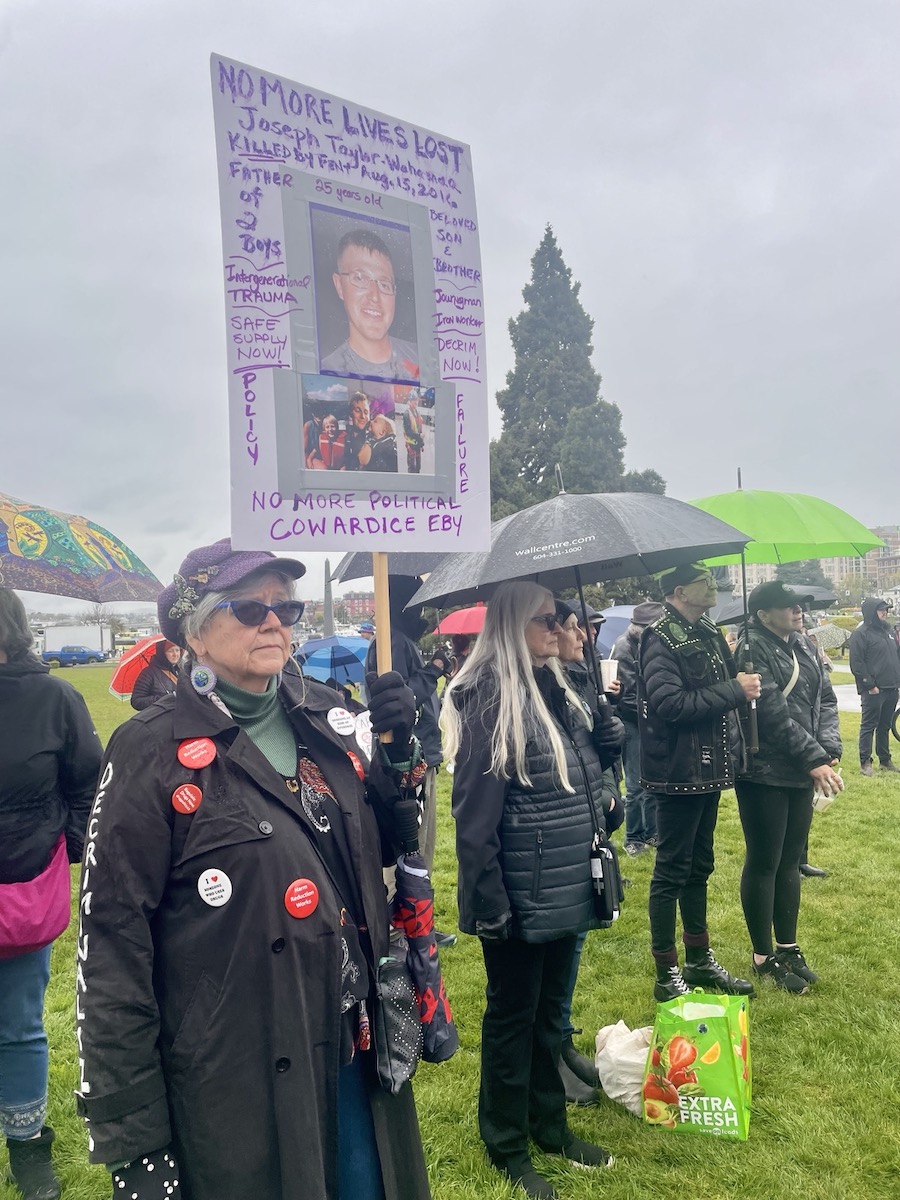
Over 18,000 people have lost their lives to poisoned street drugs in the last 10 years in BC. This poster, and others like it, dotted the lawn outside the BC legislature on Tuesday. Photo credit: Brishti Basu
At one point, in between speeches and music at the legislature event on Tuesday, the moderator — nurse, researcher and advocate Corey Ranger — asked folks to say out loud the names of their deceased loved ones. For two minutes, the air was rent with voices from the crowd, as people called out in remembrance.
Minister Osborne made an appearance at the event, as did Victoria municipal councillors and Mayor Marianne Alto.
“Over the last 10 years, our government has taken many different actions, building out a continuum of supports and services, right from early intervention and prevention through to harm reduction, treatment and recovery,” Osborne had said at the press conference the day before.
“We know that it is not enough, and that there is more work that needs to be done to build this out.”
BC Premier David Eby was inside the parliament building at this time, introducing legislation that, if passed, would ratify a long-negotiated treaty with the K’ómoks First Nation on Vancouver Island.
As of Wednesday afternoon, the premier has yet to make a statement about the 10-year anniversary of this public health emergency.
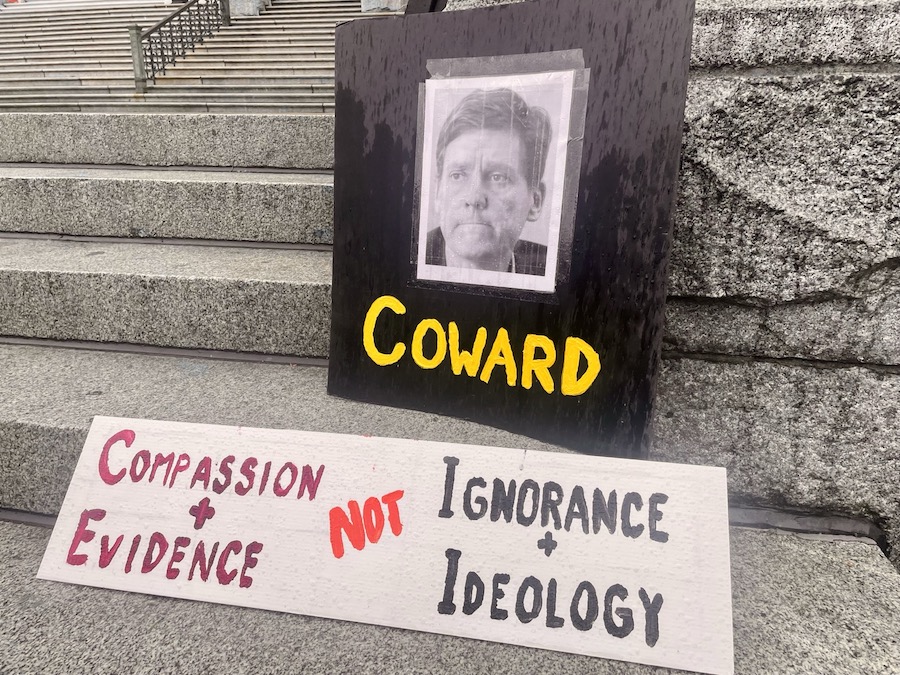
A poster depicting frustrations aimed at Premier David Eby, who was not present at the event.
Photo credi: Brishti Basu
On the lawn outside the parliament building on Tuesday, Eby was present in posters drawn by attendees who were frustrated with his government’s recent priorities towards people who use drugs — like opening new involuntary-treatment facilities inside prisons and issuing guidance that allows doctors to force medication on youth under 19.
As noted by experts both inside the legislature on Monday and those speaking at the event outside on Tuesday, there is no evidence to suggest that forced treatment — which is already more prevalent in BC than anywhere else in the country — actually works.
Canada’s federal health minister has also said she does not believe involuntary treatment is the “way to solve the problem” of addiction, but will not intervene.
“The general public and some politicians want to fall back to enforcement, as if that has been a very useful tool. It has never been a useful tool,” said Lapointe, who served as chief coroner in BC for 13 years before stepping down in 2024.
“We have to move away from this abstinence-or-nothing belief, because it really isn’t realistic… It’s about supporting people in their health, and then hopefully, over time, with the right supports and the right medications, they will move towards abstinence.”
Hard data: harm reduction saves lives
At the press conference on Monday, Dr. Nel Wieman, chief medical officer at the First Nations Health Authority (FNHA), talked about a meeting about a year ago in which an Indigenous man asked her, “Why don’t you ever talk about the number of lives that have been saved because of harm-reduction programs and services?”
“We took that advice to heart,” Wieman said. “We engaged with the BCCDC, we did a modeling study.”
According to this BC Centre for Disease Control (BCCDC) model, she said, harm reduction services like take-home naloxone, opioid agonist therapy (OAT) programs, overdose prevention/supervised consumption sites and naloxone programs had been responsible for reversing 2,650 overdoses among First Nations people between January 2018 and December 2023.
There were 1,836 lives lost among the same demographic in that time period.
In a statement last year, the FNHA had also attributed a decrease in toxic drug deaths among First Nations people in 2024, as compared to 2023, to harm-reduction efforts.
“We know when we add that layer of cultural safety, of anti-racism, of services being Indigenous-led, people feel comfortable coming forward,” Wieman said.
“People feel comfortable getting trained in how to use naloxone. When we work with our partners to increase the number of prescribers, people come forward to seek the services they need.”
In general across the province, BCCDC modelling estimates that 46,300 overdoses were prevented by harm-reduction initiatives like the naloxone program, supervised consumption sites and OAT between January 2019 and April 2025.
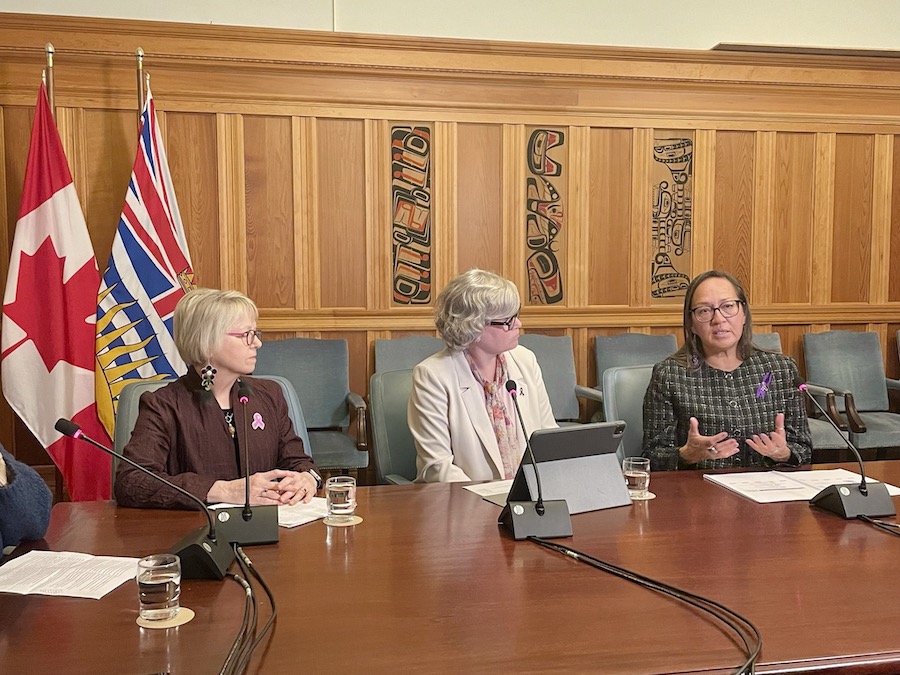
Dr. Nel Wieman discussed BCCDC modelling data that proves Indigenous-led harm reduction initiatives prevented thousands of overdoses. Photo credit: Brishti Basu
Much-needed hospital overdose prevention sites on pause
As the toxic street-drug supply gets increasingly contaminated with benzodiazepines and tranquilizers like medetomidine, the efficacy of naloxone, which only works on opioids, diminishes.
At the same time, harm-reduction interventions — like much-needed overdose prevention sites at hospitals, where the need for them was determined by the province until the government changed its mind and scrapped the project abruptly before implementation — remain on pause.
“It’s really unclear to us as physicians what kind of a position we would be putting potential patients in if we were to open unsanctioned overdose prevention sites [now], in terms of legality,” said Dr. Jess Wilder, former lead of Nanaimo Regional General Hospital’s addictions medicine department.
Wilder is also a co-founder of Doctors for Safer Drug Policy, a group of physicians on Vancouver Island who set up unsanctioned, volunteer-run overdose prevention sites outside two hospitals where they had been originally planned by the province.
These sites were opened periodically over the last two years before BC’s decriminalization pilot project ended. Even under decrim, doctors in Victoria faced local police officers who instructed them to take their tents down.
“We knew that when we were there, people chose to use them rather than using [drugs] alone, which shows us that this is a service that would be accessed and would save lives,” Wilder said.
Our journalism is powered by readers like you.
We’re an award-winning non-profit news organization that covers topics like social and economic inequality, big business and labour, and right-wing extremism.
Help us build so we can bring to light stories that don’t get the attention they deserve from Canada’s big corporate media outlets.
Become a member
 @brishti.bsky.social