

Alberta Won’t Budge on Charging Indigenous People for COVID Vaccines
Though health advocates argue the province's $100 fee amounts to a treaty violation, the federal government rebuffed a request to step in, pointing out it's still free on reserves
Last June, Alberta’s United Conservative government announced that most people in the province would have to pay for a COVID-19 vaccine in the coming immunization season. Very few Albertans — including seniors in supportive-living situations and people who are immunocompromised — would be exempt from the new $100 “administrative” fee.
After union advocacy, healthcare workers and teachers were subsequently added to the fee-exempt list.
But the financial barrier to accessing the vaccine has remained in place for most members of one vulnerable group in Alberta: Indigenous people.
First Nations, Métis and Inuit people are some of the priority groups most strongly recommended to receive COVID-19 vaccines, according to guidance from Canada’s National Advisory Committee on Immunization (NACI).
But they have not been included in Alberta’s list of groups exempt from the $100 fee, a barrier that has reduced the total number of doses administered in the province by nearly half this season, compared to last.
- Read more: Most Albertans Will Soon Have to Get Out Their Wallets for COVID Shots
- Read more: Number of COVID-19 Shots Delivered in Alberta Drops By Half, Following $100 Fee and Other Restrictions
Instead, the province points out that on-reserve clinics run by the federal government continue to offer vaccination at no charge. However, according to census data, the majority, or nearly 64%, of First Nations people with registered or Treaty Indian status in Alberta don’t live on reserve.
Back and forth between province and feds
Chris Gallaway, executive director of Friends of Medicare, was among the advocates who wrote to provincial and federal authorities asking them to remove this access barrier last fall.
“We believe it’s incumbent on us to point out that Alberta’s current approach to immunization violates the Treaty 6 Medicine Chest Clause and the Treaty Right to Health,” Gallaway wrote to the Alberta and federal health ministers in October. “Neither of your governments should allow policies that perpetuate systemic racism in our healthcare system.”
An unnamed representative from the “Executive Correspondence Unit” of Canada’s public health agency (PHAC) responded “on behalf of” federal Health Minister Marjorie Michel, stating that when federal funding for COVID-19 vaccines ended, so too did the federal government’s role in their distribution.
Adriana LaGrange, Alberta’s Minister of Primary and Preventative Health Services, also replied to Gallaway later that month, stating that decisions about the COVID-19 vaccine fee were made to “ensure long-term sustainability, reduce waste, and use taxpayer dollars responsibly,” and emphasized that “Indigenous Services Canada will not charge for COVID-19 vaccines when clients present for immunization through their on-reserve clinics.”
The advocacy group then turned to the federal Indigenous Services Minister, Mandy Gull-Masty, penning a similar letter in November. They received a response in December from the department’s medical officer of health in Alberta.
“I recognize that these changes, including the introduction of an administration fee, have raised significant concerns among First Nations leadership, health partners, and community members,” Dr. Christopher Sarin wrote.
“Many Chiefs have communicated their strong opposition to the change and its potential impacts on access and vaccine confidence.”
The letter went on to state that the Alberta office of Indigenous Services Canada (ISC) had repeatedly emphasized to the provincial government’s Primary and Preventative Health ministry — a new department fragmented from the province’s overall health ministry last year — “the importance of addressing barriers to vaccines and the need for decisions to be grounded in public health evidence.”
But because provinces and territories have sole jurisdiction over vaccine delivery, ISC Alberta and PHAC defer to the UCP government’s policy.
“Despite the recent policy shift, it is important to note that all individuals, regardless of
residency, may continue to receive COVID-19 vaccines at on-reserve health centres,
where First Nations have continued to report steady or increased uptake following the
provincial changes,” Sarin added.
In response to questions from PressProgress, ISC said in a statement that they had “received numerous inquiries from First Nations leadership, organizations and other Indigenous partners from all Treaty areas regarding the Province of Alberta’s changes to the COVID-19 vaccine eligibility criteria. On reserve, our priority is to offer vaccines to eligible individuals at no charge.”
Concerns about fees, they said, should be directed to the province.
‘As soon as they hear there’s a cost, they think they can’t get it’
Dr. Lana Potts, who is a family doctor from Piikani Nation in southern Alberta and founder of Aisokinaki primary care clinic, said she was immediately concerned that the $100 vaccine fee contradicts First Nations peoples’ treaty right to health.
“In working with communities and working with a lot of First Nations people, there’s a mistrust generally of healthcare systems, a mistrust of especially new systems and vaccines, because previously, vaccines have been tested on First Nations people in residential schools,” said Potts, who co-founded a national initiative to promote COVID-19 vaccine education among First Nations people when the vaccine was first introduced.
She said she was “very shocked” that First Nations people were not exempted in Alberta’s plan.
Anecdotally, Potts said she has heard Indigenous people are not going out of their way to access a free vaccine on reserve because they are not aware that it would in fact be free.
“As soon as they hear there’s a cost, they think they can’t get it, and not all of them are seeking out that second layer of information that, ‘Yes, I might be eligible,’ ‘Yes, maybe I can go here,’” she said.
Minister LaGrange did not respond to questions from PressProgress.
The Indigenous Wellness Core of Alberta Health Services also did not respond to a request for comment. Primary Care Alberta said they did not have a spokesperson who could speak to the topic and referred to information on the Alberta government website.
PressProgress also reached out to a number of clinics in Calgary and Edmonton that offer culturally specific healthcare to Indigenous people. Workers at two of the four clinics we contacted spoke off the record about their awareness of advocacy efforts against the COVID-19 vaccine fee for First Nations people off reserve, but declined to comment further or be quoted in this article for fear of backlash from the province.
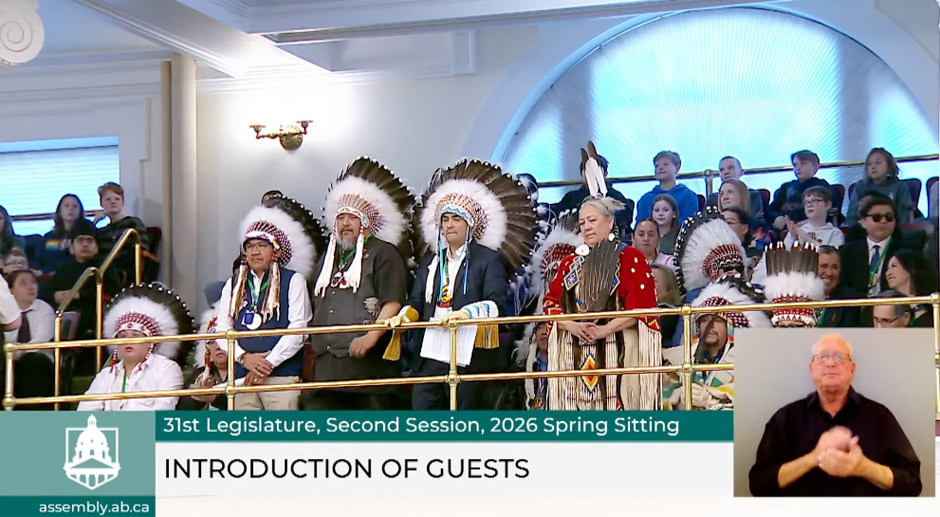
Treaty Chiefs attended the Alberta Legislature on Monday in support of an NDP non-confidence motion in the UCP government, which followed the chiefs’ own vote of non-confidence in the government late last month. (Screenshot via the Legislative Assembly of Alberta on YouTube.)
Earlier this week, dozens of First Nations chiefs and peoples attended the Alberta legislature to back a non-confidence motion against the UCP government from NDP Opposition leader Naheed Nenshi. The Assembly of Treaty Chiefs of Treaty No. 6, Treaty No. 7, and Treaty No. 8 had unanimously passed their own vote of non-confidence in Alberta’s government late last month, citing its “continued failure to meet Treaty-based constitutional and governance responsibilities.”
According to the latest guidance from NACI for 2025-26, Indigenous people in Canada are at higher risk of severe COVID-19 illness despite being a younger population than other demographics, due to “intersecting health determinants” including “social, environmental, and economic factors, rooted in historic and ongoing colonization and systemic racism.”
For Potts, there is a definite need for more advocacy surrounding access to COVID-19 vaccines for Indigenous people, at all levels of government.
“The stories of community are not always filtered to the top, and the reality that people are facing in the community around accessibility to healthcare is still not well known,” she said.
“It is the federal government’s responsibility to provide healthcare to First Nations people — that’s a part of what was decided in the treaties around what they would provide. They’re not always doing it [according] to what the needs are.”
Our journalism is powered by readers like you.
We’re an award-winning non-profit news organization that covers topics like social and economic inequality, big business and labour, and right-wing extremism.
Help us build so we can bring to light stories that don’t get the attention they deserve from Canada’s big corporate media outlets.
Become a member
 @brishti.bsky.social