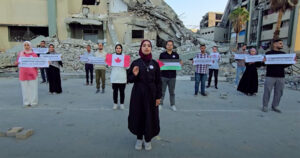

More Than 100 Gazans Have Been Accepted to Canadian Universities. Canada Isn’t Letting Them In.
See a map of the graduate programs they're planning to attend, if the government finally processes their visas
Despite a UN report and multiple human rights organizations stating Israel has committed genocide in Gaza, advocates are accusing the federal government of stalling on providing student visas for people from or currently in the region.
Graduate students living in or originally from Gaza have been stuck in limbo waiting for the government of Canada to approve their visas, in some cases for well over a year. One group says these wait times are evidence of a “systematic bias” against Palestinians.
The Palestinian Scholars and Students at Risk Network (PSSAR) is an advocacy group speaking on behalf of these students who have been unable to get their visas approved.
In a statement, Immigration, Refugees and Citizenship Canada (IRCC) told PressProgress part of the reason behind the delays was the lack of biometric data provided with these applications. (Typically, a visa application requires biometric data — a photo and fingerprints — to get processed.) IRCC added that they understood that some students were experiencing longer processing times for study permits, but prospective international students must still meet all visa requirements, including biometrics and a security screening by a third party.
Making this a more complicated process however, IRCC said biometrics can only be submitted after people leave Gaza, because IRCC has no presence there. Nada El-Falou, director of student services at PSSAR, affirmed this.
“What people used to do was cross over to Egypt, to Cairo, where there is a centre, or sometimes to Jordan as well,” said El-Falou. “However, since early 2024, the Rafah border between Gaza and Egypt has been completely shut down, and so these students have not been able to leave Gaza to provide their biometrics.” (There are indications that the crossing could soon reopen to some extent.)
Even with biometric data, El-Falou said some students were still having difficulties getting their visa applications approved. El-Falou said some people in Gaza provided their biometrics a long time ago (biometrics are valid for up to 10 years), and while 30 students in Egypt have been able to provide biometric information, these applicants are still being subjected to the same delays.
El-Falou said the lack of biometric data is the easiest obstacle for IRCC to point at as a reason for these visa delays, but she thinks the answer goes beyond that. When bringing up the delayed visas that did include biometric data to the IRCC, El-Falou said they did not give PSSAR a straight answer.
“A lot of times they kept saying, ‘These applications must be non-routine’ and ‘Let me take a look at the application,’ but from where I stand, it cannot be a coincidence,” El-Falou said. “It is statistically almost impossible to me that this is a coincidence of all of these applications being non-routine.”
El-Falou said that the difference in wait times for Palestinian students compared to students from other countries was significant.
“Other applications submitted in the same office in Egypt are being processed between six to nine, maybe 12 weeks, while Palestinian applications are taking over a year and a half,” said El-Falou. “That’s not non-routine, that’s something systematic, a systematic bias against Palestinian students.”
On the IRCC government portal, you can check what it says are the current processing times to get a visa application approved. As of Jan. 27, the site says there is a four-week wait for student visa applications from India, and a five-week wait from Brazil and Russia, but — as with with many other countries — there is currently no stated processing time available for applications from Palestine.
A spokesperson said IRCC remains “deeply concerned about the ongoing situation in Gaza” and is committed to a “fair and non-discriminatory application of immigration procedures.”
In regards to there not being anywhere for biometrics to be collected, the spokesperson said IRCC understands that “this can be challenging for residents of Gaza, but these requirements are necessary to ensure the integrity of our immigration system and the safety of Canadians.”
PSSAR provided PressProgress with a dataset of 134 students they are aware of that are waiting for IRCC to approve their applications. The IRCC told PressProgress there are currently 150 study permit applications pending for people from Palestine (including both Gaza and the West Bank).
The records shared by PSSAR show that these students have been accepted into a wide range of programs at 26 universities across the country, but predominantly in STEM fields. These fields — engineering, computer science, mathematics, physics, etc. — have been designated as express-entry categories for working professionals, however this is does not extend to applications for study permits.
We’ve plotted the students on a map of Canada, by the location of their intended study, with information about the graduate programs in which they were accepted and where PSSAR’s records indicate they were residing as of mid-January:
PSSAR said that no biometrics exemptions were provided for students in Gaza, despite the fact that on September 16 of last year, the UN Independent International Commission of Inquiry on the Occupied Palestinian Territory, including East Jerusalem, and Israel reported that Israel had committed genocide against Palestinians in the Gaza Strip.
El-Falou said it was clear to her that IRCC has chosen to not make the visa process easier for these students by waiving the biometrics requirement, something that other countries have done. She said this is not the only action other countries have taken that Canada could replicate.
“The UK, Ireland, they have facilitated safe exit for residents who have secured scholarships and so on in their countries,” El-Falou said. “They help them with the overall process.”
This past fall, Italy also announced they would be establishing “university corridors” to allow Palestinian students who were offered scholarships to travel to Italy.
PSSAR held a joint press conference in early December about the permit delays for Palestinian students. Justice For All Canada, Independent Jewish Voices, professors from Carleton and the University of Ottawa, and Liberal MP Iqra Khalid took part in the press conference.
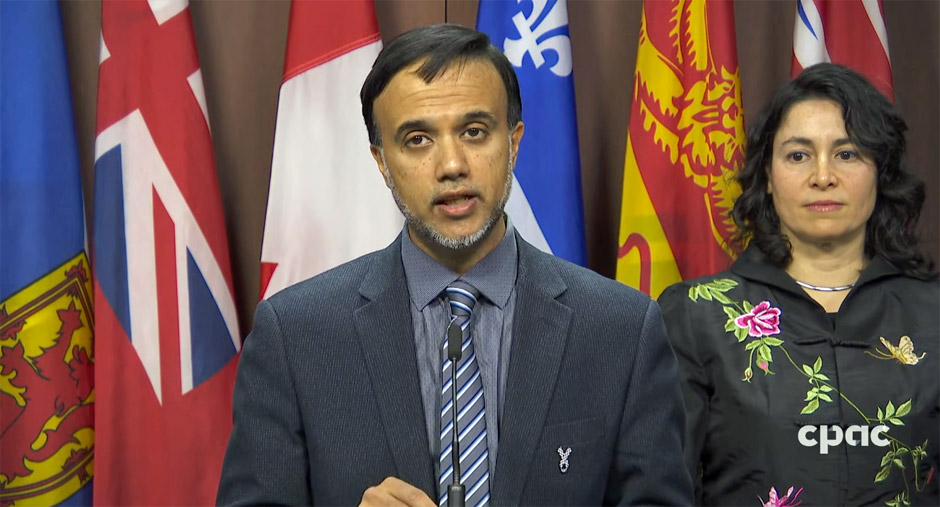
Taha Ghayyur, executive director of Justice For All Canada, was among the speakers at a press conference last month on Parliament Hill. (screencap via CPAC on YouTube)
Taha Ghayyur, the executive director of Justice For All Canada, referred to these delays as a “deliberate imposition of exceptional barriers on these students,” and referred to the decision to not implement an existing framework for exemptions offered to Ukrainians after Russia invaded their country.
“Today we remind the minister that the duty of the Canadian government to protect civilians facing mass atrocity is non-negotiable,” said Ghayyur at the press conference.
El-Falou said that if students can’t even get their visas to study in Canada, it doesn’t speak well of the government’s level of interest in offering other support to Gaza.
“I look back at it as a citizen and I think to myself, if Canada does not support this, what will Canada support?” said El-Falou.
El-Falou said that PSSAR, professors and academics met with IRCC to discuss the delayed visas and the safety of these students and that the response they received was concerning.
“IRCC’s response was that this is not a priority for them, point blank,” said El-Falou.
Our journalism is powered by readers like you.
We’re an award-winning non-profit news organization that covers topics like social and economic inequality, big business and labour, and right-wing extremism.
Help us build so we can bring to light stories that don’t get the attention they deserve from Canada’s big corporate media outlets.
Become a member
 @ericwickham.ca