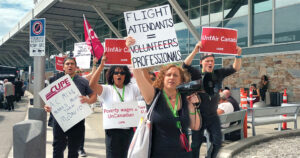

What Air Canada’s Flight Attendants Are Fighting For
Defying an order to end the strike, union president Wesley Lesosky proclaimed, "If we stick together, they can’t fire us all"
Over 10,000 Air Canada flight attendants across the country are on strike, defying an order from the federal government to return to their jobs.
Last week, the union representing flight attendants at Air Canada, CUPE’s Air Canada Component, issued a 72-hour strike notice after membership voted 99.7% in favour of strike action the previous week. Air Canada responded with a lockout notice and began cancelling flights the next day.
The company also requested that the federal government step in and send both parties to binding arbitration. After just 12 hours on strike, Minister of Jobs and Families Patty Hajdu did just that, utilizing section 107 of the Canada Labour Code to order flight attendants back to work.
The union has defied the government’s order and remains on strike. Here’s why flight attendants are striking and refusing to be forced back to work.
Why are flight attendants striking?
The dispute has brought to light major issues in how flight attendants are paid.
Flight attendants are seeking an end to mandatory unpaid work. According to CUPE, much of the work that flight attendants do before and after flights — safety checks, preparing the cabin, helping passengers, boarding and deplaning procedures — is not paid.
While workers in most industries are paid as soon as they report for duty or “clock in,” flight attendants are essentially only paid for the time that a plane is in the air.
The union is demanding that flight attendants receive a full wage for this currently-unpaid work, called “ground pay.”
On a Zoom call with CUPE’s Air Canada Component bargaining team on Sunday evening, union president Wesley Lesosky rejected a claim by Mark Nasr, Air Canada’s chief operations officer, that the issue of ground pay has been “settled.”
“I do want to confirm that there is no agreement on ground pay,” said Lesosky.
Another major sticking point is low wages.
According to CUPE, wages for entry-level flight attendants have increased by only $3/hour over more than 20 years, meaning that those workers earn just $27,000/year before taxes — below the federal minimum wage.

The Air Canada flight attendants’ strike got a mention on Last Week Tonight with John Oliver on August 17th (Borchard Entertainment / HBO).
At the meeting on Sunday evening, Lesosky told membership that the strike is also about the bigger issue of respect for workers.
“But it’s not just about unpaid work, wages, contractual entitlements, vacation days. It’s about respect as well,” said Lesosky.
The most recent, 10-year collective agreement between Air Canada and CUPE expired at the end of March. Negotiations began in December 2024, but after eight months, both sides said they remained far apart on the issues of wages and ground pay. Lesosky told CBC that Air Canada offered “nothing of substance” at the last bargaining session on Friday evening.
Air Canada has said its offer would make the company’s flight attendants “the best compensated in Canada.”
On August 13, the company announced it had requested “immediate intervention” by the Canadian government to order binding arbitration “before a work stoppage becomes effective.”
“The airline believes recent government interventions in rail, port and airline labour disruptions in Canada provide a proven precedent.”
Stephanie Ross, professor of labour studies at McMaster University, told PressProgress that the federal government’s track record of sending federally-regulated workers back to work during strikes and lockouts has undermined the collective-bargaining process.
She said that Air Canada has been “encouraged by the federal government’s pattern of intervention in labour disputes,” such that they’ve come to “expect that they won’t actually have to bargain seriously, because there’s a ‘Get Out of Jail Free’ card now, with the use of section 107.”
Section 107 empowers the labour minister (now known as the Minister of Jobs and Families) to refer questions to the Canada Industrial Relations Board or direct it to do things the minister thinks are necessary to “secure industrial peace.”
I’m at Vancouver Airport where CUPE’s Air Canada Component is picketing.
Air Canada flight attendants are still on strike, defying a back-to-work order from the federal government.
— Emma Arkell (@emmaarkell.bsky.social) August 18, 2025 at 5:51 PM
Hours after flight attendants began striking on Saturday at 12:58 am ET, Minister Hajdu announced that she had directed the CIRB to order them back to work and both bargaining teams to submit to binding arbitration.
“These parties have had months at the negotiation table. They’ve had support through the federal mediation service, and they have been unable to cross the finish line,” Hajdu said in a press conference on Saturday afternoon. “Arbitration is the most stable way to conclude this process for Canadians, while allowing parties to reach a deal.”
In a statement posted on X, CUPE said Hajdu’s back-to-work order is “crushing flight attendants’ Charter rights” by forcing arbitration. The union has applied to Federal Court for a judicial review of the order, requesting that it be stayed in the meantime.
This is the fourth time in a year that the federal government has used section 107 to end a strike or lockout and send workers back to their jobs. Last year, then-Minister of Labour Steven MacKinnon sent railway, longshore and Canada Post workers back to work during strikes and lockouts.
On picket lines across the country, flight attendants remained determined to strike.
“I don’t think anyone’s in the mood to go back to work,” Lillian Speedie, vice president of CUPE Local 4092, told CBC News Network at a picket line outside Toronto Pearson International Airport on Sunday. “To legislate us back to work 12 hours after we started? I’m sorry, snowstorms have shut down Air Canada for longer than we were allowed to strike.”
CUPE’s National President Mark Hancock – YYZ – August 16th 2025
— CUPE SCFP (@cupescfp.bsky.social) August 17, 2025 at 11:07 AM
On Sunday evening’s bargaining committee call, Lesosky told union members that the bargaining team was not willing to accept binding arbitration.
“At this stage of the game, we’re not willing to accept binding arbitration being ordered and rammed down our throat,” said Lesosky. “It’s just not something we’re willing to accept after 10 years of shitty conditions.”
The union president said that CUPE’s refusal to abide by the back-to-work order means that Air Canada needs to return to the bargaining table.
“We’re waiting diligently. You can see we’re all still in our hotel rooms here in Toronto for you to come back to the table, Air Canada, so we can bargain a collective agreement and our members can have a say.”
Lesosky also reassured union members that CUPE’s legal team will fight any terminations that happen as a result of the work stoppage.
“If we stick together, they can’t fire us all.”
What happens now?
On Monday morning, the CIRB ruled that CUPE’s refusal to abide by the back-to-work order was “unlawful.” The board ordered the union to end the strike and direct flight attendants to return to work.
On the picket line at Pearson, CUPE national president Mark Hancock tore up a copy of the board’s order. “This strike will end when we get a collective agreement that works for our members,” he told the crowd.
At a press conference, he confirmed that the flight attendants would remain on strike.
“If it means folks like me going to jail, then so be it,” said Hancock.
CUPE’s Mark Hancock is prepared to be jailed for defying the Carney government’s back-to-work order to force Air Canada to negotiate with flight attendants
“If it means folks like me going to jail, so be it…Our members want a solution here, but that solution has to be found at a bargaining table”
— Luke LeBrun (@lukelebrun.ca) August 18, 2025 at 12:55 PM
Our journalism is powered by readers like you.
We’re an award-winning non-profit news organization that covers topics like social and economic inequality, big business and labour, and right-wing extremism.
Help us build so we can bring to light stories that don’t get the attention they deserve from Canada’s big corporate media outlets.
Become a member
 @emmaarkell.bsky.social