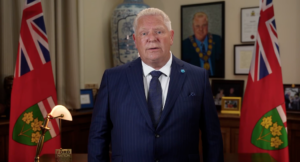

While Doug Ford’s Government Changes Eligibility for Social Assistance, Experts say Existing Programs are Failing Those in Need
“I think there's a real lack of political will with this government, because they see some people as undeserving of support”
While Doug Ford’s Government makes changes to who exactly is eligible to receive social assistance in Ontario, advocates are trying to draw attention to a larger issue: social assistance in Ontario is failing those in need.
Last Thursday, the province announced that individuals on student visas, temporary work permits and illegal immigrants would be ineligible for social assistance programs in Ontario.
But advocates say the province is missing the point when it comes to the real, structural issues with social assistance programs in Ontario.
“Social assistance is a last resort, and people who are facing tough times need a safety net to catch them and help them get back on their feet,” Robin Nobleman, staff lawyer at the Income Security Advocacy Centre (ISAC) – a legal clinic that fights on behalf of low-income people in Ontario – told PressProgress.
Nobleman said Ontario Works– one of the two social assistance programs offered by the province– fails at that task.
“Our clients consistently tell us they do not want to be on social assistance, it’s a dehumanizing way to live, and it’s impossible to get by,” Nobleman said.
Ontario Works gives a maximum benefit of $733 a month for a single person–a number that has not increased in eight years.
If rates kept in line with inflation, the maximum would be $902, an amount that would still be difficult to live on in 2026.
“I don’t think anybody on OW was ever, you know, doing well,” Joel Yinger of Waterloo Region Community Legal Services told PressProgress. “There’s the combined factors of rates stalling completely or growing at a snail’s pace, and then inflation.”
“If these two things become completely misaligned, then everyone who is on social assistance just gets stuck behind,” said Yinger. “I’d have to imagine this is the absolute worst it’s ever been.”
In a report published by ISAC earlier this year, 82% of respondents on Ontario Works said that they’ve noticed a significant decrease in what they’re able to purchase with their benefit because of inflation.
One respondent stated they had contemplated assisted suicide as a result of mental health struggles stemming from the lack of income support.
Some advocates think the province’s focus on eligibility for social assistance, rather than the inadequacy of the programs, is being done for political reasons.
“You’ll find the average Ontario citizen is much more concerned with immigrants stealing $733 a month than homelessness or housing,” said Ron Anicich – an activist who has spent years pushing the province to raise social assistance rates.
One obstacle advocates face is a public perception that people on social assistance are taking advantage of the program.
During his 2025 re-election campaign, in a bizarre clip, Doug Ford claimed Ontario Works recipients “sit on the couch and watch The Flintstones” instead of going out and finding work.
Doug Ford criticized for out-of-touch comments comparing Ontario Works recipients to lazy youths watching The Flintstones cartoons at home
Ontario PC leader said unemployed workers “sit on the couch and watch The Flintstones” instead of looking for jobshttps://t.co/ns9L10ts1X
— PressProgress (@pressprogress) February 11, 2025
However, according to ISAC’s report, Ontario Works recipients largely use their benefit to pay off housing costs, food and other necessities.
The ODSP ActionCoalition provided a dataset of the maximum amount a single recipient could receive on Ontario Works from 1994 to present day. This dataset began just before the 21.6% cut to social assistance by the Mike Harris Progressive Conservative Government in 1995.
When this data is set against the average monthly rent of a one-bedroom apartment in Ontario, the issue of the eight year rate freeze becomes more obvious, as housing costs began to skyrocket in 2018.
While the maximum benefit being much too low is a key issue with Ontario Works, there are other compounding issues with this program.
Nobleman said recipients who are employed are only permitted to make $200 a month while on Ontario Works–which is approximately 12.5 hours at minimum wage–before their benefit begins to be clawed back at 50% of their earnings.
Nobleman says this works against the province’s own goal of getting people back to work through Ontario Works.
“When that number was chosen in 2012, I believe that amounted to significantly more hours of work than it amounts to now,” Nobleman said. “It’s a really punitive system in that the more you work, the more is clawed back.”
Ontario Works also includes a shelter allowance. This allowance doesn’t come close to covering housing costs in 2026, and if an Ontario Works recipient becomes homeless while on the program, they lose access to this shelter allowance.
As a result, homeless recipients of Ontario Works actually receive less from the province than others.
“When you don’t have shelter, you don’t get the shelter allowance,” Nobleman said. “So it’s basically impossible to pull yourself up by your bootstraps– which this government seems to want people to do– because you have no savings, you have no money for first and last month’s rent.“
Ontario Works is one of two social assistance programs available for Ontarians, along with the Ontario Disabilities Support Plan (ODSP). While ODSP has a higher ceiling for monthly benefits and has recently had its rates increased to account for inflation, it is also much more difficult to obtain.
According to Nobleman, around one in two applications for ODSP are rejected. Many appeals are successful, but Nobleman says the people applying for social assistance are often unable to obtain legal representation for the onerous appeal process that could take upwards of a year to complete.
Those unable to successfully navigate the complicated process to get on ODSP often end up on Ontario Works, which has a much lower maximum benefit. It is also geared towards getting people back in the workforce, which is not a possibility for some recipients of Ontario Works.
“I think there’s a misunderstanding about who is on Ontario Works,” said Yinger. “A lot of people on Ontario Works probably should be on ODSP.”
65% of respondents on Ontario Works in ISAC’s report stated that a reason for them not being able to transition from the social assistance program back into the workplace was that they had “health/disability barriers to work.”
Nobleman says incentivizing people back into the workforce by keeping social assistance rates low is the incorrect approach, not just for people whose disabilities prevent them from working.
“The government has tried keeping rates low to push people into work, and the evidence is clear: that doesn’t work,” said Nobleman.
Nobleman said the province had planned to increase the number of people leaving social assistance for employment from 35,000 in 2019 to 60,000 in 2024. According to The Trillium, the government failed to achieve that target, with only 43,425 people leaving social assistance to employment last year.
“That just shows that what they’ve been trying all these years, keeping rates low, is failing,” Nobleman said. “And the research shows that higher rates help people stabilize their lives, and being on stable ground lets people climb out of poverty.”
To the frustration of advocates, solutions to the issues plaguing Ontario Works are evident and available to the province, there’s just one thing missing: political will.
“I think there’s a real lack of political will with this government, because they see some people as undeserving of support,” Nobleman said. “We see that in a lot of their comments in the media about being willing to support people with disabilities, but they say nothing about people on Ontario Works who have fallen on hard times.”
“What is the biggest crisis in our time? In my view, it’s the cost of living and how life is just becoming completely unaffordable,” Yinger said.
“It’s bad enough for people who do have jobs, imagine how it is for people who for whatever reason can’t work or are looking for work.”
Our journalism is powered by readers like you.
We’re an award-winning non-profit news organization that covers topics like social and economic inequality, big business and labour, and right-wing extremism.
Help us build so we can bring to light stories that don’t get the attention they deserve from Canada’s big corporate media outlets.
Become a member
 @ericwickham.ca