
‘Ludicrous’ Alberta-Ontario Pipeline Fuels Climate Anxiety as Wildfires Rage Across the Country
Experts say proposed Northern Shield Energy Corridor project presents numerous challenges.
Against the backdrop of summer heatwaves, hundreds of wildfires and Toronto claiming the title of worst air quality in the world, critics of Ontario’s latest pipeline announcement say the Northern Shield Energy Corridor project simply does not stand up to scrutiny.
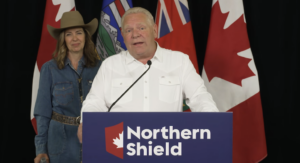
The proposed route for the pipeline expected to run between Alberta and Ontario was announced by Ontario premier Doug Ford and Alberta premier Danielle Smith earlier this month.
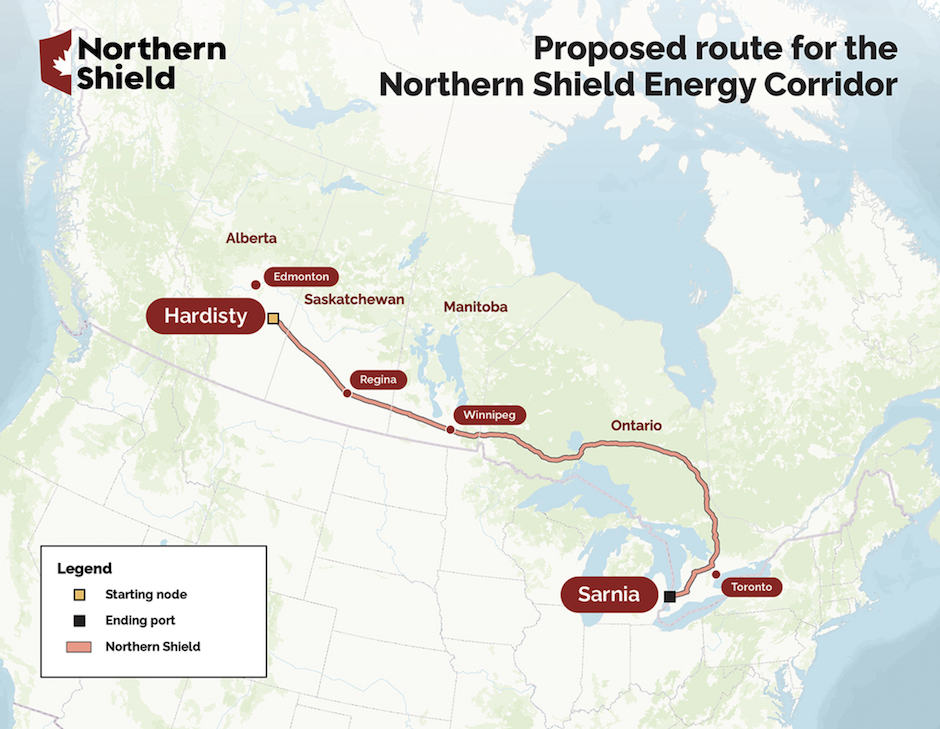
According to a three page brief released on the Government of Ontario’s website, the Northern Shield Energy Corridor will span 3,300km and connect refineries in Sarnia, Ontario to Hardisty, Alberta. A feasibility study for the project is currently underway.
“The proposed route is entirely within Canadian borders, bolstering energy security and unlocking opportunities to extend pipeline infrastructure across Canada,” reads the document.
Source: Government of Ontario
Hadrian Mertins-Kirkwood, a political economist at the Canadian Centre for Policy Alternatives, said the announcement of a 3000 km+ pipeline through the Canadian Shield was ‘ridiculous.’
“I was flabbergasted, I mean, it seems like such an absurd proposition,” Mertins-Kirkwood told PressProgress. “The more we’ve looked at it, other experts have looked at it, everyone seems to have reached that same conclusion: it’s a kind of a ludicrous idea.”
Given current climate realities, declining demand for oil in Europe and North America, and no private support to speak of, critics have expressed skepticism that this pipeline will even get built. As hundreds of wildfires currently between the two endpoints of the pipeline, they are also wondering whether the Canadian public will connect the idea that carbon emissions from non-renewable energy sources have increased the likelihood of wildfires across the continent.
The director of the oil and gas program at the Pembina Institute, Janetta McKenzie, told PressProgress that the Northern Shield Energy Corridor’s announcement was notably light on information.
“This Northern project has scant details, there’s no private proponent, there’s no cost estimate, there is a tentative route, but it’s so early in the process that obviously there’s very few numbers floating around,” said McKenzie. “If it went ahead, I cannot imagine oil going through that pipeline earlier than 2035.”
According to experts, there are a number of barriers and challenges both ahead of, and arising from the pipeline project.
Climate Change
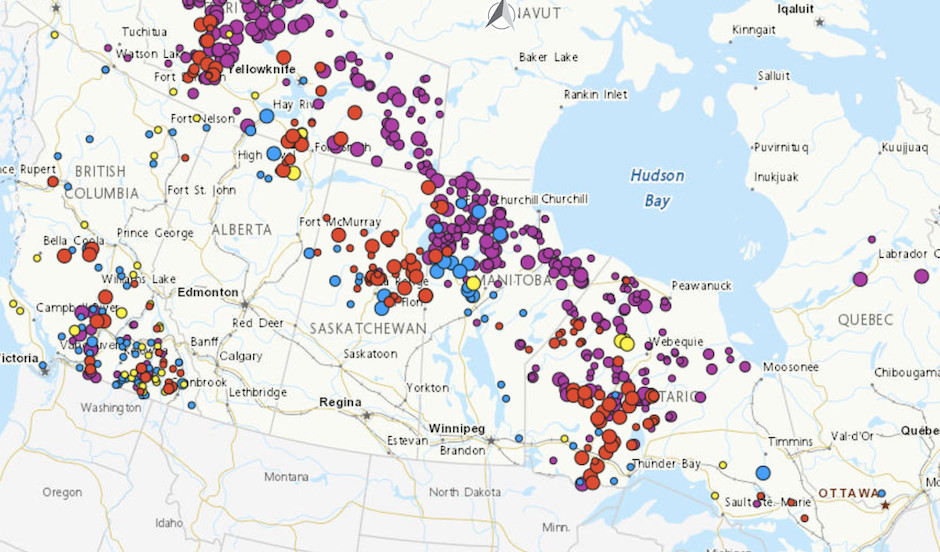
In the weeks following this pipeline announcement, Ontario has dealt with hostile environmental conditions stemming from heatwaves and wildfires–conditions that could be exacerbated by a pipeline.
The tentative route of the Northern Shield Energy Corridor through Northern Ontario appears to pass nearby locations currently experiencing several active wildfires.
Source: Government of Canada Canadian Wildland Fire Information System
“I would like to think that the most obvious argument against [building the pipeline] is the climate argument,” Mertins-Kirkwood said. “We should not be, and cannot afford to be– in light of the orange skies above us– doubling down on oil and gas production.”
If the Northern Shield Energy Corridor gets built, along with the West Coast Pipeline, the potentially revived Keystone XL pipeline and a number of other expansion projects on the table, McKenzie says there is only one way to ensure that these pipelines would be able to move enough oil to recoup their costs– increase oilsands production.
“All of these put together, if they go ahead, represent quite a lot of additional oil sands production,” said McKenzie. “And with that additional production comes rather a lot of greenhouse gas emissions.”
“Those emissions obviously contribute to the climate crisis and climate change, and some of the effects that Ontarians are seeing right now and feeling right now.”
Declining Global Demand for Oil
Mertins-Kirkwood said pipelines are incredibly risky investments because of how many decades they need to operate to break even. Forecasters are predicting a decline in global demand for oil beginning in 2030, and the fact this pipeline is years away from operating makes it even riskier.
“When we look at long-term forecasts for oil demand, the best case scenario for an oil producer is selling to Japan and Vietnam and India and stuff—hat’s theoretically where long-term oil demand is going to be,” said Mertins-Kirkwood. “Oil demand is already falling in Europe and in North America.”
Energy Security
The Ontario Government claims this pipeline would strengthen Canada’s energy security. But McKenzie said if energy security is the priority, then provinces are going about this the wrong way.
“The government of Ontario has noted that a lot of the oil that gets imported to Ontario comes from the United States or comes through the United States,” said McKenzie.“As we’re seeing globally, which may be a better path for Ontario, the best way to reduce your reliance on the volatile oil sector and on imports is to reduce your reliance on oil generally.”
Mertins-Kirkwood agreed.
“That’s how you have energy security in Canada: you build up electricity and you electrify everything we can: transportation, homes, industry, whatever,” said Mertins-Kirkwood.
McKenzie added that electrification could insulate Ontario from any energy security concerns coming through the United States.
No Private Interest
In addition to the likelihood that the announced project would not accomplish its stated goal and the general lack of detail, there were other fairly obvious issues with this announcement, including the fact the government has not secured any private interest in the project.
“Ultimately, the private sector is concerned about increasing returns and making money off of new projects,” said McKenzie. “So if they don’t feel there’s a good bet to do that or a good opportunity to do that, they’re not going to step up.”
McKenzie said that the lack of private interest raises some questions about this pipeline’s ability to make money, adding that the more expensive it is to build a pipeline, the higher the tolls will be to use it– making it less likely producers will want to ship their oil through this pipeline.
“So then it kind of calls into question again, who’s asking to build this pipeline at this point?” asked McKenzie
Public funding
During the pipeline announcement, Ontario Premier Doug Ford mentioned he was open to the province funding the pipeline’s construction.
Mertins-Kirkwood said this is a problem for one obvious reason.
“It’s not obvious that this is of public benefit,” Mertins-Kirkwood said. “The greatest beneficiaries, of course, are the oil producers, which are the oil sand companies, all privately owned, largely American-owned, that benefit because they can then transport via these pipelines.”
Mertins-Kirkwood said the idea of public benefit comes from increased royalties and taxes from the production of oil–“classic trickle down economics.”
Political Opportunism
This announcement, according to McKenzie, may just be an attempt from Ontario and Alberta to capitalize on pipeline momentum.
“We’ve seen pipelines and oil and gas infrastructure get a lot of attention in the last year, in the last 18 months, and so perhaps there is a desire to sort of take advantage of that attention and move some of these projects ahead,” said McKenzie.
Mertins-Kirkwood shared this sentiment.
“I think pipeline proponents recognize that if you’re going to get pipelines built, you need to seize political momentum when you have it,” Mertins-Kirkwood said. “And right now, we’re in a moment where the federal government has signaled its willingness.”
Adding to the federal government’s willingness for pipeline projects, Mertins-Kirkwood said Canadians are feeling economic anxiety and large infrastructure projects like pipelines may be reassuring for some.
Mertins-Kirkwood says that may be the appeal of the Northern Shield project – “when you don’t look at any of the details.”
But according to Mertins-Kirkwood, there are already answers on the table to address economic uncertainty and the climate crisis.
“We know how to build a cleaner economy that is actually more prosperous and particularly more equal, where more people are better off, and it does come down to dealing with climate change,” Mertins-Kirkwood said. “If we can come up with $30, $40, $50 billion to build a pipeline, we can spend a lot less money to decarbonize a lot of the economy.”
Our journalism is powered by readers like you.
We’re an award-winning non-profit news organization that covers topics like social and economic inequality, big business and labour, and right-wing extremism.
Help us build so we can bring to light stories that don’t get the attention they deserve from Canada’s big corporate media outlets.
Become a member
 @ericwickham.ca