

What Doug Ford Should Know About Encampment Residents
If a judge who is ex-military can recognize that homeless people have rights, why not Ontario's premier?
Down the street from the Kitchener GO station and beside a busy four-lane arterial road, exposed to traffic, the elements, and anything else that comes its way, sits a sandy lot. Tents nestle throughout. A few fences covered in tarps provide a small amount of privacy for sections. Garbage bins and portable washrooms have been placed in the middle, creating a small clearing where people can gather.
Rectangular blocks, several feet long and a few feet tall, form a dotted line between the tents and the sidewalk. It is the only physical barrier between the encampment and the outside world. A number of the blocks have messages painted on them.
One reads, “Keep your coins. I want change.”
This Kitchener encampment at 100 Victoria St. N., home to around 30 people, does not look dramatically different from the hundreds of others that have formed in Ontario since the pandemic. But it has distinguished itself by repeatedly thwarting the regional government’s attempts to clear it, and by being at the centre of a recent landmark court decision.
And, after some inflammatory remarks by Premier Doug Ford about that decision, the encampment has also become a focal point for larger conversations about the Charter rights of homeless people in Canada, the independence of the province’s courts and overreach by Queen’s Park.
To the people who live here, it remains the only place they can go.
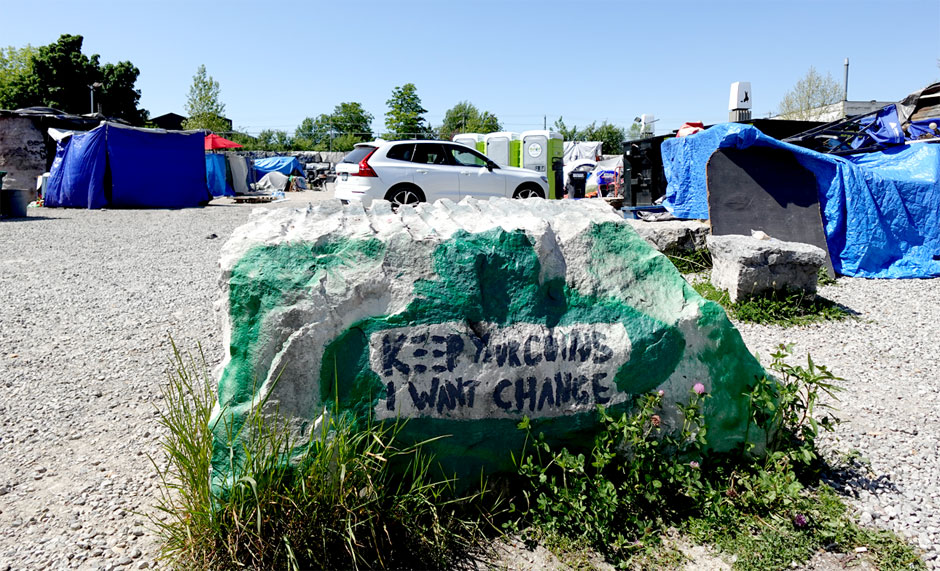
“Keep your coins. I want change,” reads a message at the Victoria Street encampment in Kitchener, Ont. (Photo by Eric Wickham / PressProgress)
On May 21, Ontario Superior Court Justice Michael Gibson struck down a site-specific bylaw in Waterloo Region that would prevent people from entering the property and setting up tents there, ruling that it violated two sections of the Canadian Charter of Rights and Freedoms.
“The most exciting part is the Section 15 analysis and the real recognition of the inherent dignity of people experiencing homelessness,” said Ashley Schuitema, the executive director of Waterloo Region Community Legal Services (WRCLS), who helped lead the challenge. “This decision really reflects that homeless people are people — they’re people who are deserving of rights.”
Section 15 of the Charter pertains to equality rights, “that every individual is equal before and under the law without discrimination.” Justice Gibson concluded that homeless status should be seen as analogous to race, disability and other protected grounds on which discrimination is prohibited.
Gibson also ruled that the bylaw violated Section 7 of the Charter, which establishes “the right to life, liberty and security of the person.”
David Ernst, a 35-year-old man with a backwards Hurley baseball cap, a dark beard and a serious expression, tells PressProgress he had been “bouncing from place to place” before ending up in the encampment a few months ago. Ernst takes his time before responding to questions.
“People just don’t understand where we’re coming from — we don’t have anywhere to go, we don’t have any sort of resources, really,” said Ernst.
“We’re doing this for survival, not just because we want to.”
There were approximately 678,000 people living in Waterloo Region at the end of 2024. According to Justice Gibson’s decision, a point-in-time count of homeless people in the region in October 2024 found 2,371 — with 1,009 of them “living rough.” As of mid-2025, there were a total of 377 emergency shelter beds in the region, but Justice Gibson, citing one of the region’s own witnesses, found that “very few of the 1,009 people ‘living rough’ would be able to readily access a shelter bed, interim housing, or motels” due to capacity issues.
“If they [the region] want to come back to court to get permission to clear the encampment, they actually need to develop either a safe tenting protocol or they need to provide an alternative encampment site or both,” said Schuitema.
“The Encampment is currently the only place in the Region where it is not illegal for
homeless people to set up a tent or structure,” said Gibson’s decision. “The Region has clearly stated that if the Encampment is cleared, it is not prepared to allow homeless people to shelter outdoors anywhere on Region property.”
He wrote that “the extremity of this position” is what led him to find that the bylaw’s infringements on rights were unjustifiable.
Like many other encampments, this one formed in 2021 during the pandemic.
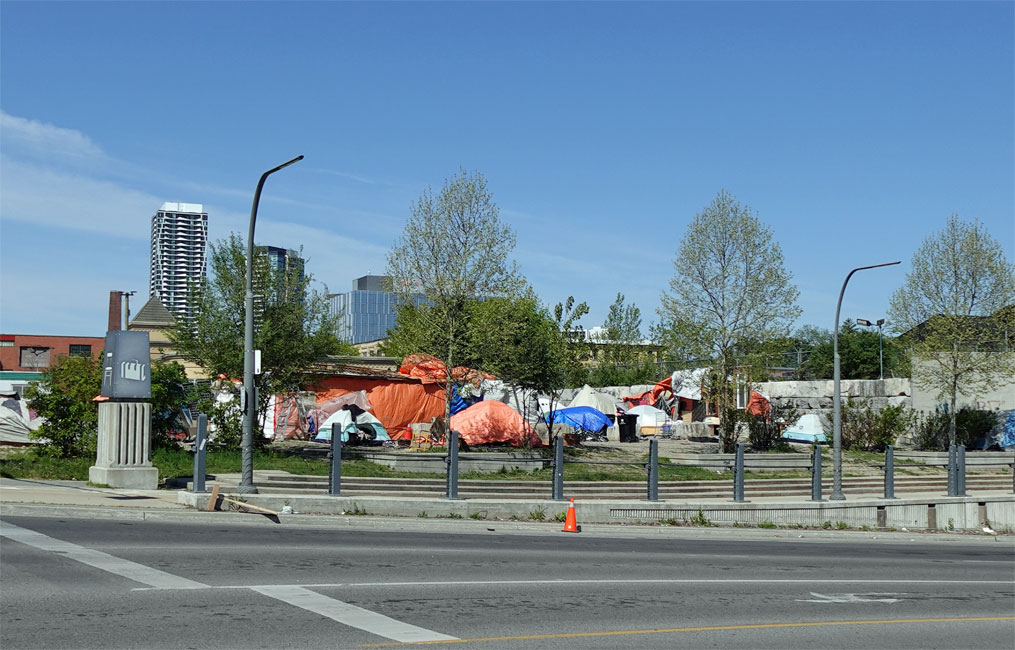
A view of the encampment at 100 Victoria St. N. in Kitchener, Ont. (Photo by Eric Wickham / PressProgress)
“We’ve heard from so many people who said, ‘I lost my job in the pandemic,’ ‘my mental health deteriorated during the pandemic,’ ‘my relationships broke down during the pandemic,’” said Schuitema.
Not long after the encampment formed, so did the fight over its existence.
In 2022, Waterloo regional council passed a policy that it believed would allow the region to clear the encampment. Metrolinx said it needed the lot as a lay-down site for construction materials that would be used to build the new Kitchener Central Transit Hub, on which work was expected to begin in the spring of 2023.
But the clearance was stopped by a Superior Court judge in January 2023, who ruled that evicting the encampment residents without having available shelter space for them would be a violation of their Charter rights.
At the time, Justice Michael Valente said that if the region wanted to lift his order, it would need to have shelter space available.
By 2025, with construction on the transit hub still yet to begin, Waterloo Region passed a new bylaw that applied only to the 100 Victoria St. site. The region then brought an application to the court to allow it to clear the encampment based on this new bylaw.
(PressProgress reached out to Metrolinx, and despite a spokesperson saying they should be able to have a response by the next day, the organization missed yet another self-imposed deadline.)
Schuitema said her organization immediately sought an injunction, which Justice Gibson granted, and the region was once again unable to clear the encampment, pending a ruling on whether the bylaw violated the Charter.
The constitutional case was heard by the court in April, with the decision released in May.
Justice Gibson’s 88-page decision spends a significant amount of time speaking to the human rights of the “vulnerable and marginalized” people who live in encampments.
“The homeless are not Other. They are Us. They are rights bearers no less entitled than any other Canadian citizens to the full benefit and protection of the Charter,” it stated.
Gibson, who has a background in international law, also brought up Canada’s international commitments on housing, including its obligations under the Universal Declaration of Human Rights.
Schuitema said she finds it hard not to get emotional about the decision after working for so long on the case, which included taking affidavits from encampment residents about the circumstances that led to them living there.
“I wish they’d show up in this judge’s backyard and set up camp,” Ford said
Ernst says the ruling provides a little bit of stability in the lives of his fellow encampment residents.
“At least we know where we’re going to lay our heads at night, and where we know we can be safe,” said Ernst.
Despite the years-long fight to prevent the region from clearing the encampment, no one talks about it like it is a permanent solution. It’s just a site for people who have nowhere else to go. It is the only place in the region where people can stay outdoors without the threat of being evicted at any given point.
Justice Gibson stated this quite plainly in his decision.
“No one should romanticize or be starry-eyed about the Encampment,” wrote Gibson. “It is a miserable and desperate place. But it represents the only remaining safety valve for the Region’s homeless as a refuge of last resort.”
Ernst affirmed that people live in the encampment out of necessity.
“It’s not a vacation that we’re doing here — we’re not doing this for fun. This is all we actually have,” Ernst said. “This is how we are living. We don’t have anything else. It’s down to the bare minimum.”
Another person in the encampment, Jamie McCrea, says he has been around for about a year and a half. He says the region clearing the encampment would have a serious negative effect on the people now living there.
“They’d be in shambles,” said McCrea. “They wouldn’t know where to go, or what to do.”
The regional government has not yet indicated whether it plans to appeal. A spokesperson told PressProgress they were reviewing the decision and “will determine next steps in the coming days.”
But the decision has earned the attention of the province.
“Doug Ford has made it very clear that he’s not happy with this decision, so I think it probably is far from over — although I can’t say with certainty,” Schuitema said.
At the end of May, Gibson became the latest Ontario judge to be lambasted by the premier over a decision with which he disagreed.
“This judge, the cheese slipped off the cracker with this guy,” said the premier at one of two unrelated press conferences at which he was asked about the ruling and went off.
Ford prefaced his statements by saying how much he respects the judiciary, then repeatedly insulted the intelligence of Gibson, who was appointed to the Superior Court in 2015 after two decades working exclusively in the military justice system (an appointment that, at the time, was believed to be a Canadian first).
“You get these judges that just, you know — I’m sorry, the guy’s a few fries short of a Happy Meal and he just doesn’t get it,” said Ford.
Ford did not comment on the substance of Justice Gibson’s findings, about the Charter rights of homeless people or about the remedies offered by the judge.
“So for what, 30 people, they’re gonna hold up millions and millions of riders, communities and everything, saying, ‘You can’t go in there, you can’t touch ‘em’? So guess what, folks. Anyone can show up in your backyard. I wish they’d show up in this judge’s backyard and set up camp. It’s the craziest thing I’ve ever heard.”
He added, “I wish I could get that guy’s address, I’ll send 15 encampments in his backyard and see how he likes it.”
“The humanity being recognized, the dignity being recognized by the court, is so powerful,” said Schuitema
As for potential intervention on the government’s part, the premier said, “Hopefully the region’s going to appeal it, we’ll intervene and then stay tuned. Because that’s the reason they have Section 33, notwithstanding clause — because of crazy decisions like this one.”
The notwithstanding clause, Section 33 of the Charter, allows provincial and federal governments to pass laws that operate in spite of certain sections of the Charter, including both sections Gibson cited in striking down the region’s bylaw. It had been used sparingly, outside of Quebec, until Ford invoked it in a 2018 effort to override a judge’s ruling that he had acted unconstitutionally in cutting the size of Toronto’s city council in the middle of its election. (The ruling was overturned on appeal, and so the government abandoned its effort to pass a law overriding it.) Ford has invoked it twice since (including in a law ending teachers’ ability to collectively bargain, which he quickly repealed) and threatened to use it on other matters, such as to remove bike lanes in Toronto.
Schuitema said the premier threatening to override Charter rights, and openly disparaging a judge, should concern everyone.
“I find the premier’s comments — this is me personally speaking — very deeply offensive,” said Schuitema. “I think it’s really troubling to have a premier making these sorts of comments about judges, because the judiciary needs to be independent, they shouldn’t be feeling threatened.”
Shannon Down, the former executive director of WRCLS who argued the case alongside Schuitema, called the premier’s comments “profoundly disturbing.”
“As a lawyer and just as a citizen, I expect more from our elected officials — criticize the decision, the substance of the decision, but don’t go after the judge,” said Down. “The judge literally was doing the job that he’s constitutionally required to do.”
Schuitema said that it’s deeply frustrating to hear the premier, whose level of government is responsible for housing policy, make comments like this.
“The problem is not people who are experiencing homelessness, the problem is not the judge in this decision — the problem is that all levels of government need to be making housing available,” she said.
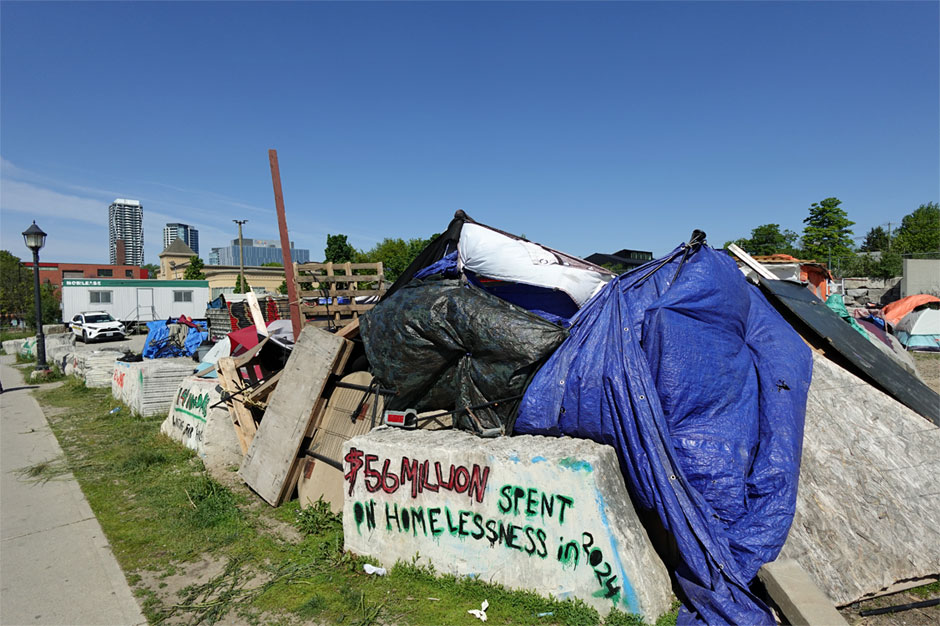
Another view of the Victoria Street encampment in Kitchener, Ont. (Photo by Eric Wickham / PressProgress)
Down said she hoped people could have more compassion for those living in encampments, who are forced to live there because of the failure of government systems.
Schuitema added that the province is currently holding up funding that would provide more shelter space for people experiencing homelessness.
“In our community, there are a number of supportive housing beds that are sitting empty — they’re ready to go — there’s spaces available, but they’re waiting for operational funding from the province,” she said.
A dozen lawyers involved with the case, including Schuitema and Down, contacted Attorney General Doug Downey about the premier’s comments attacking the independence of the judiciary. In a letter dated May 26 [pdf], they asked that the attorney general:
- Publicly reaffirm the constitutional principle of judicial independence and the obligation of all members of the executive branch to refrain from conduct that may reasonably be perceived as threatening or intimidating judges;
- Publicly repudiate any suggestion that judges should be subjected to personal targeting or exposure of private residential information because of decisions they render;
- Confirm that appropriate steps are being taken to ensure the safety and security of the judge concerned and of members of the judiciary generally; and
- Advise whether any additional protocols, guidance, or measures will be adopted to prevent conduct that may undermine public confidence in the administration of justice.
They say they have yet to hear back.
Schuitema says it is unfortunate that the story about this encampment is now being framed around another instance of overreach by Queen’s Park and comments from the premier.
“This story should be about a win for human rights and for dignity of a historically marginalized group, and it should be seen as a win for equality advocates, it should be seen as a win for international-law advocates,” said Schuitema.
“The humanity being recognized, the dignity being recognized by the court, is so powerful, and that really should be the story.”
Asked what he’d say to the premier if he had the opportunity, Ernst offered, “Maybe it’s time for a change. Maybe somebody needs to step up from the little guys to represent the little guys. Maybe somebody needs to actually give a crap about ‘em, instead of shutting everything down.”
Our journalism is powered by readers like you.
We’re an award-winning non-profit news organization that covers topics like social and economic inequality, big business and labour, and right-wing extremism.
Help us build so we can bring to light stories that don’t get the attention they deserve from Canada’s big corporate media outlets.
Become a member
 @ericwickham.ca