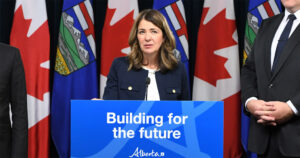

Danielle Smith’s Rough Year
Charter violations, power grabs and angry separatists take Alberta into the next 12 months
2025 was a rough year for Danielle Smith’s United Conservative Party.
With all that’s happened in recent months, next year could be rougher.
The new year will begin with over a third of the caucus facing recall petitions, a major healthcare scandal and an increasingly disgruntled far-right wing within the party.
Despite legislating against trans rights, breaking a teacher’s strike and seizing power from the courts and the Alberta elections watchdog, the UCP’s government is at a low point in popularity, both within the party and among the electorate.
A Leger poll conducted during October’s teachers’ strike showed 61% of Albertans felt the province was heading in the wrong direction, a 10-point jump since the spring.
The year ended with the UCP invoking the notwithstanding clause four times in under two months, to break that strike and then to attack LGBTQ2SIA+ rights.
The notwithstanding clause allows a legislature to declare in a statute that a law is valid, notwithstanding rights and freedoms guaranteed by the Charter.
Bill 9, passed earlier this month, contains various provisions to police acceptable pronouns used by students, ban puberty blockers and prevent trans girls from participating in women’s sports. Because the bill invoked the notwithstanding clause, the government has largely insulated its attacks on rights from clear-cut legal challenges, effectively preempting Charter-based actions in the courts.
Its use in Bill 2 (the Back To School Act) forced teachers back to work after striking against a contract they’d overwhelmingly rejected. This move resulted in a flood of petitions to recall UCP MLAs.
As of now, 20 UCP MLAs are facing citizen-led recall petitions that have been accepted by Elections Alberta. Over half of these submissions directly cite Bill 2 and the attack on the constitutional right to strike it represents. (One NDP MLA is also facing a recall petition.)
Petition chaos continued earlier this month, when the Smith government pushed through a seemingly unprecedented power grab to the detriment of the courts and Elections Alberta.
In a surprise announcement that reinvigorated debates around Alberta separation, Justice Minister Mickey Amery put forward Bill 14 — a massive piece of legislation that paved the way for a constitutional referendum on Alberta leaving Canada.
The sudden announcement came just two days after the “Forever Canadian” petition, spearheaded by former deputy premier Thomas Lukaszuk, was accepted by Elections Alberta, with nearly half a million signatures from Albertans pledging support for the province to stay Canadian.
Amery’s announcement also came as the separatist group the Alberta Prosperity Project (APP) was defending the constitutionality of its own petition in the courts. Shortly after Bill 14 was announced, Alberta judge Colin Feasby issued a ruling against the separatist petition, calling it unconstitutional.
Feasby also took the provincial government to task for a provision in Bill 14 that would have very likely discontinued the case had he not ruled before it passed.
“Alberta’s cavalier disregard for court resources and lack of consideration for the parties and First Nations intervenors who participated in this proceeding in good faith is disappointing to say the least,” Feasby wrote.
With last week’s passage of Bill 14, however, Feasby’s ruling on the APP petition may no longer matter.
However it’s framed, a ballot question on Alberta’s future ends up as a simple binary, and a referendum in the coming months seems likely.
Beyond the petition application, the separatists have been busy. 2025 was a year that took PressProgress to Alberta towns to observe town hall meetings and even a by-election challenge from the new Republican Party of Alberta, led by former pro-Smith organizer Cam Davies and others who have largely turned against the premier.
It’s a movement based on pipelines (they want more), immigration (they want less) and general antipathy towards Prime Minister Mark Carney and Ottawa more broadly. The APP spent much of the year organizing town halls in almost every corner of the province, sometimes filling small-town community centres to capacity.
Led by lawyer and rancher Jeffrey Rath, co-founder and president Mitch Sylvestre and co-founder Dennis Modry, the APP took its show on the road to agitate and build a network of support for Alberta leaving Canada. They claim to have hundreds of thousands of pledges from voters.
The APP’s message is that, in pursuing separation, a constitutional path within existing legal frameworks is a waste of time. They’re counting on America to make it happen.
On my way to Washington DC for another of APP’s ongoing meetings with the US administration.
Reflecting on the joint benefits to Alberta and the USA when we finally free Alberta from Communist Chinese controlled governments in Ottawa.
For Albertans – no federal income tax.…
— Jeffrey Rath (@JeffreyRWRath) December 15, 2025
To this end, they continue to travel to the States to meet with American officials close to or within the Trump administration, from whom they claim they’re getting interest and support.
Going into next year, Smith finds herself walking a tightrope between the separatist wing of her party and the majority of Albertans, who want to keep the province Canadian. What form the independence question takes is still unknown, but the turmoil is certain to play out in 2026 as Alberta’s right wing steadily becomes less and less “united.”
Our journalism is powered by readers like you.
We’re an award-winning non-profit news organization that covers topics like social and economic inequality, big business and labour, and right-wing extremism.
Help us build so we can bring to light stories that don’t get the attention they deserve from Canada’s big corporate media outlets.
Become a member
 @stephenmag.bsky.social