
Ontario Cities Are Clearing Homeless Encampments. Where Are People Supposed to Go?
Amidst a housing crisis with no end in sight, municipalities across the province have been cracking down on the unhoused
When PressProgress reached her by phone on the evening of Wednesday, Oct. 15, Maggie Helwig was at the Toronto Reference Library. Her memoir had been shortlisted for this year’s Toronto Book Award, and she was waiting for the prize ceremony to start.
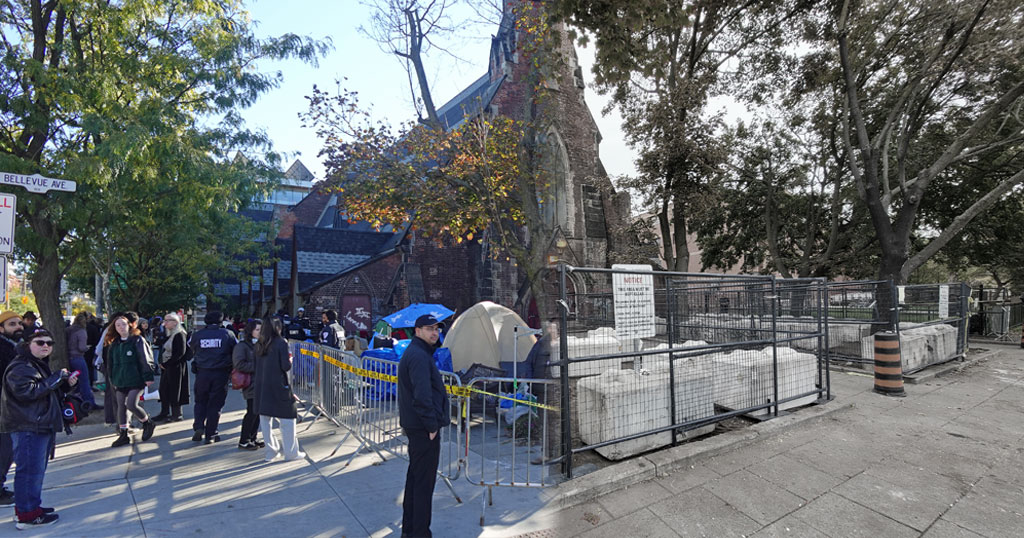
The book, Encampment: Resistance, Grace, and an Unhoused Community, is about the years-long struggle to keep open the homeless encampment located outside the Church of St. Stephen-in-the-Fields, on the edge of Kensington Market. Helwig is the rector of St. Stephen’s, and has been a long-time advocate for the homeless in the city.
On her mind, however, was the encampment’s immediate fate, which had been thrown into question early that morning, when staff from the City of Toronto posted a notice warning that they would clear it in 24 hours, alleging it violated bylaws governing the use of streets and sidewalks. By noon, the authorities had declared the entire encampment at the corner of College and Bellevue a fire hazard.
“I filed a request for review, which is supposed to put the process on hold, but my request for review has not been acknowledged,” Helwig said Wednesday evening.
“Some of these people are very vulnerable people — we’ve been looking after them for nearly four years now, and I’m terrified about the effect,” Helwig said. “I’ve been weeping inside all day.”
She was unsure about where the encampment’s dozen or so residents would go and said the city’s Encampment Office would presumably scrape something up to offer residents by the next day. But she worried that what the city had to offer might not be suitable for them; many had been evicted from shelter hotels in the past and would also be hesitant to go into a city shelter.
“No one will go into city shelters, like no one will,” said Helwig, who was an acclaimed poet prior to becoming an Anglican priest. “I wouldn’t go into a city shelter, I don’t blame anyone for not going into a city shelter, they’re terrible.”
That night, Helwig won the award from the city, which includes a $20,000 prize. Less than 24 hours later, city staff began dismantling the encampment that her now award-winning book had documented the fight to save.
On the afternoon of Thursday, October 16, a large shovel crushed and lifted people’s belongings into a series of trucks parked along the adjacent street, which had been shut down to allow for city staff to remove materials from the encampment unencumbered.
As housing advocates in Ontario sound the alarm about a housing crisis that has no end in sight, the clearance of the encampment outside St. Stephen-in-the-Fields is just the latest in a string of forceful actions that municipalities across the province have been taking to remove homeless people from their provisional shelters.
A spokesperson for the City of Toronto, Elise von Scheel, told PressProgress that the city’s abrupt actions had been prompted by an order from Toronto Fire Services, and that every resident was offered shelter space and many had accepted. She added that encampment residents were offered locker space to keep their belongings, although she did not know what size the lockers were. The church also offered space to the residents.
Still, by late that afternoon, many belongings — including tents and items of clothing — that had been left on the site by the encampment’s former residents were thrown in a pile and lifted into a dump truck:
With encampment residents throughout Ontario continuing to be evicted and displaced, the organization representing the province’s cities and towns says homelessness has reached a tipping point.
The Association of Municipalities of Ontario (AMO) is warning that without significant intervention, homelessness in Ontario will skyrocket, with the number of homeless people quadrupling in the next decade and a half. Across the province, shelter and temporary-housing infrastructure is already insufficient to provide everyone who needs one a place to sleep, and decisions from policy makers continue to displace homeless residents rather than offer support.
According to a report the AMO released earlier this year, there were 80,000 homeless people in Ontario in 2024, a 25% increase since 2022.
There were 15,400 homeless people in Toronto as of last fall [pdf]. London reported nearly 2,000 homeless people as of June 30. Ashley Schuitema from Waterloo Region Community Legal Services said there were an estimated 2,300 people experiencing homelessness in Waterloo Region, with over 1,000 living unsheltered.
As a result, homeless encampments have begun to proliferate all over the province. And cities are cracking down — not on poverty itself but on its symptoms.

The clearing of the encampment outside Toronto’s Church of Saint Stephen-in-the-Fields on October 16. (Photo by Eric Wickham)
On a Monday evening in late July, the municipality of Chatham-Kent held a special council meeting about encampments in the area. The four-hour meeting included 28 deputations (16 in person, one on Zoom, 11 emailed) from members of the public, as well as presentations from municipal staff and police.
“The biggest issue we face in Chatham-Kent — housing,” Mayor Darrin Canniff told those in attendance. “How do we make sure everyone has housing?”
According to the staff of the southwestern Ontario municipality, there were 242 homeless people in Chatham-Kent as of that date, but there were only 44 emergency shelter beds. They said an average of 33 people enter Chatham-Kent’s homeless system every month, while only 19 exit.
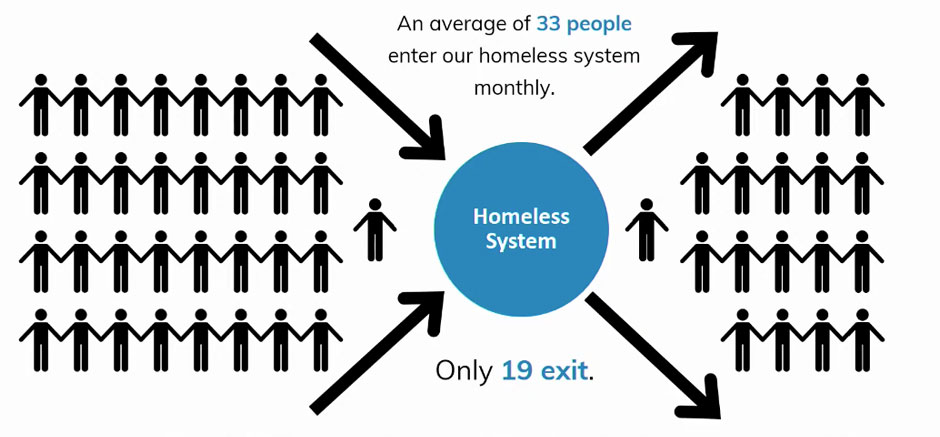
An excerpt from the July 28th presentation delivered by staff at the Municipality of Chatham-Kent.
Even before the pandemic, homelessness in Chatham-Kent was already on the rise, staff said, showing a graph that indicated the number of people experiencing homelessness in December 2024 had doubled since the same month in 2018.

An excerpt from the July 28th presentation delivered by staff at the Municipality of Chatham-Kent.
Since that meeting, Chatham-Kent Council has voted to amend a by-law in order to prevent encampments from being within 25 metres of commercial or residential properties, which prevents them being set up in multiple locations in which they’d existed. The council also gave police a green light to set up cameras in parks near encampments.
The Chatham-Kent Police Service, in a response to PressProgress at the end of July, did not say if they were indeed planning to set up security cameras, but said they’d be reviewing “relevant evidence-based data to assess the feasibility of implementing CCTV in the area.”
These actions are part of a pattern across the province, of governments mitigating the visibility of homelessness by enacting policies to displace it rather than addressing the causes of homelessness. Ontario’s Bill 6, Hamilton’s camping by-law used to evict encampments from parks, the state of emergency declared in Barrie specifically about encampments, as well as multiple recent encampment clearances in Toronto have all effectively moved homeless people further away from the services that help them survive while living outside.
It’s not just policies that are hostile to visible poverty.
The special meeting on homelessness in Chatham-Kent included several deputations from residents who expressed their wishes to see the encampments dismantled. One woman, on the verge of tears, accused a homeless person of defecating near her home to send her a threatening message, supposedly for not calling emergency services for their friend.
Renee Geniole, executive director of Reach Out Chatham-Kent (ROCK), a local encampment-outreach organization, told PressProgress that that situation wasn’t driven by malice, but in fact was caused by a lack of infrastructure.
“This happened a few days before the porta potties were put out at the encampment site, so where did you want them to shit?” said Geniole. “There was no forethought or malice or anything like that, there was no porta potty for them to go.”
Geniole added that there was a lot of misinformation about encampment residents, and that ROCK had spent much time trying to educate the community about homelessness. However, as evident in the deputations, hostility from the community persists.
“Our property values have been impacted,” one man said. “For many of us in these more unstable economic times, our net worth is often tied up in our property.” He asked if it was “fair for those of us who are already struggling” to have to bear the burden of having a large encampment nearby.
“People have these moral arguments about [whether] people who use substances and live in encampments [are] as valuable or as important as people who live in a nice neighbourhood and pay taxes,” Geniole said.
One particular encampment, at 100 Victoria St. S. in Kitchener-Waterloo, has been a flashpoint for how municipalities treat encampments.
In 2022, the encampment was set to be dismantled after the provincial agency Metrolinx claimed it needed the property for its new transit hub. This was stopped in an Ontario courtroom by Justice Michael Valente, who said it would be a violation of the encampment residents’ Charter rights to remove them from the property without having shelter space available for them.
Schuitema, of Waterloo Region Community Legal Services, told PressProgress that Metrolinx said it needs the lot to store construction equipment and materials when it begins building the transit hub, which is now slated to start construction in March 2026.
This past summer, the Superior Court once again blocked the clearance, and encampment dwellers are permitted to continue living there at least until a decision is rendered following a November hearing, where the encampment-clearing bylaw can be properly reviewed.
Although some people have treated this as a victory, Schuitema said it’s grim to be celebrating the continuation of the status quo.
The August decision quotes one of the encampment residents: “[We] are at the bottom, and now [they] are just taking away the bottom.”
“It’s so true, like people don’t want to be living in tents,” said Schuitema. “This shouldn’t be where the fight is, this should be the absolute baseline where people are allowed to exist.”
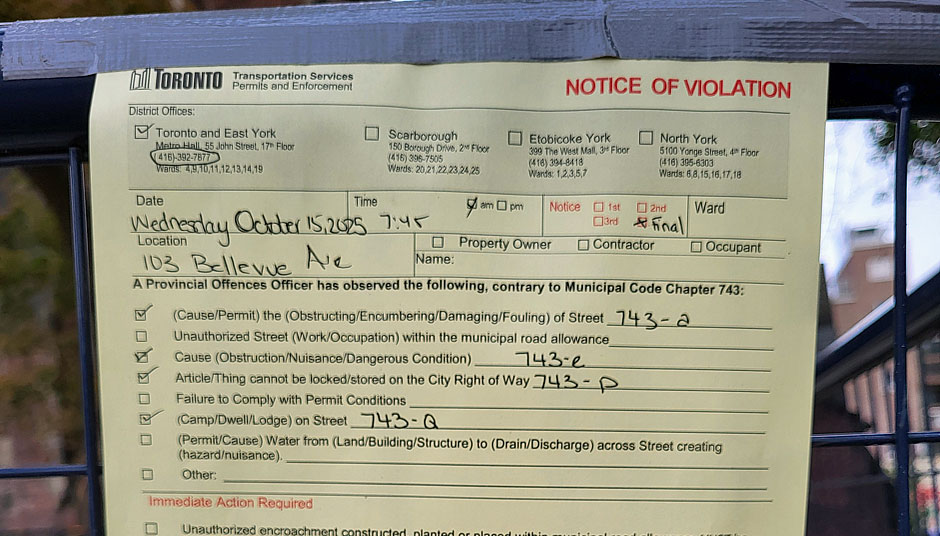
The notice posted by the City of Toronto at the encampment outside the Church of Saint Stephen-in-the-Fields, per an order by the Toronto Fire Service. (Photo by Eric Wickham)
While there may be no end in sight for this ongoing crisis, experts point to a number of ways to meaningfully address it.
“The primary solution needs to be housing,” Alicia Neufeld, who helps lead policy for the AMO, told PressProgress. “There is currently not the right mix of housing supply in Ontario to address the homelessness crisis.”
Neufeld added that there were several compounding factors contributing to the rapid increase in homelessness across the province, including income insecurity, an insufficient supply of deeply affordable housing and inadequate access to mental health and addictions supports.
Schuitema said that social assistance in the province, both Ontario Works and the Ontario Disability Support Program (ODSP), is far too low — especially considering how difficult ODSP is to obtain — and that increasing the rates would help prevent people from falling into homelessness. In the case of Waterloo Region in particular, Schuitema said it should be mindful of the costs associated with how it is approaching this problem — the human costs, of course, but also the financial ones.
“Why are they again spending resources on litigating these types of issues, when that money and those resources could certainly be used towards solutions instead?” asked Schuitema.
“Instead of trying to enforce their way out of this crisis, they need to actually be providing resources and funding so that we can have proper housing.”
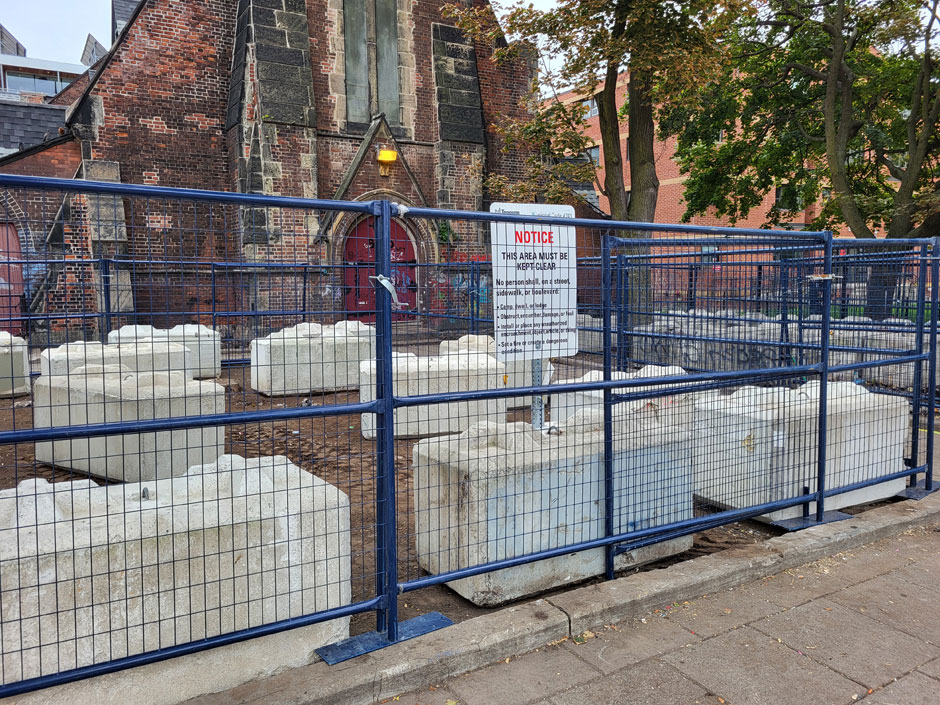
The former site of the encampment outside Toronto’s Church of Saint Stephen-in-the-Fields, as seen on October 17, the day after its clearing. (Photo by Eric Wickham)
Last Thursday night, after the City of Toronto had fenced off the encampment site outside St. Stephen-in-the-Fields, and placed large concrete blocks where tents stood hours earlier, Helwig sent a statement to PressProgress and other reporters who had been present at the clearing.
“The people who were removed today are our friends and our community,” she said. “They are people who have already suffered a tremendous amount of trauma and displacement, and who have now been subjected to the same again.”
She observed that what Toronto was describing as a remedy was merely a quick, superficial fix: “The language of offering ‘housing,’ frequently used by the City, is misleading. No one was offered housing. Shelter-hotels are a short-term solution at best, and most people will be back on the street within a short period of time.”
As elsewhere in Ontario, the city appeared more interested in tackling the visibility of poverty than the underlying reasons for it.
“People have lived in the churchyard for decades. The yard is now fully fenced and covered with concrete blocks in order to prevent this. We do not know what shape our support and solidarity will take tomorrow, but we know that it will not and cannot end.”
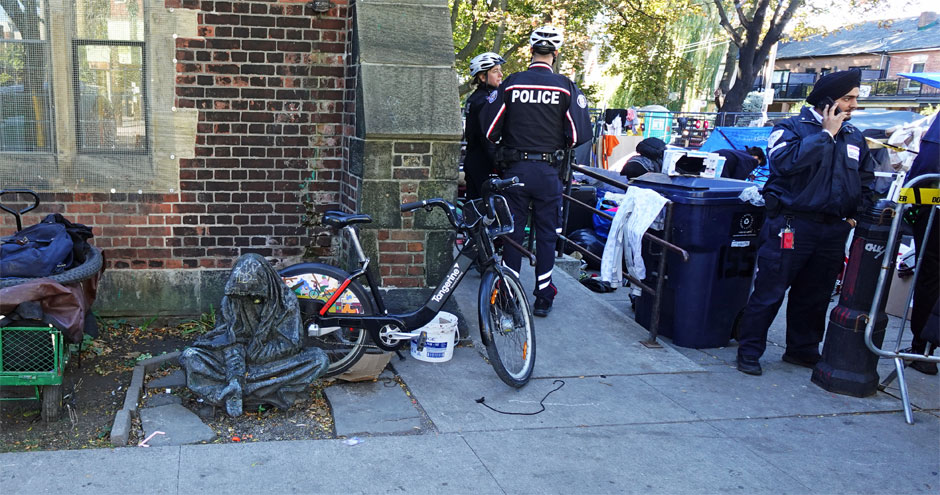
The “Homeless Jesus” statue by artist Timothy Schmalz, as seen outside the Church of Saint Stephen-in-the-Fields on October 16. (Photo by Eric Wickham)
The full statement sent to media by Rev. Maggie Helwig the night of October 16th:
The people of the Church of St. Stephen-in-the-Fields are grieved and angry at the eviction of the residents of our encampment today, in a rushed and chaotic process in which we were given less than 24 hours’ notice, a process which violated the City’s own Encampment Protocol in multiple ways. The Ontario Fire Marshal also violated their own regulations by ignoring the rector’s request for a review of the order, which was submitted within hours of the order being received by us and which received no response or acknowledgement.
The people who were removed today are our friends and our community. They are people who have already suffered a tremendous amount of trauma and displacement, and who have now been subjected to the same again. Some have been expelled from a place which had been their home for close to four years. In some cases, church staff had been actively working with people on housing plans. These plans have now been put in jeopardy by dispersing and scattering people, and potentially derailing their processes.
Some of the residents chose to go into shelter-hotels. We support those who made this choice, and also those who chose not to do so. We want to emphasize again that the language of offering “housing,” frequently used by the City, is misleading. No one was offered housing. Shelter-hotels are a short-term solution at best, and most people will be back on the street within a short period of time.
We need to address the City’s statement that the church “cooperated” with the eviction. It is important to understand that such “cooperation” as there was came about due to threats to charge one or more people associated with the church with a serious provincial offence bearing a potential fine of $20,000 per day, as long as any materials remained on church property, as well as a possible additional charge for City staff time and equipment. In addition, our actions throughout the day were limited by a large and aggressive presence of hired security.
Everything that we have done in the encampment, now and at all times, has been done after serious discussion with the encampment residents, and we took no actions which did not have their consent — insofar as any of us could give consent in a situation of duress. Residents who accepted shelter-hotel rooms expressed to us that this was not what they wished to do, but they felt they had no real choice, as the City had already explicitly told them that their homes would be destroyed within 24 hours, no matter what.
We acknowledge that there have been fires in the encampment (as there have been in private dwellings). We note that there has never been a fire in which any person was seriously injured; but we do know there are real concerns about fire safety. We believe these could have been handled through a comprehensive mitigation plan, and our request for review was asking for time to develop such a plan. We also note that when we distributed fire extinguishers to encampment residents, they were confiscated by the City; and that when the district fire chief spoke to the rector on Wednesday afternoon, she specifically noted neighbourhood complaints as one of the factors causing this extremely rushed action.
We stand in solidarity with all those who are unhoused, marginalized, and cast aside by our society, and we will always continue to do so. People have lived in the churchyard for decades. The yard is now fully fenced and covered with concrete blocks in order to prevent this. We do not know what shape our support and solidarity will take tomorrow, but we know that it will not and cannot end.
Our journalism is powered by readers like you.
We’re an award-winning non-profit news organization that covers topics like social and economic inequality, big business and labour, and right-wing extremism.
Help us build so we can bring to light stories that don’t get the attention they deserve from Canada’s big corporate media outlets.
Become a member
 @ericwickham.ca