How Gerrymandering Could Threaten Democracy in Alberta
The UCP government has opened the door to a new kind of riding boundary. Will they walk through it?
Alberta’s United Conservative Party has opened the door to what critics are calling a potential “gerrymandering” of the province that could disempower urban representation in the legislature.
Upcoming changes to provincial ridings could seriously affect the province’s political landscape, shifting the power balance between rural and urban ridings.
Two additional ridings are being added, bringing the total seat count from 87 to 89, alongside a complex and messy undertaking to redraw electoral riding boundaries that is putting cities (with their exploding populations) and rural communities (with their shrinking populations) at odds. Alberta law requires that an Electoral Boundary Commission be established roughly every eight years to propose adjustments that take into account changing population patterns.
Nathan Neudorf, the Minister of Affordability and Utilities, has put forward a proposal that would add the two seats by dividing one Alberta city between four rural ridings in what he describes as an “urban-rural collaboration.”
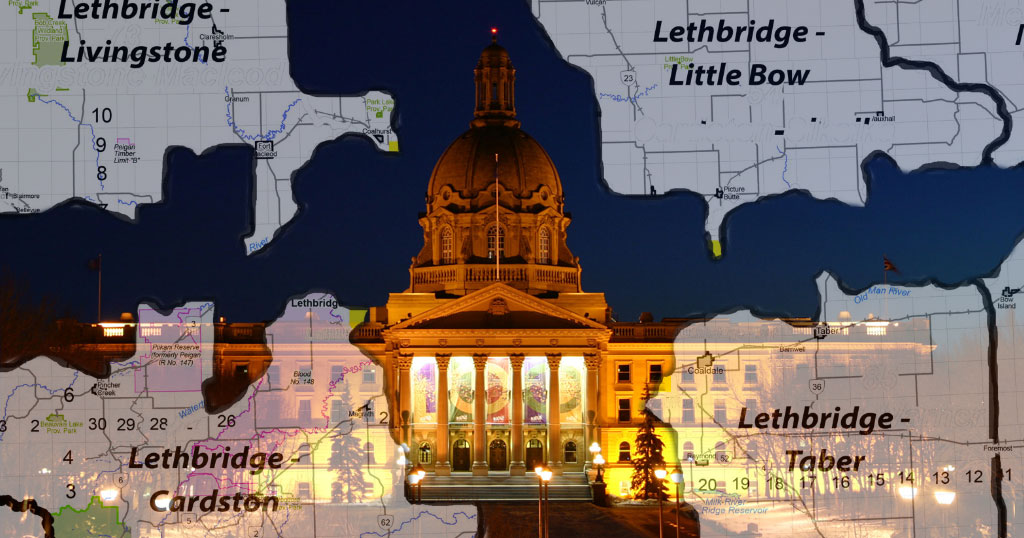
The proposal advanced by the Lethbridge-East MLA seeks to split the city of Lethbridge, whose two ridings are currently divided between the NDP (MLA Rob Miyashiro) and the UCP (Neudorf), into a pie of four ridings with each encompassing part of the surrounding communities.

An excerpt from a map showing proposed boundaries in southern Alberta that was included with the submission to the Alberta Electoral Boundaries Commission from Lisa Reis, deputy mayor of the Town of Coaldale (pdf).
Under this plan, the southern Alberta city would be divided into a patchwork of conservative voting areas in a move that critics are describing as an attempt to undermine the political representation of urban Alberta, where voters are often more progressive.
Edmonton city councillor Michael Janz puts it bluntly.
“If it walks like a duck and quacks like a duck, it sure sounds like gerrymandering to me,” Janz told PressProgress.
Janz was responsible for one of the 197 written submissions accepted as part of the consultation process carried out by the boundaries commission, which were recently made public on its website. Most of the submissions advocate keeping rural and urban ridings separate.
Submissions came from citizens as well as current and former politicians, and concerned various ridings across the province and potential changes to their boundaries newly permissible under legislation brought in by Danielle Smith’s government.
Changes made by the UCP government last year opened the door to blending urban and rural ridings. Critics of the change include former Calgary mayor Al Duerr, former Lethbridge mayor David Carpenter and various opposition MLAs.
“The fact that they have removed [the requirement to take into account] contiguous boundaries from municipalities is not designed to provide better representation for Albertans. It’s designed to gerrymander ridings for the benefit of the premier and her party,” Janz said.
University of Lethbridge political scientist Lars Hallstrom agrees that Neudorf’s proposal amounts to an attempt to gerrymander the city to favour conservatives.
“It’s really hard to see this is being motivated by anything other than possibly even, believe it or not, fear, right? It looks like an attempt to appease a rural conservative, southern Alberta base that is both anti-Edmonton and in some cases, even anti-Lethbridge, as a city trying to give the perception of increased political voice to a population that has expressed ongoing dissatisfaction with any number of different things,” Hallstrom told PressProgress.
The office of Lethbridge Mayor Blaine Hyggen declined to comment.
“Leaving aside the regional differentiation in population growth, there’s some rationale for considering how many seats we actually have, but obviously what is more important is where those boundaries are and what are the political ends that those boundaries may support or stifle,” Hallstrom says.
In other words, he added, “This is not a pragmatic or public-interest proposal. It’s highly political in its goals.”
In a statement, the United Conservative Caucus said it supports the work of the Electoral Boundaries Commission, which “will consider legal requirements, including population changes to existing constituencies, relative population densities and common community interests. Albertans were encouraged to give the commission input and feedback to ensure its success, and all MLAs were able to file written submissions.”
The caucus declined to weigh in on Neudorf’s proposal, but took to task what it described as opposition efforts to “politicize and cast doubt over this independent process — it’s a disservice to Albertans. A fair distribution of electoral divisions is essential to the democratic process, and our caucus looks forward to the commission’s initial report on October 28.”
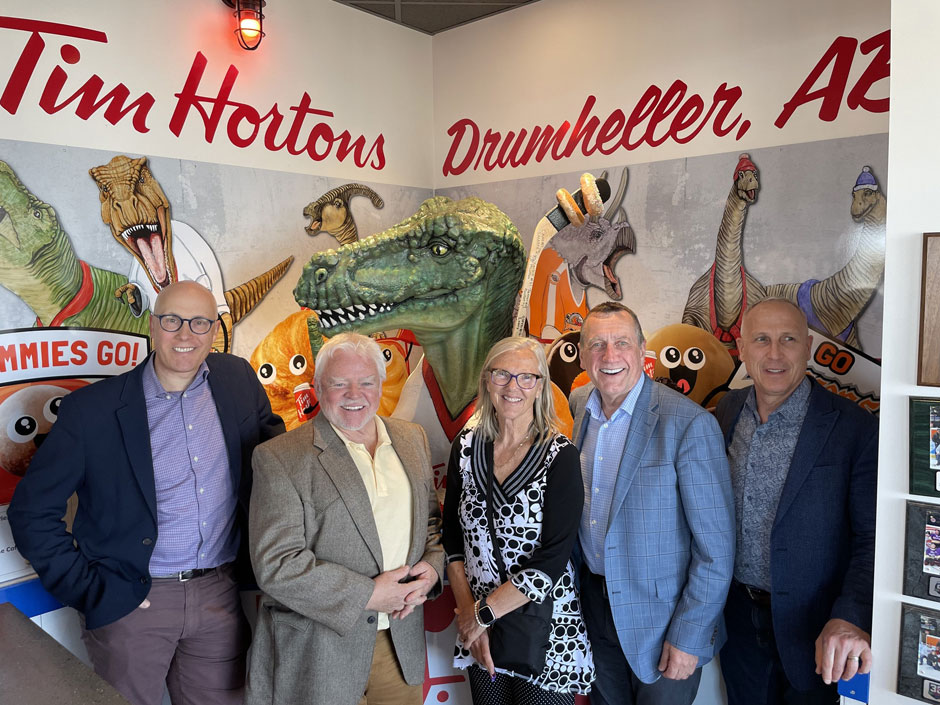
The members of the Alberta Electoral Boundaries Commission paid a visit to Drumheller in June (photo via the commission’s Facebook page).
Alberta’s population exploded in recent years, with cities taking on most of the influx.
According to Statistics Canada, the provincial population was 4,262,635 in 2021. In the second quarter of 2025, it was estimated to reach 5 million, according to the provincial government.
Major centres like Edmonton and Calgary have taken on the overwhelming share of this growth, with most of the province residing in the Calgary, Red Deer and Edmonton corridor. For this reason, many are pushing for the seat distribution to reflect the much higher urban populations.
“The reality is, right now, even the status quo is broken. Even the way the 87 seats are allocated is broken, and it over-represents rural Albertans. We need more representation for urban Albertans. We are more of the population, and we are not having our voice heard in this government, and that has a negative impact,” said Janz.
“We should be building in additional MLA capacity right now into the urban centres, including Calgary and Edmonton, because we know this is where the additional growth is going,” Janz said.
The Alberta Federation of Labour submitted a report to the commission calling for the creation of four new ridings in Calgary and Edmonton, and consolidating two sparsely populated rural ridings for balance (pdf, starting on page 16). It also argued that the commission was created before current population data could become available.
Their report points to the rural ridings of Central Peace-Notley and Lesser Slave Lake, two ridings encompassing massive geographical areas, whose populations may fall more than 50% short of the average.
Under the AFL’s recommended scenario, Medicine Hat, Alberta’s sixth largest city, which is currently split into two separate ridings encompassing other communities, would be consolidated into one. Nearly all submissions to the commission concerning the city of 63,280 echoed this.
“A distinctive electoral division with distinct boundaries will also clear up confusion with the citizens of Medicine Hat. The change of electoral districts was very confusing to the voters in Medicine Hat,” wrote resident Marle Roberts.
“Dividing my small city into Brooks-Medicine Hat and Cyprus Medicine Hat means that 2 MLA representatives support one city. This is an unnecessary redundancy. One representative of our city could better focus on our unique urban issues and support our citizens,” wrote Brenda Ives.
The boundaries commission will produce an interim report with recommendations based on its findings on October 28th, and is intended as an arms-length independent body composed of two appointees selected by the UCP and two by the opposition NDP, as well as Justice Dallas Miller.
Final boundaries will ultimately be approved by the legislature.
Our journalism is powered by readers like you.
We’re an award-winning non-profit news organization that covers topics like social and economic inequality, big business and labour, and right-wing extremism.
Help us build so we can bring to light stories that don’t get the attention they deserve from Canada’s big corporate media outlets.
Become a member
 @stephenmag.bsky.social